Krug Katja, Kraus Katharina I, Herrmann Kathrin, Joos Stefanie
Department of General Practice and Health Services Research, University Hospital Heidelberg, Marsilius-Arkaden, Turm West, Im Neuenheimer Feld 130.3, 69120, Heidelberg, Germany.
Institute of General Practice and Interprofessional Care, University Hospital Tübingen, Österbergstr. 9, 72074, Tübingen, Germany.
BMC Complement Altern Med. 2016 Oct 24;16(1):409. doi: 10.1186/s12906-016-1402-8.
In Germany, complementary and alternative medicine (CAM) in primary health care is offered by general practitioners (GPs) and by natural health practitioners, so called 'Heilpraktiker' (HPs). Considering the steadily growing number of unregulated HPs, the aim of the study was to assess characteristics of patients consulting HPs in comparison to patients consulting GPs.
In a cross-sectional study, patients of randomly selected GPs and HPs were asked to complete a questionnaire about their health care status, health care behavior, and symptoms rated on the Measure Yourself Medical Outcome Profile (MYMOP-D). Patient groups were compared based on health care provider (HP, GP with high use of CAM (CAM-GP), and GP with no/little use of CAM (nCAM-GP)) using Kruskal-Wallis tests and analyses of variance (ANOVA).
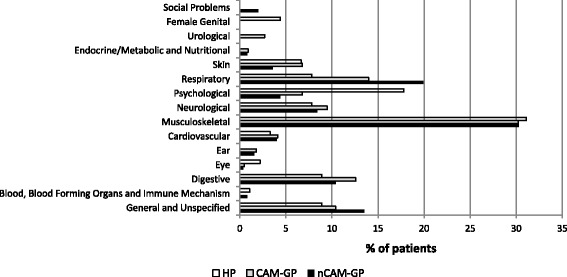
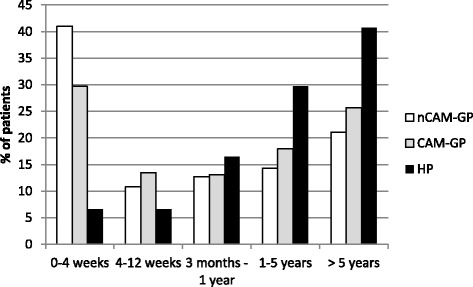
Altogether, 567 patients (91 of 11 HPs, 223 of 15 CAM-GPs, 253 of 19 nCAM-GPs) filled in the questionnaire. Patients of HPs had a higher education level and were more often female. The most common reason for encounter among all three groups were musculoskeletal problems (30.2-31.1 %). Patients seeing HPs reported more psychological (4.4 % vs. 17.8 %), but less respiratory problems (19.9 % vs. 7.8 %), and longer symptom duration (>5 years: 21.1 % vs. 40.7 %), than patients of nCAM-GPs.
The high percentage of patients with psychological illness and chronic health problems consulting HPs demonstrates the urgent need for action with regard to CAM therapy in primary care and regulation of natural health practitioners. Appropriate measures with regard to quality and patient safety should be taken given the growing numbers of HPs and the absence of a regulatory body.
在德国,初级卫生保健中的补充和替代医学(CAM)由全科医生(GPs)以及自然健康从业者(即所谓的“Heilpraktiker”,简称HPs)提供。鉴于未受监管的HPs数量不断增加,本研究旨在评估咨询HPs的患者与咨询GPs的患者的特征。
在一项横断面研究中,随机选择的GPs和HPs的患者被要求填写一份关于其医疗保健状况、医疗保健行为以及根据自我测量医疗结果概况(MYMOP-D)评分的症状的问卷。使用Kruskal-Wallis检验和方差分析(ANOVA),根据医疗保健提供者(HP、大量使用CAM的GP(CAM-GP)以及不使用/很少使用CAM的GP(nCAM-GP))对患者组进行比较。
共有567名患者(11名HPs中的91名、15名CAM-GPs中的223名、19名nCAM-GPs中的253名)填写了问卷。咨询HPs的患者教育水平较高,女性比例也更高。三组中最常见的就诊原因都是肌肉骨骼问题(30.2 - 31.1%)。与nCAM-GPs的患者相比,咨询HPs的患者报告有更多心理问题(4.4%对17.8%),但呼吸问题较少(19.9%对7.8%),且症状持续时间更长(>5年:21.1%对40.7%)。
咨询HPs的心理疾病和慢性健康问题患者比例较高,这表明在初级保健中针对CAM疗法以及对自然健康从业者进行监管方面迫切需要采取行动。鉴于HPs数量不断增加且缺乏监管机构,应采取有关质量和患者安全的适当措施。