Di Wei, Shi Xiaolei, Lv Hua, Liu Jun, Zhang Hong, Li Zhiwei, Fang Yannan
Department of Neurology, Shaanxi Provincial People's Hospital, The Third Affiliated Hospital of Xi'an Jiaotong University, Shaanxi, 710068, China.
Department of Neurology, The First Affiliated Hospital, Yijishan Hospital of Wannan Medical College, Anhui, 241001, China.
J Headache Pain. 2016 Dec;17(1):99. doi: 10.1186/s10194-016-0694-x. Epub 2016 Oct 24.
Antioxidants have been proven to weaken hyperalgesia in neuropathic pain. Endogenous antioxidant defense system may have a role in the prevention of hyperalgesia in migraine. In this study, we aimed to evaluate the role of nuclear factor E2-related factor 2/antioxidant response element (Nrf2/ARE) pathway in regulating the activation of the trigeminovascular system (TGVS) and hypersensitivity in nitroglycerin (NTG)-induced hyperalgesia rats.
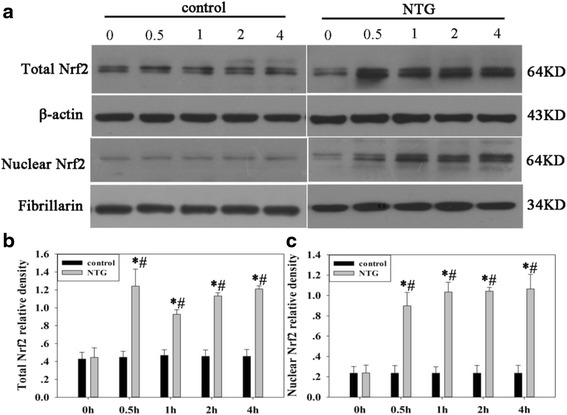
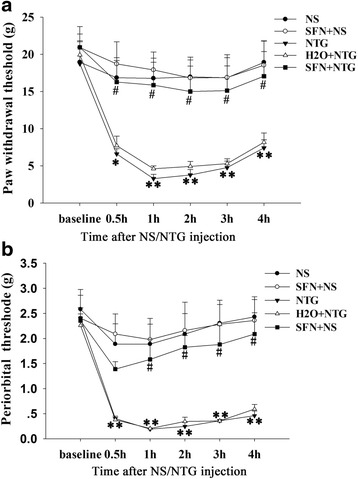
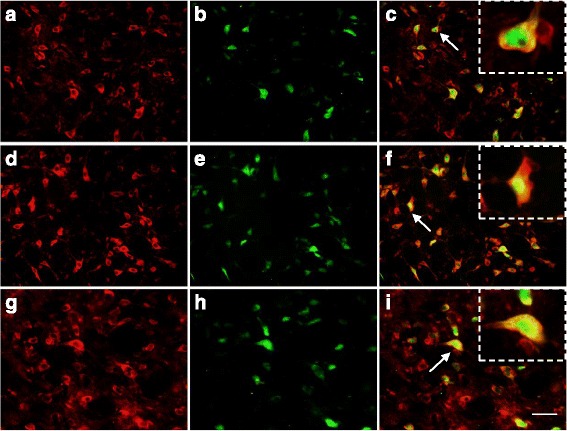
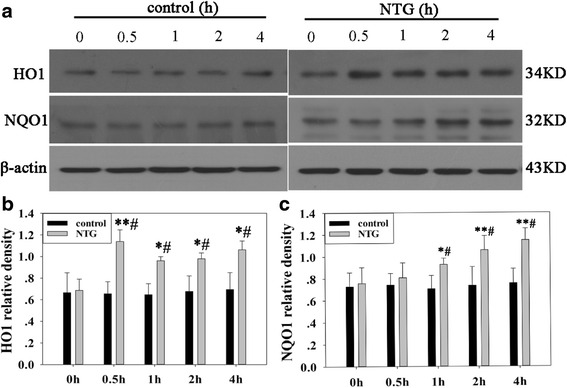
The expression levels of Nrf2, HO, HO1, and NQO1 in the trigeminal nucleus caudalis (TNC) were detected by western blot. Immunofluorescence was used to demonstrate the cell-specific localization of Nrf2 in TNC. Sulforaphane, a Nrf2 activator, was administered to NTG-induced rats. Then, the number of c-Fos- and nNOS-immunoreactive neurons in TNC was evaluated using immunofluorescence, and c-Fos and nNOS protein levels were quantified using western blot. Von Frey hair testing was used to evaluate the tactile thresholds of rats at different time points in different groups.
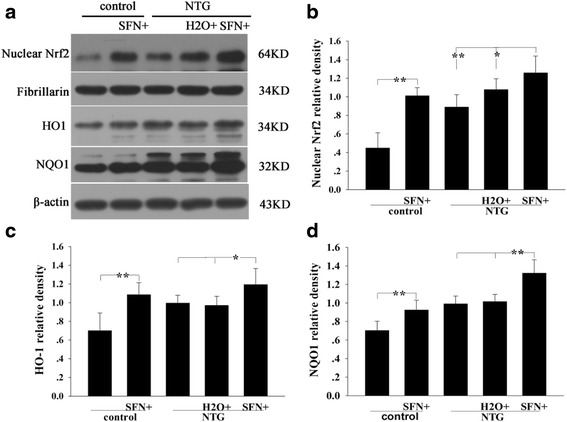
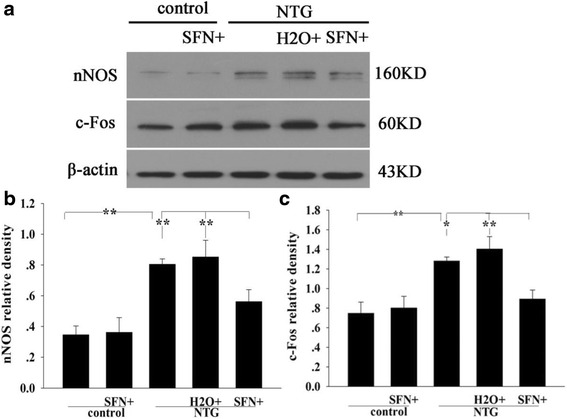
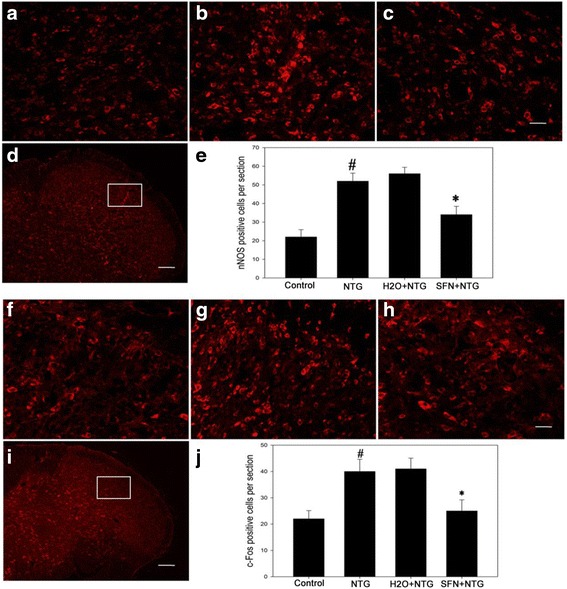
Total cellular and nuclear levels of the proteins Nrf2, HO1, and NQO1 were elevated in TNC after NTG injection, and Nrf2 was found to be located in the nucleus and cytoplasm of the neurons. Sulforaphane pretreatment significantly increased the nuclear Nrf2, HO1, and NQO1 levels in TNC. In addition, sulforaphane exposure effectively inhibited the expression of nNOS and c-Fos, reduced the number of nNOS and c-Fos immunoreactive neurons in TNC, and attenuated the tactile thresholds induced by NTG injection.
Oxidative stress was involved in nitroglycerin-induced hyperalgesia. Activation of the Nrf2/ARE pathway inhibited the activation of TGVS and prevented the induction of hyperalgesia. Sulforaphane might therefore be an effective agent for hyperalgesia. Further studies are needed to discover the underlying mechanisms of the process.
抗氧化剂已被证明可减轻神经性疼痛中的痛觉过敏。内源性抗氧化防御系统可能在预防偏头痛中的痛觉过敏方面发挥作用。在本研究中,我们旨在评估核因子E2相关因子2/抗氧化反应元件(Nrf2/ARE)通路在调节三叉神经血管系统(TGVS)激活及硝酸甘油(NTG)诱导的痛觉过敏大鼠超敏反应中的作用。
采用蛋白质免疫印迹法检测三叉神经脊束核(TNC)中Nrf2、HO、HO1和NQO1的表达水平。利用免疫荧光法显示Nrf2在TNC中的细胞特异性定位。将Nrf2激活剂萝卜硫素给予NTG诱导的大鼠。然后,使用免疫荧光法评估TNC中c-Fos和nNOS免疫反应性神经元的数量,并通过蛋白质免疫印迹法定量c-Fos和nNOS蛋白水平。使用von Frey毛发测试评估不同组大鼠在不同时间点的触觉阈值。
NTG注射后,TNC中Nrf2、HO1和NQO1蛋白的总细胞水平和核水平升高,且发现Nrf2位于神经元细胞核和细胞质中。萝卜硫素预处理显著增加了TNC中核Nrf2、HO1和NQO1水平。此外,萝卜硫素暴露有效抑制了nNOS和c-Fos的表达,减少了TNC中nNOS和c-Fos免疫反应性神经元的数量,并减弱了NTG注射诱导的触觉阈值。
氧化应激参与了硝酸甘油诱导的痛觉过敏。Nrf2/ARE通路的激活抑制了TGVS的激活并预防了痛觉过敏的诱导。因此,萝卜硫素可能是一种治疗痛觉过敏的有效药物。需要进一步研究以发现该过程的潜在机制。