Pironti Alejandro, Walter Hauke, Pfeifer Nico, Knops Elena, Lübke Nadine, Büch Joachim, Di Giambenedetto Simona, Kaiser Rolf, Lengauer Thomas
*Department of Computational Biology and Applied Algorithmics, Max-Planck-Institut für Informatik, Saarbrücken, Germany; †Medizinisches Infektiologiezentrum Berlin, Berlin, Germany; ‡Medizinisches Labor Stendal, Stendal, Germany; §Institute for Virology, University Clinic of Cologne, Germany; ‖Institute of Virology, University of Düsseldorf, Germany; and ¶Clinic of Infectious Diseases, Catholic University of the Sacred Heart, Rome, Italy.
J Acquir Immune Defic Syndr. 2017 Apr 15;74(5):e129-e137. doi: 10.1097/QAI.0000000000001198.
HIV-1 drug resistance can be measured with phenotypic drug-resistance tests. However, the output of these tests, the resistance factor (RF), requires interpretation with respect to the in vivo activity of the tested variant. Specifically, the dynamic range of the RF for each drug has to be divided into a suitable number of clinically meaningful intervals.
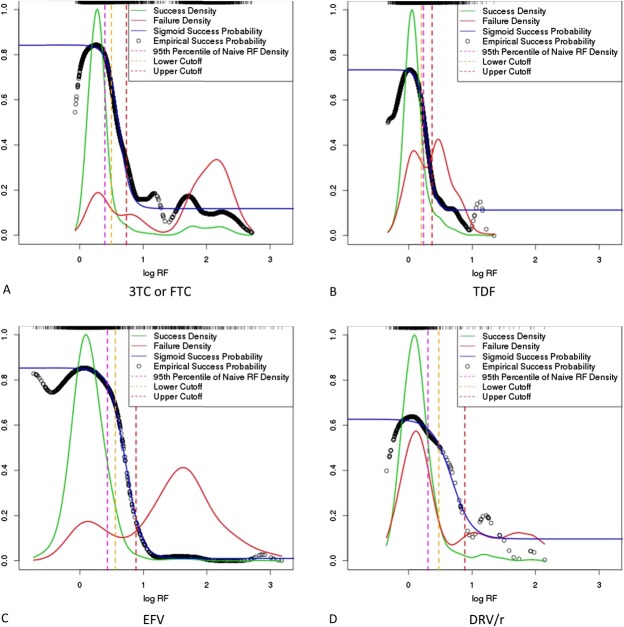
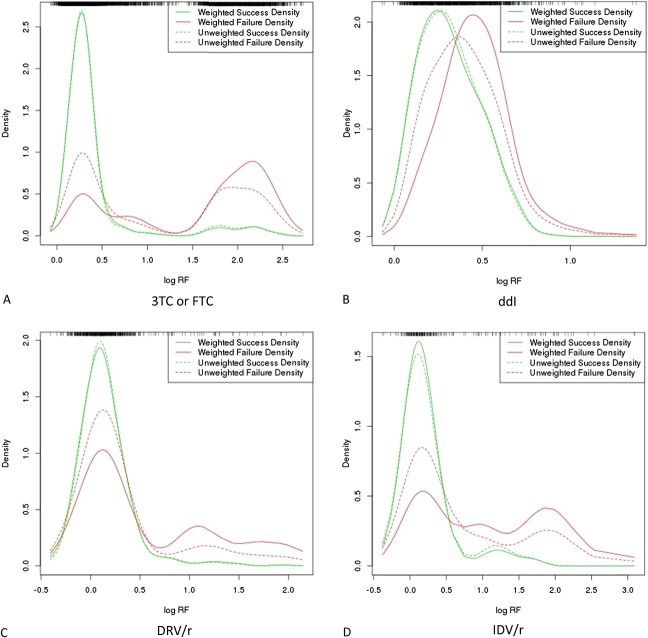
We calculated a susceptible-to-intermediate and an intermediate-to-resistant cutoff per drug for RFs predicted by geno2pheno[resistance]. Probability densities for therapeutic success and failure were estimated from 10,444 treatment episodes. The density estimation procedure corrects for the activity of the backbone drug compounds and for therapy failure without drug resistance. For estimating the probability of therapeutic success given an RF, we fit a sigmoid function. The cutoffs are given by the roots of the third derivative of the sigmoid function.
For performance assessment, we used geno2pheno[resistance] RF predictions and the cutoffs for predicting therapeutic success in 2 independent sets of therapy episodes. HIVdb was used for performance comparison. On one test set (n = 807), our cutoffs and HIVdb performed equally well receiver operating characteristic curve [(ROC)-area under the curve (AUC): 0.68]. On the other test set (n = 917), our cutoffs (ROC-AUC: 0.63) and HIVdb (ROC-AUC: 0.65) performed comparatively well.
Our method can be used for calculating clinically relevant cutoffs for (predicted) RFs. The method corrects for the activity of the backbone drug compounds and for therapy failure without drug resistance. Our method's performance is comparable with that of HIVdb. RF cutoffs for the latest version of geno2pheno[resistance] have been estimated with this method.
HIV-1耐药性可通过表型耐药性检测来测定。然而,这些检测的结果,即耐药因子(RF),需要根据被检测变体的体内活性进行解读。具体而言,每种药物的RF动态范围必须划分为适当数量的具有临床意义的区间。
我们针对由geno2pheno[resistance]预测的RF,计算了每种药物的敏感至中等耐药以及中等耐药至耐药的临界值。从10444个治疗疗程中估计治疗成功和失败的概率密度。密度估计程序校正了主干药物化合物的活性以及无耐药性的治疗失败情况。为了在给定RF的情况下估计治疗成功的概率,我们拟合了一个S形函数。临界值由S形函数的三阶导数的根给出。
为了进行性能评估,我们在2组独立的治疗疗程中使用geno2pheno[resistance]的RF预测值和用于预测治疗成功的临界值。使用HIVdb进行性能比较。在一个测试集(n = 807)上,我们的临界值和HIVdb的表现同样出色(受试者操作特征曲线[(ROC)-曲线下面积(AUC):0.68])。在另一个测试集(n = 917)上我们的临界值(ROC-AUC:0.63)和HIVdb(ROC-AUC:0.65)表现相对较好。
我们的方法可用于计算(预测的)RF的临床相关临界值。该方法校正了主干药物化合物的活性以及无耐药性的治疗失败情况。我们方法的性能与HIVdb相当。已使用此方法估计了最新版本的geno2pheno[resistance]的RF临界值。