Olivieri Patrick, Solitar Bruce, Dubois Michel
NYU School of Medicine, New York, NY, USA.
Department of Rheumatology.
Open Access Rheumatol. 2012 Dec 17;4:109-114. doi: 10.2147/OARRR.S36086. eCollection 2012.
Fibromyalgia is a disease process without an obvious etiology. While some evidence suggests that adverse experiences in childhood contribute to its development, specific evidence has been equivocal.
A total of 36 patients with fibromyalgia from the greater New York area were recruited and surveyed using the Centers for Disease Control's Behavioral Risk Factor Surveillance System survey, and questions from the section on adverse childhood experiences were administered. The results were compared to those obtained from over 400,000 people surveyed by the Centers for Disease control each year, and were monitored for statistically significant differences.
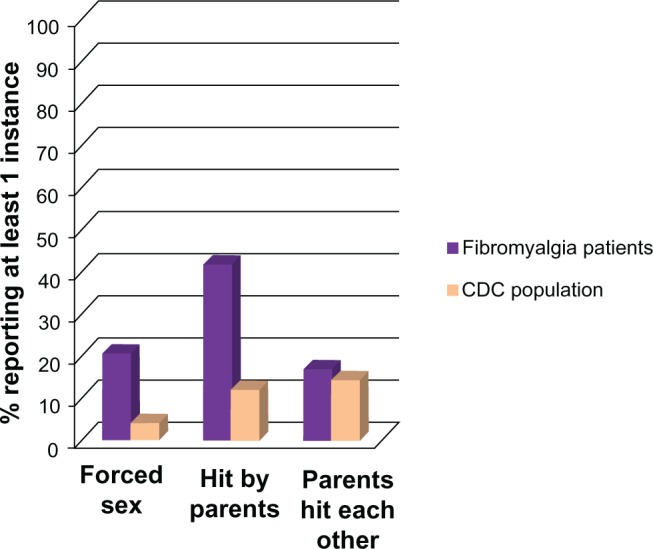
A statistically significant difference was noted among the control group, suggesting that individuals reported growing up with someone who was depressed when the respondents were between the ages of 0 and 18 years old. Moreover, respondents reported that they were hit by their parents in some way, were insulted or cursed at by their parents, and had been forced to have sex with someone at least 5 years older than them or with an adult. No correlation was found with the following variables and the development of fibromyalgia: growing up with divorced or separated parents; growing up with someone sentenced to serve time in jail; or having parents that abused each other. Additionally, statistically significant differences were found for the following categories: lack of emotional support; life dissatisfaction; fair or poor health; physical, mental or emotional disability; and being divorced or not married.
Using this well-validated survey, it became clear that at least six specific adverse childhood experiences were correlated with the development of fibromyalgia. Data pertaining to disability, quality of life, life satisfaction, number of days of depression, emotional support, and marriage status illustrated the extent of subjective disability that these patients feel every day.
纤维肌痛是一种病因不明的疾病过程。虽然有证据表明童年时期的不良经历会促使其发病,但具体证据并不明确。
从纽约大区招募了36名纤维肌痛患者,并使用疾病控制中心的行为危险因素监测系统进行调查,询问了有关童年不良经历的问题。将结果与疾病控制中心每年对40多万人进行调查所获得的结果进行比较,并监测统计学上的显著差异。
在对照组中发现了统计学上的显著差异,这表明个体报告称在0至18岁之间与抑郁症患者一起长大。此外,受访者报告称他们曾受到父母某种方式的殴打、被父母辱骂或诅咒,并且曾被迫与比他们大至少5岁的人或成年人发生性关系。未发现以下变量与纤维肌痛的发病有相关性:与离异或分居的父母一起长大;与被判刑入狱的人一起长大;或父母相互虐待。此外,在以下类别中发现了统计学上的显著差异:缺乏情感支持;生活不满意;健康状况一般或较差;身体、心理或情感残疾;以及离婚或未婚。
通过使用这种经过充分验证的调查,很明显至少六种特定的童年不良经历与纤维肌痛的发病相关。与残疾、生活质量、生活满意度、抑郁天数、情感支持和婚姻状况相关的数据说明了这些患者每天感受到的主观残疾程度。