Hanly John G, Thompson Kara, Skedgel Chris
Division of Rheumatology, Department of Medicine; Department of Pathology.
Department of Medicine, Queen Elizabeth II Health Sciences Centre, Dalhousie University.
Open Access Rheumatol. 2015 Nov 6;7:69-75. doi: 10.2147/OARRR.S92630. eCollection 2015.
To validate and compare the decision rules to identify rheumatoid arthritis (RA) in administrative databases.
A study was performed using administrative health care data from a population of 1 million people who had access to universal health care. Information was available on hospital discharge abstracts and physician billings. RA cases in health administrative databases were matched 1:4 by age and sex to randomly selected controls without inflammatory arthritis. Seven case definitions were applied to identify RA cases in the health administrative data, and their performance was compared with the diagnosis by a rheumatologist. The validation study was conducted on a sample of individuals with administrative data who received a rheumatologist consultation at the Arthritis Center of Nova Scotia.
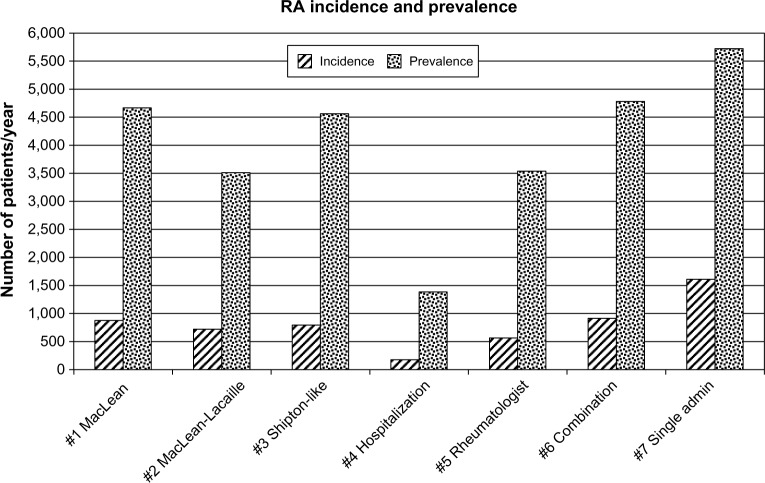
We identified 535 RA cases and 2,140 non-RA, noninflammatory arthritis controls. Using the rheumatologist's diagnosis as the gold standard, the overall accuracy of the case definitions for RA cases varied between 68.9% and 82.9% with a kappa statistic between 0.26 and 0.53. The sensitivity and specificity varied from 20.7% to 94.8% and 62.5% to 98.5%, respectively. In a reference population of 1 million, the estimated annual number of incident cases of RA was between 176 and 1,610 and the annual number of prevalent cases was between 1,384 and 5,722.
The accuracy of case definitions for the identification of RA cases from rheumatology clinics using administrative health care databases is variable when compared to a rheumatologist's assessment. This should be considered when comparing results across studies. This variability may also be used as an advantage in different study designs, depending on the relative importance of sensitivity and specificity for identifying the population of interest to the research question.
验证并比较行政数据库中识别类风湿性关节炎(RA)的决策规则。
利用来自100万享有全民医保人群的行政医疗保健数据进行了一项研究。可获取医院出院摘要和医生账单信息。将健康行政数据库中的RA病例按年龄和性别以1:4的比例与随机选择的无炎性关节炎对照进行匹配。应用七种病例定义来识别健康行政数据中的RA病例,并将其性能与风湿病学家的诊断结果进行比较。验证研究是在新斯科舍省关节炎中心接受风湿病学家会诊且有行政数据的个体样本上进行的。
我们识别出535例RA病例和2140例非RA、非炎性关节炎对照。以风湿病学家的诊断为金标准,RA病例定义的总体准确率在68.9%至82.9%之间,kappa统计量在0.26至0.53之间。敏感性和特异性分别在20.7%至94.8%和62.5%至98.5%之间变化。在100万的参考人群中,RA的估计年发病例数在176至1610之间,年患病例数在1384至5722之间。
与风湿病学家的评估相比,使用行政医疗保健数据库从风湿病诊所识别RA病例的病例定义准确性存在差异。在比较不同研究结果时应考虑这一点。根据识别研究问题相关人群时敏感性和特异性的相对重要性,这种变异性在不同的研究设计中也可作为一个优势。