Mora Maximilian, Mahnert Alexander, Koskinen Kaisa, Pausan Manuela R, Oberauner-Wappis Lisa, Krause Robert, Perras Alexandra K, Gorkiewicz Gregor, Berg Gabriele, Moissl-Eichinger Christine
Department for Internal Medicine, Medical University of Graz, Graz Austria.
Institute of Environmental Biotechnology, Graz University of Technology, Graz Austria.
Front Microbiol. 2016 Oct 13;7:1573. doi: 10.3389/fmicb.2016.01573. eCollection 2016.
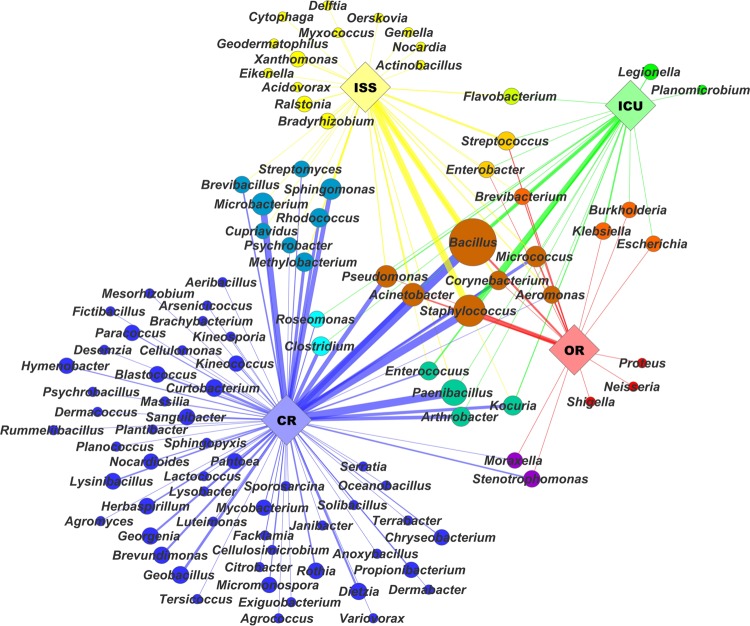
Indoor environments, where people spend most of their time, are characterized by a specific microbial community, the indoor microbiome. Most indoor environments are connected to the natural environment by high ventilation, but some habitats are more confined: intensive care units, operating rooms, cleanrooms and the international space station (ISS) are extraordinary living and working areas for humans, with a limited exchange with the environment. The purposes for confinement are different: a patient has to be protected from infections (intensive care unit, operating room), product quality has to be assured (cleanrooms), or confinement is necessary due to extreme, health-threatening outer conditions, as on the ISS. The ISS represents the most secluded man-made habitat, constantly inhabited by humans since November 2000 - and, inevitably, also by microorganisms. All of these man-made confined habitats need to be microbiologically monitored and controlled, by e.g., microbial cleaning and disinfection. However, these measures apply constant selective pressures, which support microbes with resistance capacities against antibiotics or chemical and physical stresses and thus facilitate the rise of survival specialists and multi-resistant strains. In this article, we summarize the available data on the microbiome of aforementioned confined habitats. By comparing the different operating, maintenance and monitoring procedures as well as microbial communities therein, we emphasize the importance to properly understand the effects of confinement on the microbial diversity, the possible risks represented by some of these microorganisms and by the evolution of (antibiotic) resistances in such environments - and the need to reassess the current hygiene standards.
人们大部分时间都待在室内环境中,其特点是存在特定的微生物群落,即室内微生物组。大多数室内环境通过高通风与自然环境相连,但有些栖息地更为封闭:重症监护病房、手术室、洁净室和国际空间站(ISS)是人类特殊的生活和工作区域,与外界环境的交换有限。封闭的目的各不相同:患者必须得到感染防护(重症监护病房、手术室),产品质量必须得到保证(洁净室),或者由于极端的、对健康有威胁的外部条件(如在国际空间站上)而有必要进行封闭。国际空间站是最与世隔绝的人造栖息地,自2000年11月以来一直有人类持续居住,不可避免地也有微生物存在。所有这些人造封闭栖息地都需要进行微生物监测和控制,例如通过微生物清洁和消毒。然而,这些措施会持续施加选择压力,这有利于具有抗抗生素或化学和物理压力能力的微生物,从而促进生存专家和多重耐药菌株的出现。在本文中,我们总结了上述封闭栖息地微生物组的现有数据。通过比较不同的操作、维护和监测程序以及其中的微生物群落,我们强调了正确理解封闭对微生物多样性的影响、这些微生物中的一些所代表的潜在风险以及此类环境中(抗生素)耐药性演变的重要性——以及重新评估当前卫生标准的必要性。