Plymouth Marine Laboratory, Prospect Place, Plymouth, PL1 3DH, United Kingdom.
School of Biological Sciences, University of Essex, Wivenhoe Park, Colchester, CO4 3SQ, United Kingdom.
Sci Rep. 2016 Oct 31;6:36031. doi: 10.1038/srep36031.
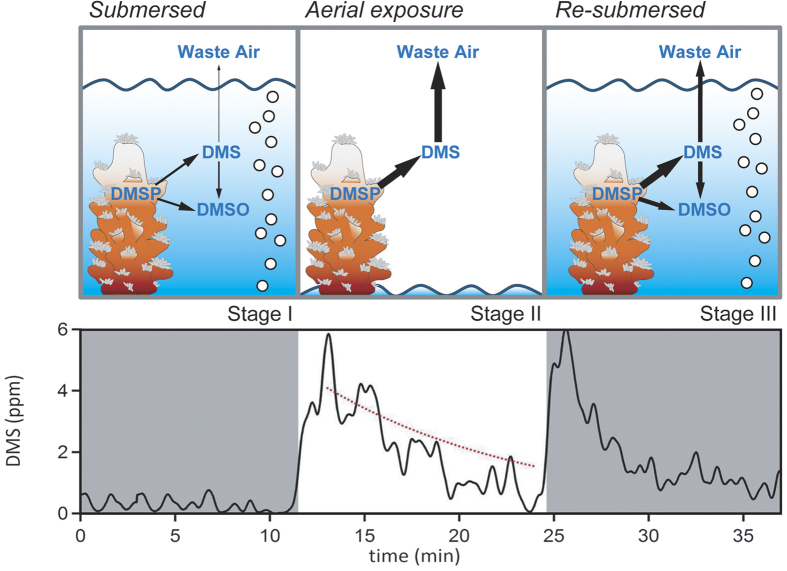
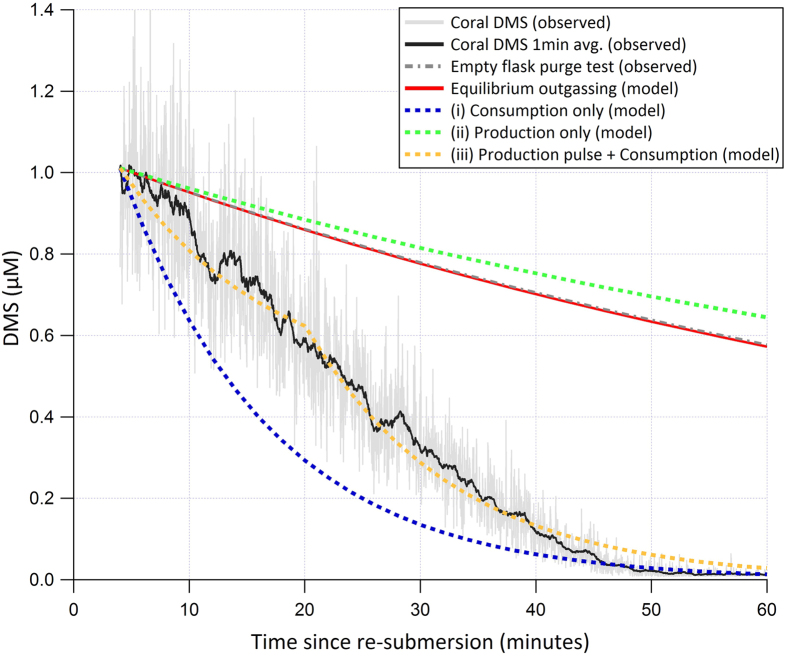
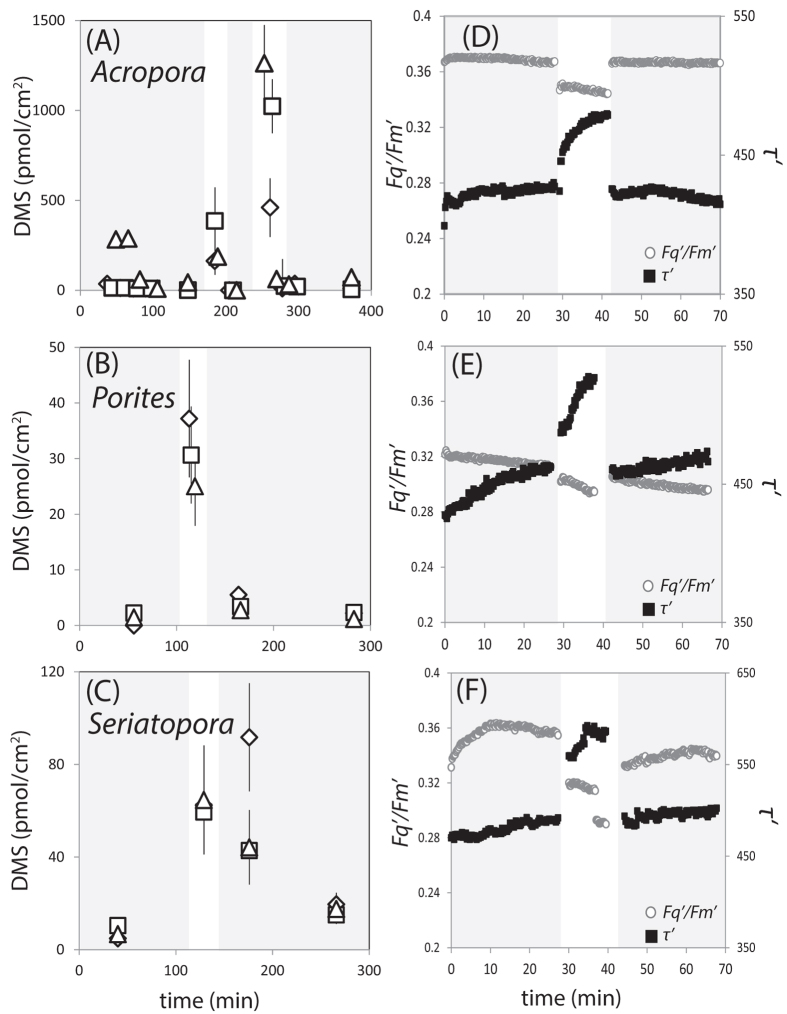
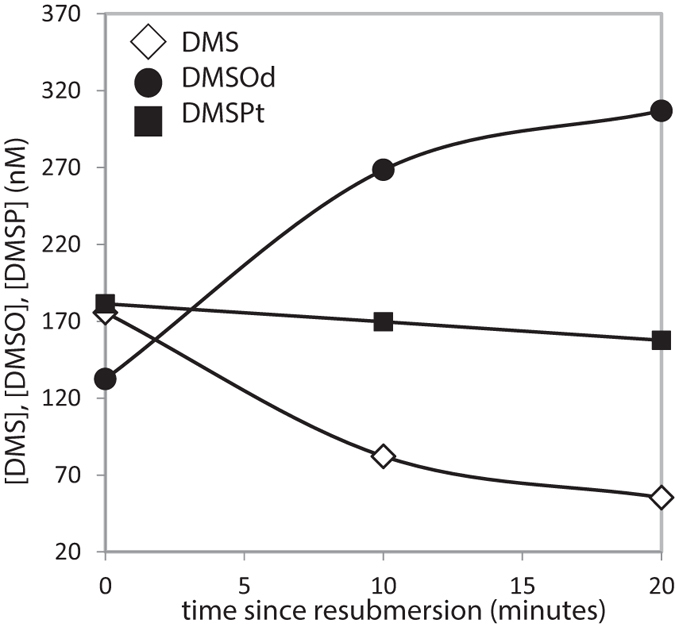
Corals are prolific producers of dimethylsulfoniopropionate (DMSP). High atmospheric concentrations of the DMSP breakdown product dimethylsulfide (DMS) have been linked to coral reefs during low tides. DMS is a potentially key sulfur source to the tropical atmosphere, but DMS emission from corals during tidal exposure is not well quantified. Here we show that gas phase DMS concentrations (DMS) increased by an order of magnitude when three Indo-Pacific corals were exposed to air in laboratory experiments. Upon re-submersion, an additional rapid rise in DMS was observed, reflecting increased production by the coral and/or dissolution of DMS-rich mucus formed by the coral during air exposure. Depletion in DMS following re-submersion was likely due to biologically-driven conversion of DMS to dimethylsulfoxide (DMSO). Fast Repetition Rate fluorometry showed downregulated photosynthesis during air exposure but rapid recovery upon re-submersion, suggesting that DMS enhances coral tolerance to oxidative stress during a process that can induce photoinhibition. We estimate that DMS emission from exposed coral reefs may be comparable in magnitude to emissions from other marine DMS hotspots. Coral DMS emission likely comprises a regular and significant source of sulfur to the tropical marine atmosphere, which is currently unrecognised in global DMS emission estimates and Earth System Models.
珊瑚是二甲基巯基丙酸酯(DMSP)的高产生产者。在低潮期间,大气中 DMSP 分解产物二甲基硫(DMS)的高浓度与珊瑚礁有关。DMS 是热带大气中潜在的关键硫源,但潮汐暴露期间珊瑚释放的 DMS 尚未得到很好的量化。在这里,我们表明,当三种印度洋-太平洋珊瑚在实验室实验中暴露于空气中时,气相 DMS 浓度(DMS)增加了一个数量级。重新淹没后,观察到 DMS 的额外快速上升,这反映了珊瑚的增加产量和/或在空气暴露期间由珊瑚形成的富含 DMS 的粘液的溶解。重新淹没后 DMS 的消耗可能是由于 DMS 被生物驱动转化为二甲亚砜(DMSO)所致。快速重复率荧光法显示,空气暴露期间光合作用受到抑制,但重新淹没后迅速恢复,表明 DMS 增强了珊瑚对氧化应激的耐受能力,而这一过程可能会导致光抑制。我们估计,暴露的珊瑚礁的 DMS 排放量可能与其他海洋 DMS 热点的排放量相当。珊瑚 DMS 排放可能是热带海洋大气中硫的一个常规且重要的来源,目前在全球 DMS 排放估计和地球系统模型中尚未得到认可。