Department of Psychology, University of Alabama at Birmingham.
Psychol Assess. 2017 Sep;29(9):1082-1095. doi: 10.1037/pas0000412. Epub 2016 Oct 31.
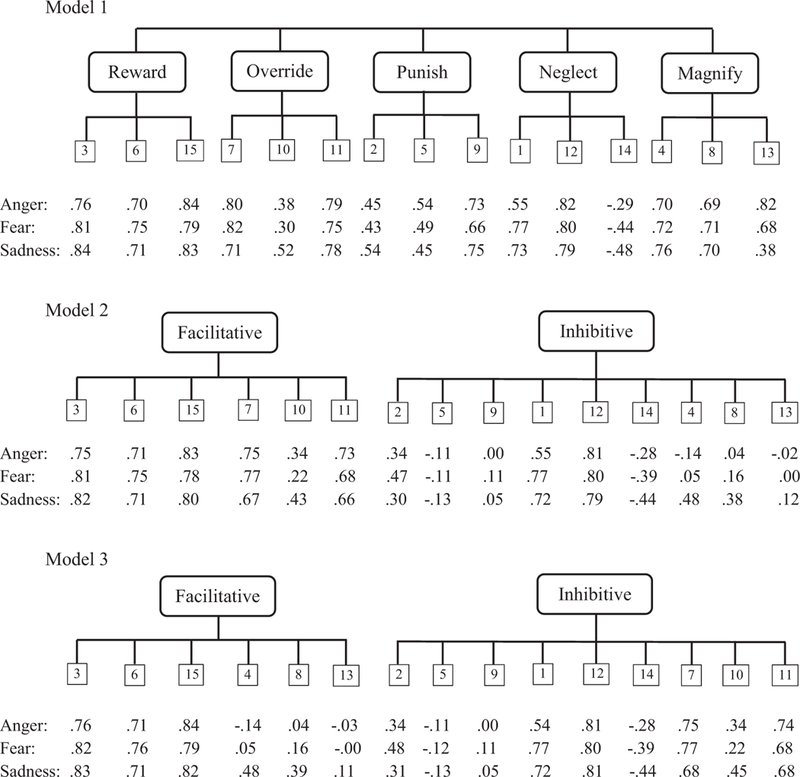
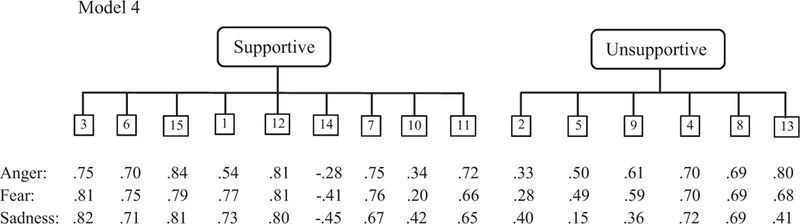
Although the Emotions as a Child Scale (EAC) has been widely used in research with children and adolescents, no peer-reviewed studies have examined its factor structure using factor analytic methods. Likewise, the measurement equivalence of the scale across gender and race/ethnicity has never been investigated. To address these gaps, this study examines the factor structure of the scale in late adolescence and emerging adulthood, compares it to previous theory-driven models, and evaluates its measurement invariance across gender and 2 racial/ethnic groups. Participants were 1,087 individuals participating in a larger community-based study of adolescent health (M = 19.35 years, SD = 1.19). Results of exploratory and confirmatory factor analyses suggest that a 2-factor model from a shortened version of the scale (3 items were eliminated from each emotion scale), involving supportive and unsupportive socialization strategies, is a good alternative model to the original 5-factor structure for researchers interested in broader conceptualization of emotion socialization strategies. This 2-factor model of the shortened scale showed stronger measurement invariance across gender than racial/ethnic groups. Future studies addressing racial/ethnic differences with this measure should compare the results with and without imposing corresponding invariance constraints on noninvariant items. Findings of this study should be replicated in other age and racial/ethnic groups, and examine the predictive utility of the abbreviated 2-factor model for emotion-related outcomes across development. (PsycINFO Database Record
虽然儿童情绪量表(EAC)已广泛应用于儿童和青少年的研究,但使用因子分析方法对其因子结构进行的同行评审研究尚无。同样,该量表在性别和种族/民族之间的测量等效性也从未被调查过。为了解决这些差距,本研究在青少年晚期和成年早期检验了该量表的因子结构,将其与以前的理论驱动模型进行了比较,并评估了其在性别和 2 个种族/民族群体之间的测量不变性。参与者是参加青少年健康的更大基于社区的研究的 1087 人(M = 19.35 岁,SD = 1.19)。探索性和验证性因子分析的结果表明,对于有兴趣更广泛地概念化情感社会化策略的研究人员来说,从量表缩短版本(每个情感量表删除 3 个项目)中得出的 2 因素模型是原始 5 因素结构的较好替代模型,涉及支持性和非支持性社会化策略。缩短量表的这个 2 因素模型在性别上的测量不变性强于种族/民族群体。未来使用该措施解决种族/民族差异的研究应将结果与非不变项目上施加相应不变性约束的结果进行比较。本研究的结果应在其他年龄和种族/民族群体中复制,并在整个发展过程中检验缩短的 2 因素模型对与情绪相关的结果的预测效用。