Thompson Spencer J, Sargsyan Ashot, Lee Seung-Ah, Yuen Jason J, Cai Jinjin, Smalling Rana, Ghyselinck Norbert, Mark Manuel, Blaner William S, Graham Timothy E
Molecular Medicine Program, Department of Medicine, Division of Endocrinology, Metabolism, and Diabetes, Department of Nutrition, and Department of Biological Chemistry, University of Utah School of Medicine, Salt Lake City, UT.
George E. Wahlen Department of Veterans Affairs Medical Center, Salt Lake City, UT.
Diabetes. 2017 Jan;66(1):58-63. doi: 10.2337/db16-0286. Epub 2016 Oct 19.
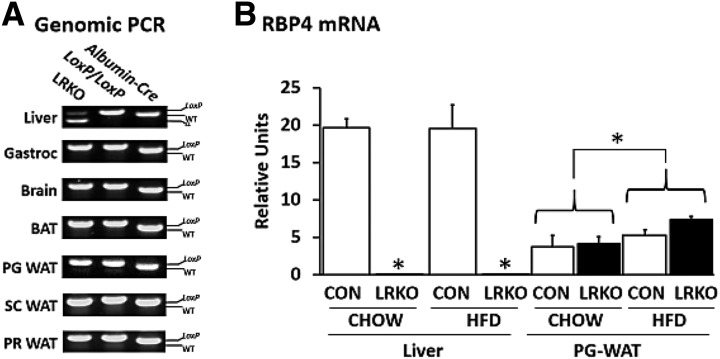
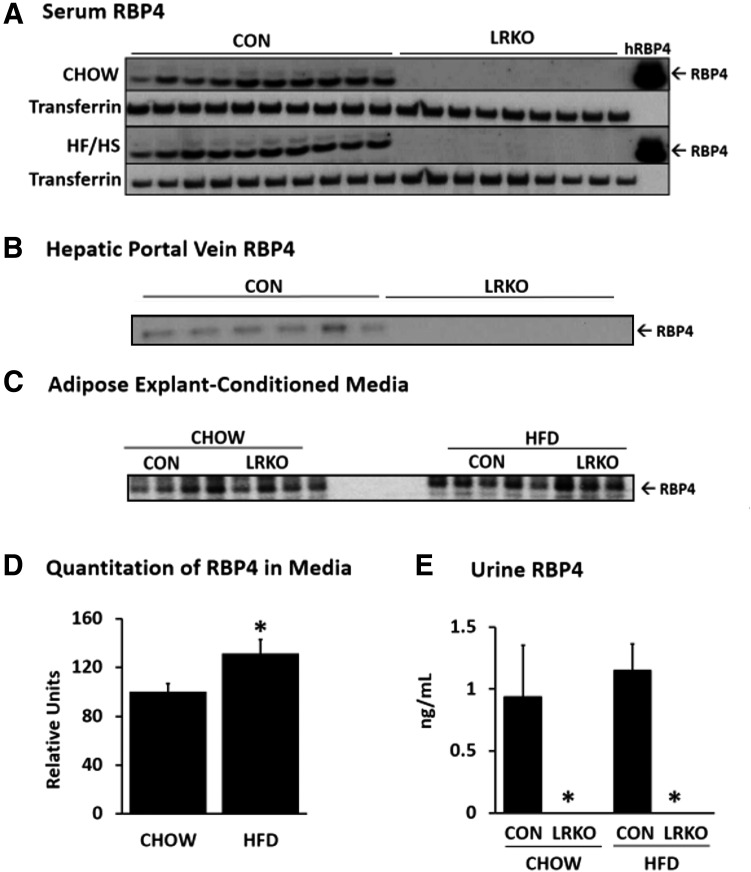
RBP4 is produced mainly by hepatocytes. In type 2 diabetes and obesity, circulating RBP4 is increased and may act systemically to cause insulin resistance and glucose intolerance. Observations that adipocyte RBP4 mRNA increases in parallel with circulating RBP4 in these conditions, whereas liver RBP4 mRNA does not, led to a widely held hypothesis that elevated circulating RBP4 is a direct result of increased production by adipocytes. To test this, we generated mice with hepatocyte-specific deletion of RBP4 (liver RBP4 knockout or LRKO mice). Adipose tissue RBP4 expression and secretion remained intact in LRKO mice and increased as expected in the setting of diet-induced insulin resistance. However, circulating RBP4 was undetectable in LRKO mice. We conclude that adipocyte RBP4 is not a significant source of circulating RBP4, even in the setting of insulin resistance. Adipocyte RBP4, therefore, may have a more important autocrine or paracrine function that is confined within the adipose tissue compartment.
视黄醇结合蛋白4(RBP4)主要由肝细胞产生。在2型糖尿病和肥胖症中,循环中的RBP4水平升高,可能会全身性地导致胰岛素抵抗和葡萄糖不耐受。在这些情况下,脂肪细胞RBP4 mRNA与循环中的RBP4平行增加,而肝脏RBP4 mRNA则不然,这导致了一种广泛持有的假设,即循环中RBP4升高是脂肪细胞产生增加的直接结果。为了验证这一点,我们构建了肝细胞特异性缺失RBP4的小鼠(肝脏RBP4基因敲除小鼠或LRKO小鼠)。在LRKO小鼠中,脂肪组织RBP4的表达和分泌保持完整,并且在饮食诱导的胰岛素抵抗情况下如预期那样增加。然而,在LRKO小鼠中检测不到循环中的RBP4。我们得出结论,即使在胰岛素抵抗的情况下,脂肪细胞RBP4也不是循环中RBP4的重要来源。因此,脂肪细胞RBP4可能具有更重要的自分泌或旁分泌功能,该功能局限于脂肪组织内。