Moraes-Vieira Pedro M, Castoldi Angela, Aryal Pratik, Wellenstein Kerry, Peroni Odile D, Kahn Barbara B
Division of Endocrinology, Diabetes and Metabolism, Department of Medicine, Beth Israel Deaconess Medical Center and Harvard Medical School, Boston, MA.
Division of Endocrinology, Diabetes and Metabolism, Department of Medicine, Beth Israel Deaconess Medical Center and Harvard Medical School, Boston, MA
Diabetes. 2016 May;65(5):1317-27. doi: 10.2337/db15-1696. Epub 2016 Mar 2.
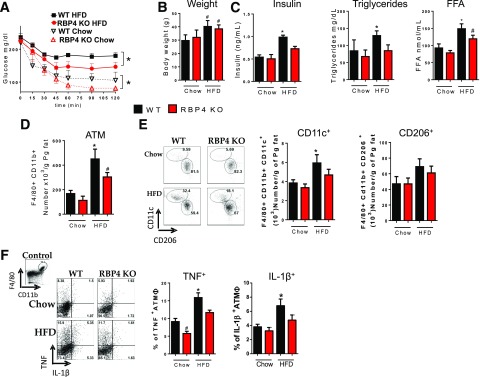
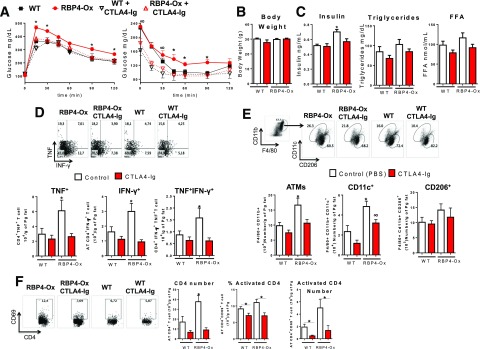
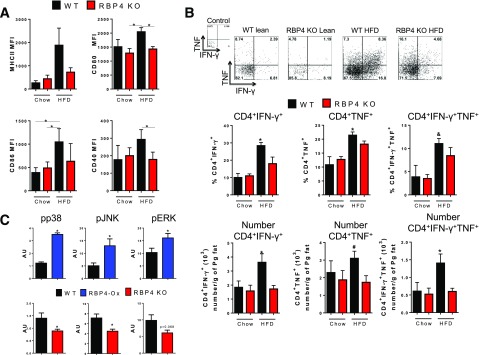
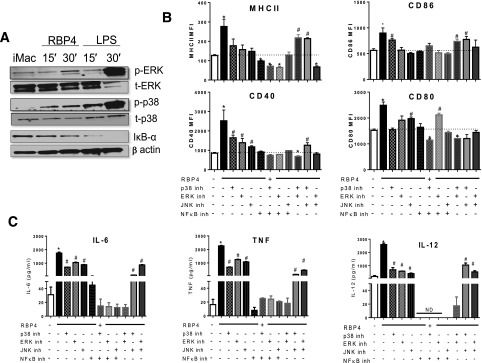
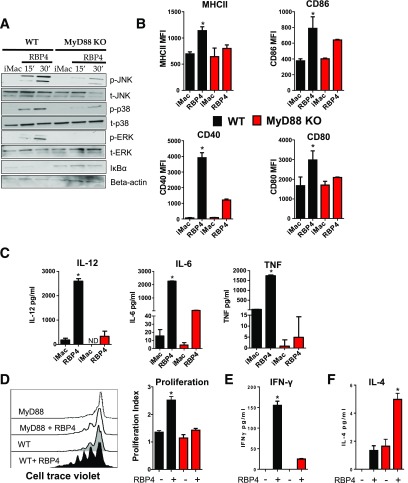
Adipose tissue (AT) inflammation contributes to impaired insulin action, which is a major cause of type 2 diabetes. RBP4 is an adipocyte- and liver-derived protein with an important role in insulin resistance, metabolic syndrome, and AT inflammation. RBP4 elevation causes AT inflammation by activating innate immunity, which elicits an adaptive immune response. RBP4-overexpressing mice (RBP4-Ox) are insulin resistant and glucose intolerant and have increased AT macrophages and T-helper 1 cells. We show that high-fat diet-fed RBP4(-/-) mice have reduced AT inflammation and improved insulin sensitivity versus wild type. We also elucidate the mechanism for RBP4-induced macrophage antigen presentation and subsequent T-cell activation. In RBP4-Ox, AT macrophages display enhanced c-Jun N-terminal kinase, extracellular signal-related kinase, and p38 phosphorylation. Inhibition of these pathways and of NF-κB reduces activation of macrophages and CD4 T cells. MyD88 is an adaptor protein involved in proinflammatory signaling. In macrophages from MyD88(-/-) mice, RBP4 fails to stimulate secretion of tumor necrosis factor, IL-12, and IL-6 and CD4 T-cell activation. In vivo blockade of antigen presentation by treating RBP4-Ox mice with CTLA4-Ig, which blocks costimulation of T cells, is sufficient to reduce AT inflammation and improve insulin resistance. Thus, MyD88 and downstream mitogen-activated protein kinase and NF-κB pathways are necessary for RBP4-induced macrophage antigen presentation and subsequent T-cell activation. Also, blocking antigen presentation with CTLA4-Ig improves RBP4-induced insulin resistance and macrophage-induced T-cell activation.
脂肪组织(AT)炎症会导致胰岛素作用受损,而这是2型糖尿病的主要病因。视黄醇结合蛋白4(RBP4)是一种由脂肪细胞和肝脏产生的蛋白质,在胰岛素抵抗、代谢综合征和AT炎症中起重要作用。RBP4水平升高通过激活先天免疫引发适应性免疫反应,从而导致AT炎症。过表达RBP4的小鼠(RBP4-Ox)具有胰岛素抵抗和葡萄糖不耐受性,且AT巨噬细胞和辅助性T细胞1数量增加。我们发现,与野生型相比,高脂饮食喂养的RBP4基因敲除小鼠的AT炎症减轻,胰岛素敏感性提高。我们还阐明了RBP4诱导巨噬细胞抗原呈递及随后T细胞活化的机制。在RBP4-Ox小鼠中,AT巨噬细胞的c-Jun氨基末端激酶、细胞外信号调节激酶和p38磷酸化增强。抑制这些信号通路以及核因子κB可降低巨噬细胞和CD4 T细胞的活化。髓样分化因子88(MyD88)是一种参与促炎信号传导的衔接蛋白。在来自MyD88基因敲除小鼠的巨噬细胞中,RBP4无法刺激肿瘤坏死因子、白细胞介素12和白细胞介素6的分泌以及CD4 T细胞的活化。用CTLA4-Ig治疗RBP4-Ox小鼠以阻断T细胞的共刺激,在体内阻断抗原呈递,足以减轻AT炎症并改善胰岛素抵抗。因此,MyD88以及下游的丝裂原活化蛋白激酶和核因子κB信号通路是RBP4诱导巨噬细胞抗原呈递及随后T细胞活化所必需的。此外,用CTLA4-Ig阻断抗原呈递可改善RBP4诱导的胰岛素抵抗和巨噬细胞诱导的T细胞活化。