Ratneswaran Culadeeban, Chisnall Ben, Li Mingyue, Tan Sarah, Douiri Abdel, Anantham Devanand, Steier Joerg
Faculty of Life Sciences and Medicine, King's College London, London, UK.
Guy's & St Thomas' NHS Foundation Trust, London, UK.
BMJ Open. 2016 Oct 24;6(10):e012693. doi: 10.1136/bmjopen-2016-012693.
We compared 2 sociocultural cohorts with different duration of exposure to graphic health warning labels (GHWL), to investigate a possible desensitisation to their use. We further studied how a differing awareness and emotional impact of smoking-associated risks could be used to prevent this.
Structured interviews of patients from the general respiratory department were undertaken between 2012 and 2013 in 2 tertiary hospitals in Singapore and London.
266 participants were studied, 163 Londoners (35% smokers, 54% male, age 52±18 years) and 103 Singaporeans (53% smokers, p=0.003; 78% male, p<0.001; age 58±15 years, p=0.012).
50 items assessed demographics, smoking history, knowledge and the deterring impact of smoking-associated risks. After showing 10 GHWL, the impact on emotional response, cognitive processing and intended smoking behaviour was recorded.
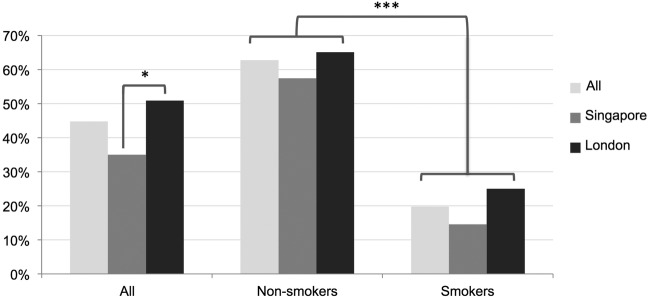
Singaporeans scored lower than the Londoners across all label processing constructs, and this was consistent for the smoking and non-smoking groups. Londoners experienced more 'disgust' and felt GHWL were more effective at preventing initiation of, or quitting, smoking. Singaporeans had a lower awareness of lung cancer (82% vs 96%, p<0.001), despite ranking it as the most deterring consequence of smoking. Overall, 'blindness' was the least known potential risk (28%), despite being ranked as more deterring than 'stroke' and 'oral cancer' in all participants.
The length of exposure to GHWL impacts on the effectiveness. However, acknowledging the different levels of awareness and emotional impact of smoking-associated risks within different sociocultural cohorts could be used to maintain their impact.
我们比较了两个接触图形健康警示标签(GHWL)时长不同的社会文化队列,以研究对其使用可能产生的脱敏现象。我们还进一步研究了如何利用对吸烟相关风险的不同认知和情感影响来预防这种情况。
2012年至2013年期间,在新加坡和伦敦的两家三级医院对普通呼吸科患者进行了结构化访谈。
共研究了266名参与者,其中163名伦敦人(35%为吸烟者,54%为男性,年龄52±18岁)和103名新加坡人(53%为吸烟者,p = 0.003;78%为男性,p < 0.001;年龄58±15岁,p = 0.012)。
50项内容评估了人口统计学、吸烟史、知识以及吸烟相关风险的威慑作用。展示10个GHWL后,记录其对情绪反应、认知加工和预期吸烟行为的影响。
在所有标签处理指标方面,新加坡人的得分均低于伦敦人,吸烟组和非吸烟组均如此。伦敦人体验到更多的“厌恶”情绪,并且认为GHWL在预防开始吸烟或戒烟方面更有效。尽管新加坡人将肺癌列为吸烟最具威慑力的后果,但他们对肺癌的认知度较低(82%对96%,p < 0.001)。总体而言,“失明”是最不为人所知的潜在风险(28%),尽管在所有参与者中,它被认为比“中风”和“口腔癌”更具威慑力。
接触GHWL的时长会影响其效果。然而,认识到不同社会文化队列中对吸烟相关风险的不同认知水平和情感影响,可用于维持其影响。