Reis Evelyze Pinheiro Dos, Paixão Débora Martins, Brustolini Otávio José Bernardes, Silva Fabyano Fonseca E, Silva Walmir, Araújo Flávio Marcos Gomes de, Salim Anna Christina de Matos, Oliveira Guilherme, Guimarães Simone Eliza Facioni
Departamento de Zootecnia, Universidade Federal de Viçosa (UFV), Viçosa, MG, Brazil.
Departamento de Bioquímica Agrícola, Universidade Federal de Viçosa (UFV), Viçosa, MG, Brazil.
Genet Mol Biol. 2016 Oct-Dec;39(4):589-599. doi: 10.1590/1678-4685-GMB-2015-0295. Epub 2016 Oct 31.
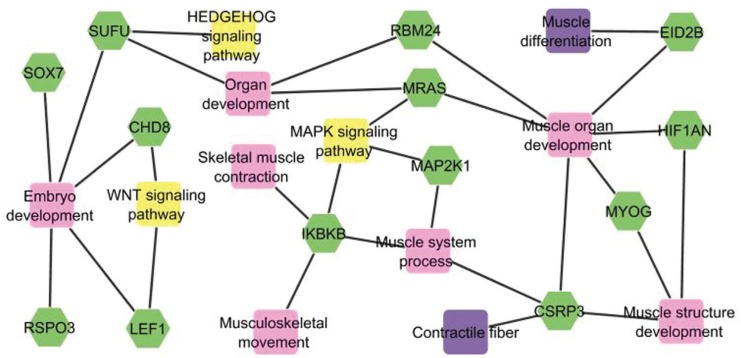
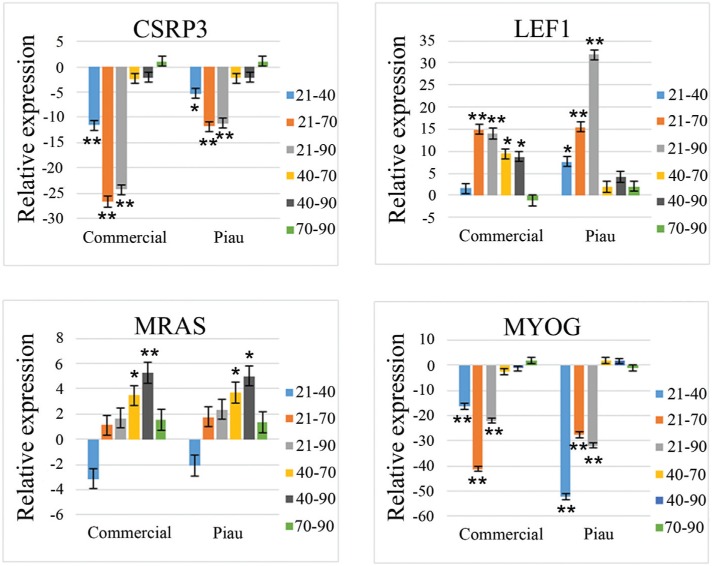
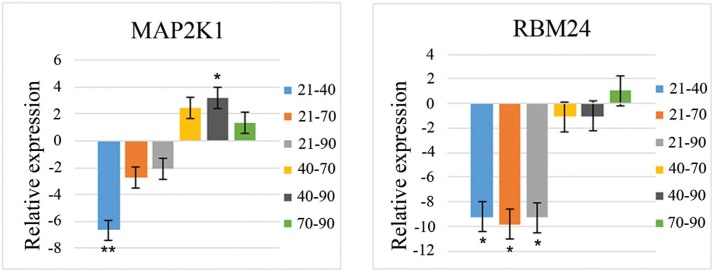
This study used qRT-PCR to examine variation in the expression of 13 myogenes during muscle development in four prenatal periods (21, 40, 70 and 90 days post-insemination) in commercial (the three-way Duroc, Landrace and Large-White cross) and local Piau pig breeds that differ in muscle mass. There was no variation in the expression of the CHD8, EID2B, HIF1AN, IKBKB, RSPO3, SOX7 and SUFU genes at the various prenatal ages or between breeds. The MAP2K1 and RBM24 genes showed similar expression between commercial and Piau pigs but greater expression (p < 0.05) in at least one prenatal period. Pair-wise comparisons of prenatal periods in each breed showed that only the CSRP3, LEF1, MRAS and MYOG genes had higher expression (p < 0.05) in at least one prenatal period in commercial and Piau pigs. Overall, these results identified the LEF1 gene as a primary candidate to account for differences in muscle mass between the pig breeds since activation of this gene may lead to greater myoblast fusion in the commercial breed compared to Piau pigs. Such fusion could explain the different muscularity between breeds in the postnatal periods.
本研究采用qRT-PCR技术,检测了在四个产前阶段(授精后21、40、70和90天)肌肉发育过程中13个肌生成相关基因在商业猪种(杜洛克、长白和大白三元杂交)和肌肉量不同的本地皮奥猪种中的表达差异。CHD8、EID2B、HIF1AN、IKBKB、RSPO3、SOX7和SUFU基因在不同产前年龄或不同猪种间表达无差异。MAP2K1和RBM24基因在商业猪和皮奥猪中表达相似,但在至少一个产前阶段表达量更高(p < 0.05)。对每个猪种的产前阶段进行两两比较发现,只有CSRP3、LEF1、MRAS和MYOG基因在商业猪和皮奥猪的至少一个产前阶段表达量更高(p < 0.05)。总体而言,这些结果确定LEF1基因为解释猪种间肌肉量差异的主要候选基因,因为与皮奥猪相比,该基因的激活可能导致商业猪种中更多的成肌细胞融合。这种融合可以解释产后阶段不同猪种间肌肉发达程度的差异。