Verbruggen Frederick, Chambers Christopher D, Lawrence Natalia S, McLaren Ian P L
Department of Psychology, University of Exeter.
Department of Psychology, Cardiff University.
J Exp Psychol Hum Percept Perform. 2017 Jan;43(1):147-168. doi: 10.1037/xhp0000284. Epub 2016 Nov 3.
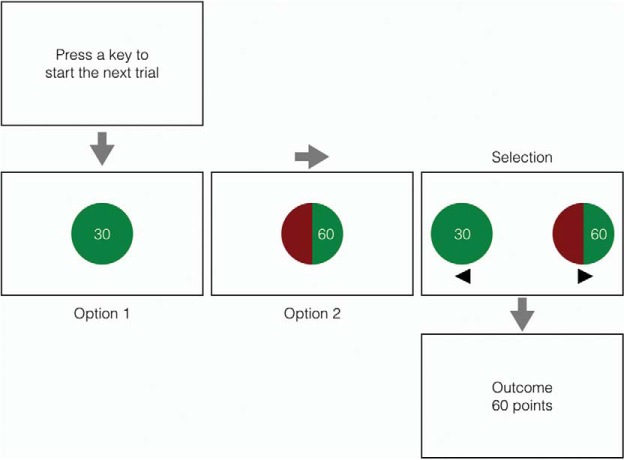
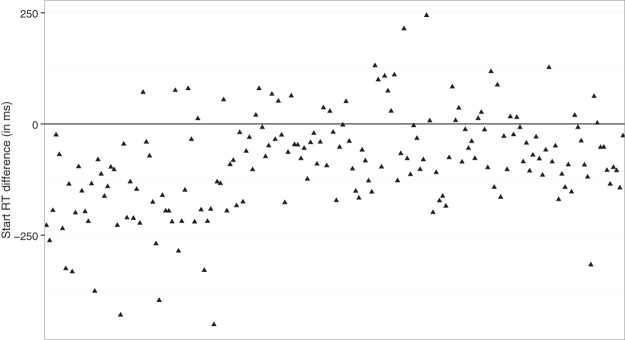
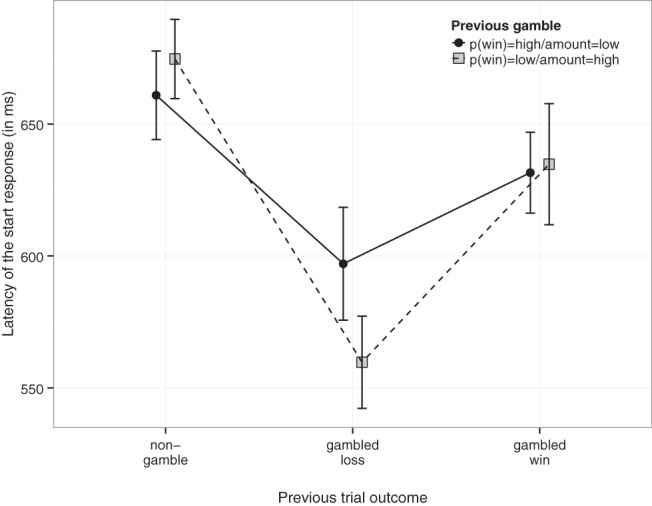
In the present study, we examined the effect of wins and losses on impulsive action in gambling (Experiments 1-3) and nongambling tasks (Experiments 4-5). In each experiment, subjects performed a simple task in which they had to win points. On each trial, they had to choose between a gamble and a nongamble. The gamble was always associated with a higher amount but a lower probability of winning than the nongamble. After subjects indicated their choice (i.e., gamble or not), feedback was presented. They had to press a key to start the next trial. Experiments 1-3 showed that, compared to the nongambling baseline, subjects were faster to initiate the next trial after a gambled loss, indicating that losses can induce impulsive actions. In Experiments 4 and 5, subjects alternated between the gambling task and a neutral decision-making task in which they could not win or lose points. Subjects were faster in the neutral decision-making task if they had just lost in the gambling task, suggesting that losses have a general effect on action. Our results challenge the dominant idea that humans become more cautious after suboptimal outcomes. Instead, they indicate that losses in the context of potential rewards are emotional events that increase impulsivity. (PsycINFO Database Record
在本研究中,我们考察了输赢对赌博任务(实验1 - 3)和非赌博任务(实验4 - 5)中冲动行为的影响。在每个实验中,受试者执行一项简单任务,即他们必须赢取分数。在每次试验中,他们必须在赌博选项和非赌博选项之间做出选择。赌博选项总是与更高的金额相关联,但获胜概率低于非赌博选项。在受试者表明他们的选择(即是否赌博)后,会给出反馈。他们必须按下一个键来开始下一次试验。实验1 - 3表明,与非赌博基线相比,受试者在赌博输后更快地开始下一次试验,这表明损失会诱发冲动行为。在实验4和5中,受试者在赌博任务和一个他们无法赢取或输掉分数的中性决策任务之间交替进行。如果受试者刚刚在赌博任务中输了,那么他们在中性决策任务中会更快做出反应,这表明损失对行为有普遍影响。我们的结果挑战了主导观点,即人类在次优结果后会变得更加谨慎。相反表明,在潜在奖励背景下的损失是会增加冲动性的情绪事件。(《心理学文摘数据库记录》 )