Yamada Rei, Rasmussen Kathleen M, Felice Julia P
Division of Nutritional Sciences, Cornell University, Ithaca, NY 14853, USA.
Children (Basel). 2016 Oct 31;3(4):22. doi: 10.3390/children3040022.
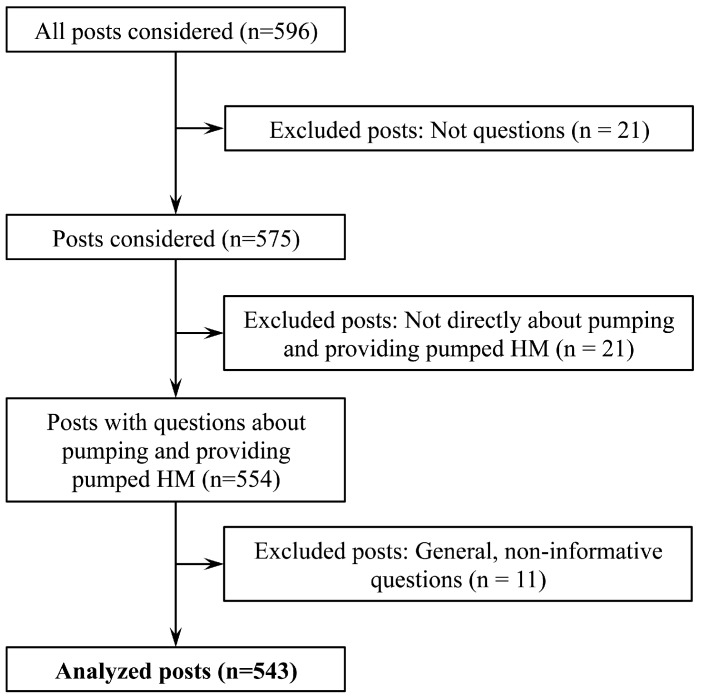
Despite U.S. mothers' wide adoption of pumps and bottles to provide human milk (HM) to their infants, mothers lack comprehensive, evidence-based guidelines for these practices. Thus, some women use online sources to seek information from each other. We aimed to characterize the information women sought online about pumping. We used data provided by ~25,000 women in an open cohort within a discussion forum about parenting. We examined 543 posts containing questions about providing pumped HM cross-sectionally and longitudinally in three time intervals: prenatal, 0 through 1.5 months postpartum, and 1.5 to 4.5 months postpartum. We used thematic analysis with Atlas.ti to analyze the content of posts. During pregnancy, women commonly asked questions about how and where to obtain pumps, both out-of-pocket and through insurance policies. Between 0-1.5 months postpartum, many mothers asked about how to handle pumped HM to ensure its safety as fed. Between 1.5-4.5 months postpartum, mothers sought strategies to overcome constraints to pumping both at home and at work and also asked about stopping pumping and providing their milk. Women's questions related to ensuring the safety of pumped HM represent information women need from health professionals, while their questions related to obtaining pumps suggest that women may benefit from clearer guidelines from their insurance providers. The difficulties women face at home and at work identify avenues through which families and employers can support women to meet their goals for providing HM.
尽管美国母亲广泛采用吸奶器和奶瓶为婴儿提供母乳,但母亲们缺乏关于这些做法的全面、基于证据的指导方针。因此,一些女性通过网络互相寻求信息。我们旨在描述女性在网上搜索的关于吸奶的信息。我们使用了一个育儿讨论论坛中一个开放队列里约25000名女性提供的数据。我们在三个时间段对543篇包含关于提供吸奶器吸出的母乳问题的帖子进行了横断面和纵向研究:产前、产后0至1.5个月、产后1.5至4.5个月。我们使用Atlas.ti进行主题分析来分析帖子内容。在孕期,女性普遍会询问如何以及在哪里自费或通过保险政策获得吸奶器。在产后0至1.5个月期间,许多母亲询问如何处理吸奶器吸出的母乳以确保喂养时的安全。在产后1.5至4.5个月期间,母亲们寻求在家中和工作中克服吸奶限制的策略,还询问了停止吸奶和提供母乳的相关问题。女性关于确保吸奶器吸出的母乳安全的问题表明她们需要从健康专业人员那里获取信息,而她们关于获得吸奶器的问题表明女性可能会从保险提供商那里获得更清晰的指导方针中受益。女性在家中和工作中面临的困难指出了家庭和雇主可以支持女性实现提供母乳目标的途径。