Lallès Jean-Paul
Division of Human Nutrition Division, INRA Clermont-Ferrand, France ; Human Nutrition Research Center - West, Nantes, France ; Present Address: INRA - SDAR, Domaine de la Motte, B.P. 35327, F-35653 Le Rheu Cedex, France.
J Anim Sci Biotechnol. 2016 Nov 8;7:66. doi: 10.1186/s40104-016-0123-7. eCollection 2016.
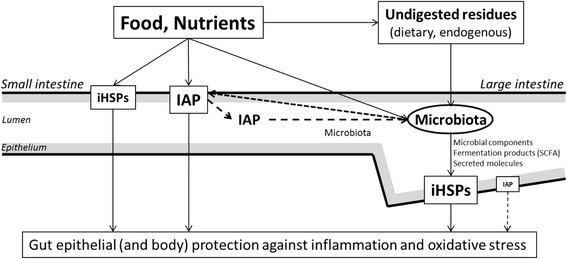
Growing evidence suggests the implication of the gut microbiota in various facets of health and disease. In this review, the focus is put on microbiota-host molecular cross-talk at the gut epithelial level with special emphasis on two defense systems: intestinal alkaline phosphatase (IAP) and inducible heat shock proteins (iHSPs). Both IAP and iHSPs are induced by various microbial structural components (e.g. lipopolysaccharide, flagellin, CpG DNA motifs), metabolites (e.g. n-butyrate) or secreted signal molecules (e.g., toxins, various peptides, polyphosphate). IAP is produced in the small intestine and secreted into the lumen and in the interior milieu. It detoxifies microbial components by dephosphorylation and, therefore, down-regulates microbe-induced inflammation mainly by inhibiting NF-κB pro-inflammatory pathway in enterocytes. IAP gene expression and enzyme activity are influenced by the gut microbiota. Conversely, IAP controls gut microbiota composition both directly, and indirectly though the detoxification of pro-inflammatory free luminal adenosine triphosphate and inflammation inhibition. Inducible HSPs are expressed by gut epithelial cells in proportion to the microbial load along the gastro-intestinal tract. They are also induced by various microbial components, metabolites and secreted molecules. Whether iHSPs contribute to shape the gut microbiota is presently unknown. Both systems display strong anti-inflammatory and anti-oxidant properties that are protective to the gut and the host. Importantly, epithelial gene expressions and protein concentrations of IAP and iHSPs can be stimulated by probiotics, prebiotics and a large variety of dietary components, including macronutrients (protein and amino acids, especially L-glutamine, fat, fiber), and specific minerals (e.g. calcium) and vitamins (e.g. vitamins K1 and K2). Some food components (e.g. lectins, soybean proteins, various polyphenols) may inhibit or disturb these systems. The general cellular and molecular mechanisms involved in the microbiota-host epithelial crosstalk and subsequent gut protection through IAP and iHSPs are reviewed along with their nutritional modulation. Special emphasis is also given to the pig, an economically important species and valuable biomedical model.
越来越多的证据表明肠道微生物群与健康和疾病的各个方面都存在关联。在本综述中,重点关注肠道上皮水平上微生物群与宿主的分子相互作用,特别强调两种防御系统:肠道碱性磷酸酶(IAP)和诱导型热休克蛋白(iHSPs)。IAP和iHSPs均由多种微生物结构成分(如脂多糖、鞭毛蛋白、CpG DNA基序)、代谢产物(如丁酸)或分泌的信号分子(如毒素、各种肽、多磷酸盐)诱导产生。IAP在小肠中产生并分泌到肠腔和内部环境中。它通过去磷酸化作用使微生物成分解毒,因此主要通过抑制肠细胞中的NF-κB促炎途径来下调微生物诱导的炎症。IAP基因表达和酶活性受肠道微生物群的影响。相反,IAP通过对促炎游离肠腔三磷酸腺苷的解毒和炎症抑制,直接或间接地控制肠道微生物群的组成。诱导型HSPs由肠道上皮细胞沿着胃肠道按微生物负荷比例表达。它们也由多种微生物成分、代谢产物和分泌分子诱导产生。目前尚不清楚iHSPs是否有助于塑造肠道微生物群。这两种系统都具有强大的抗炎和抗氧化特性,对肠道和宿主具有保护作用。重要的是,IAP和iHSPs的上皮基因表达和蛋白质浓度可受到益生菌、益生元以及多种饮食成分的刺激,这些饮食成分包括常量营养素(蛋白质和氨基酸,尤其是L-谷氨酰胺、脂肪、纤维),以及特定矿物质(如钙)和维生素(如维生素K1和K2)。一些食物成分(如凝集素、大豆蛋白、各种多酚)可能会抑制或干扰这些系统。本文综述了微生物群与宿主上皮细胞相互作用以及随后通过IAP和iHSPs实现肠道保护所涉及的一般细胞和分子机制,以及它们的营养调节作用。同时也特别强调了猪这一具有重要经济价值且有价值的生物医学模型。