Yamaguchi Ken, Nakazono Takahiko, Egashira Ryoko, Komori Yoshiaki, Nakamura Jun, Noguchi Tomoyuki, Irie Hiroyuki
Department of Radiology, Faculty of Medicine, Saga University.
Siemens Japan K.K. Research & Collaboration Department.
Magn Reson Med Sci. 2017 Jul 10;16(3):245-252. doi: 10.2463/mrms.mp.2016-0037. Epub 2016 Nov 16.
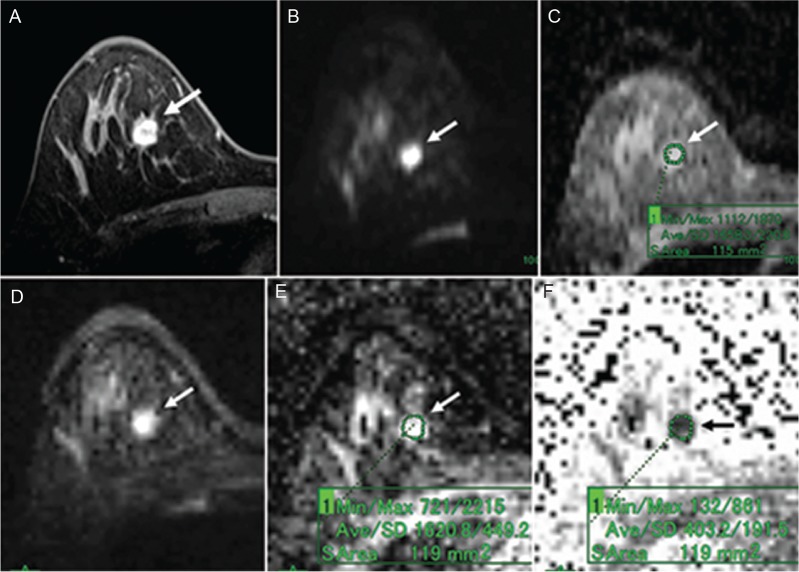
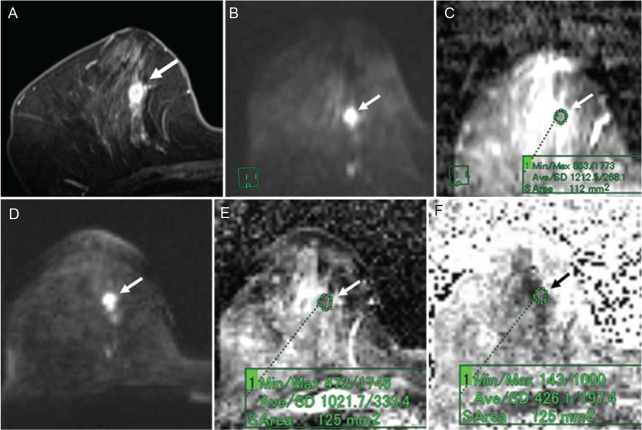
To assess the diagnostic performance of readout-segmented echo-planar diffusion tensor imaging (DTI based on rs-EPI) for breast cancer and to determine the correlation between the apparent diffusion coefficient (ADC) and fractional anisotropy (FA) values obtained from DTI based on rs-EPI with prognostic markers of invasive breast cancer.
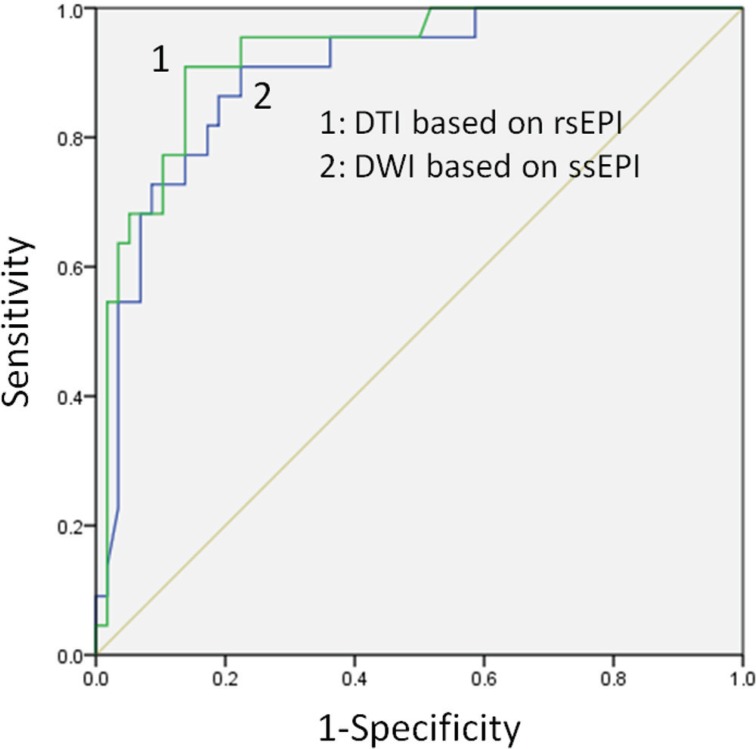
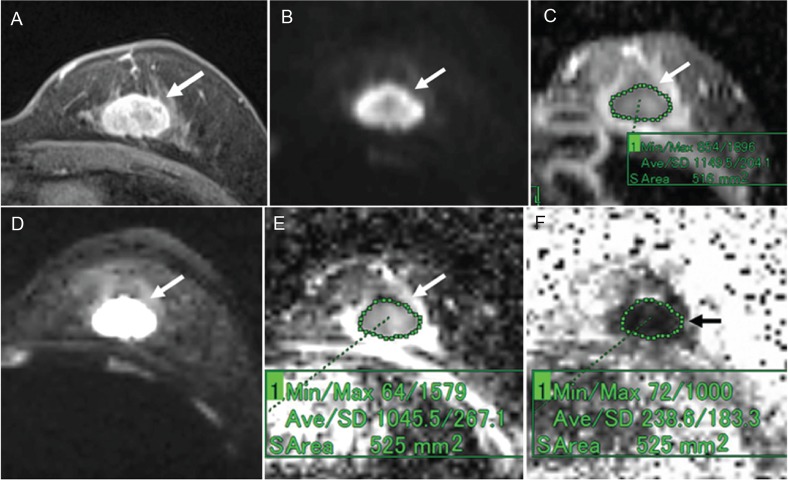
This retrospective study examined 80 pathologically proven breast lesions (22 benign and 58 malignant lesions) of 80 patients who underwent both diffusion-weighted imaging based on single-shot echo-planar imaging (DWI based on ss-EPI) and DTI based on rs-EPI with b-values of 0 and 1000. We identified and compared the diagnostic performances of the DWI based on ss-EPI and the DTI based on rs-EPI using ADCs by conducting a receiver-operating-characteristics (ROC) analysis. We determined the correlations between the ADCs and the prognostic markers and those of the FA values and the same markers.
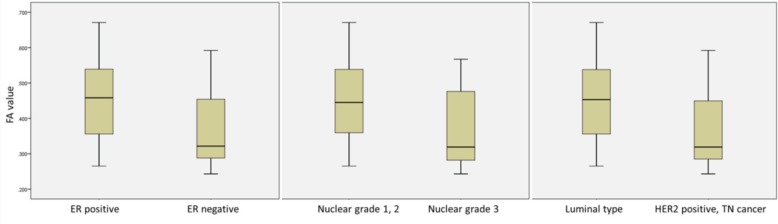
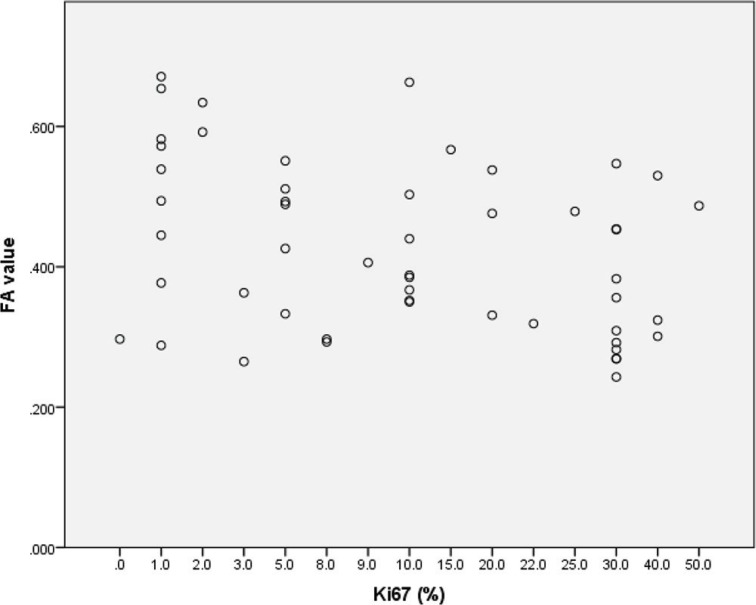
The median ADCs of the benign and malignant lesions based on the ss-EPI were 1.57 and 1.2 × 10 mm/sec, and those based on the rs-EPI were 1.53 and 1.09 × 10 mm/sec, respectively. The area under the curve on the ROC analysis based on rs-EPI (0.924) was greater than that based on ss-EPI (0.897). There were no significant correlations between the ADCs and the prognostic markers, but there were significant correlations between the FA values and the estrogen receptor status, a proliferative marker, the nuclear grade and the intrinsic subtype.
For breast cancer, DTI based on rs-EPI had superior diagnostic performance compared to DWI based on ss-EPI. Compared with the ADCs, the FA values were more closely correlated with prognostic markers of invasive breast cancer.
评估读出分段回波平面扩散张量成像(基于读出分割回波平面成像的扩散张量成像,rs-EPI-DTI)对乳腺癌的诊断性能,并确定基于rs-EPI-DTI获得的表观扩散系数(ADC)和分数各向异性(FA)值与浸润性乳腺癌预后标志物之间的相关性。
本回顾性研究检查了80例患者的80个经病理证实的乳腺病变(22个良性病变和58个恶性病变),这些患者均接受了基于单次激发回波平面成像的扩散加权成像(基于单次激发回波平面成像的扩散加权成像,ss-EPI-DWI)和b值为0和1000的基于rs-EPI的扩散张量成像(rs-EPI-DTI)。我们通过进行受试者操作特征(ROC)分析,使用ADC来识别和比较基于ss-EPI的扩散加权成像和基于rs-EPI的扩散张量成像的诊断性能。我们确定了ADC与预后标志物之间的相关性以及FA值与相同标志物之间的相关性。
基于ss-EPI的良性和恶性病变的ADC中位数分别为1.57和1.2×10⁻³mm²/sec,基于rs-EPI的分别为1.53和1.09×10⁻³mm²/sec。基于rs-EPI的ROC分析曲线下面积(0.924)大于基于ss-EPI的(0.897)。ADC与预后标志物之间无显著相关性,但FA值与雌激素受体状态、增殖标志物、核分级和内在亚型之间存在显著相关性。
对于乳腺癌,基于rs-EPI的扩散张量成像比基于ss-EPI的扩散加权成像具有更好的诊断性能。与ADC相比,FA值与浸润性乳腺癌的预后标志物相关性更强。