Department for Research in Learning and Education, Radboudumc Health Academy, Radboud University Medical Center, P.O. Box 9101, NL-6500 HB, Nijmegen (43), The Netherlands.
Adv Health Sci Educ Theory Pract. 2017 Oct;22(4):985-1009. doi: 10.1007/s10459-016-9737-y. Epub 2016 Nov 16.
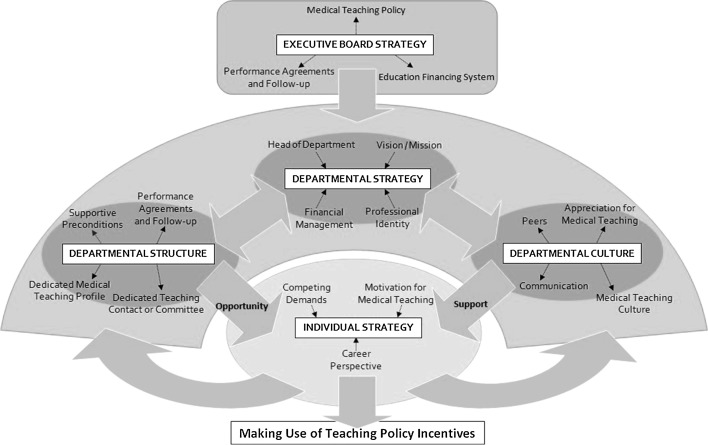
Within the unique and complex settings of university hospitals, it is difficult to implement policy initiatives aimed at developing careers in and improving the quality of academic medical teaching because of the competing domains of medical research and patient care. Factors that influence faculty in making use of teaching policy incentives have remained underexplored. Knowledge of these factors is needed to develop theory on the successful implementation of medical teaching policy in university hospitals. To explore factors that influence faculty in making use of teaching policy incentives and to develop a conceptual model for implementation of medical teaching policy in university hospitals. We used the grounded theory methodology. We applied constant comparative analysis to qualitative data obtained from 12 semi-structured interviews conducted at the Radboud University Medical Center. We used a constructivist approach, in which data and theories are co-created through interaction between the researcher and the field and its participants. We constructed a model for the implementation of medical teaching policy in university hospitals, including five factors that were perceived to promote or inhibit faculty in a university hospital to make use of teaching policy incentives: Executive Board Strategy, Departmental Strategy, Departmental Structure, Departmental Culture, and Individual Strategy. Most factors we found to affect individual teachers' strategies and their use of medical teaching policy lie at the departmental level. If an individual teacher's strategy is focused on medical teaching and a medical teaching career, and the departmental context offers support and opportunity for his/her development, this promotes faculty's use of teaching policy incentives.
在大学医院独特而复杂的环境中,由于医疗研究和患者护理领域的竞争,难以实施旨在发展学术医学职业和提高教学质量的政策举措。影响教师利用教学政策激励措施的因素仍未得到充分探索。需要了解这些因素,以便为大学医院医学教学政策的成功实施制定理论。探讨影响教师利用教学政策激励措施的因素,并为大学医院医学教学政策的实施制定概念模型。我们使用了扎根理论方法。我们对在拉德堡德大学医学中心进行的 12 次半结构化访谈中获得的定性数据应用了恒定比较分析。我们使用了一种建构主义方法,通过研究人员与现场及其参与者之间的互动,共同创造数据和理论。我们构建了一个大学医院医学教学政策实施模型,其中包括五个被认为可以促进或抑制大学医院教师利用教学政策激励措施的因素:执行委员会战略、部门战略、部门结构、部门文化和个人战略。我们发现,大多数影响个别教师策略及其对医学教学政策的利用的因素都在部门层面。如果教师个人的策略侧重于医学教学和医学教学职业,并且部门环境为其发展提供支持和机会,这将促进教师利用教学政策激励措施。