Richter Hanno, Molitor Bastian, Diender Martijn, Sousa Diana Z, Angenent Largus T
Department for Biological and Environmental Engineering, Cornell University Ithaca, NY, USA.
Laboratory of Microbiology, Wageningen University Wageningen, Netherlands.
Front Microbiol. 2016 Nov 8;7:1773. doi: 10.3389/fmicb.2016.01773. eCollection 2016.
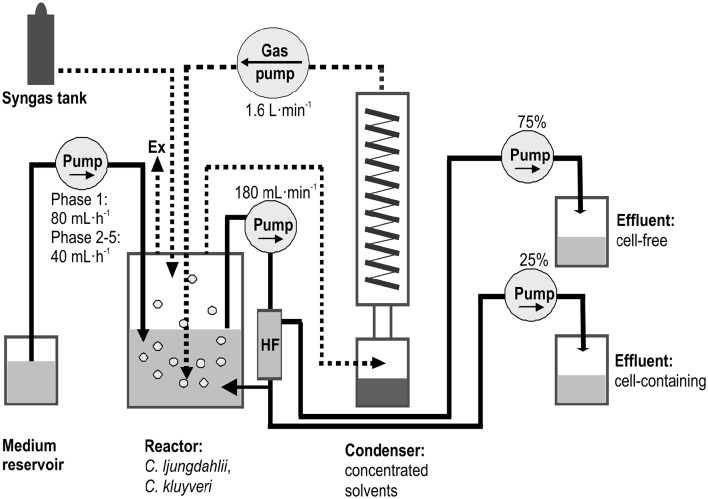
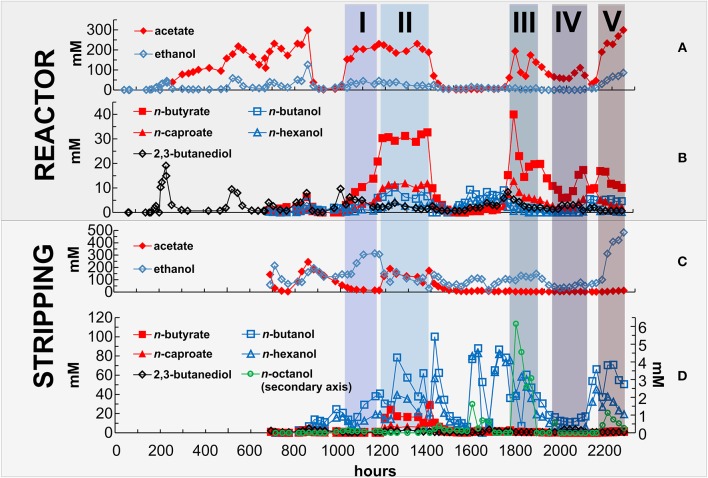
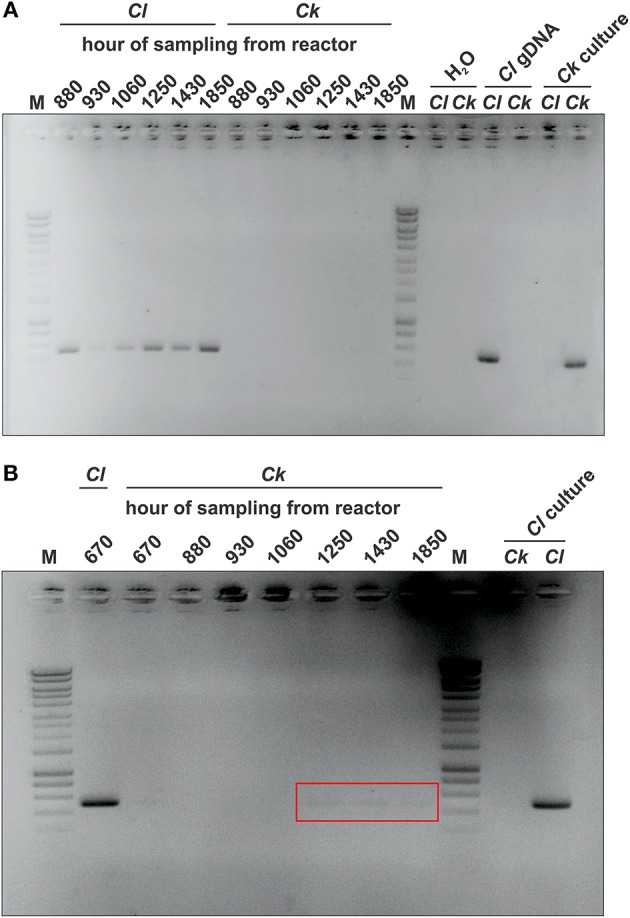
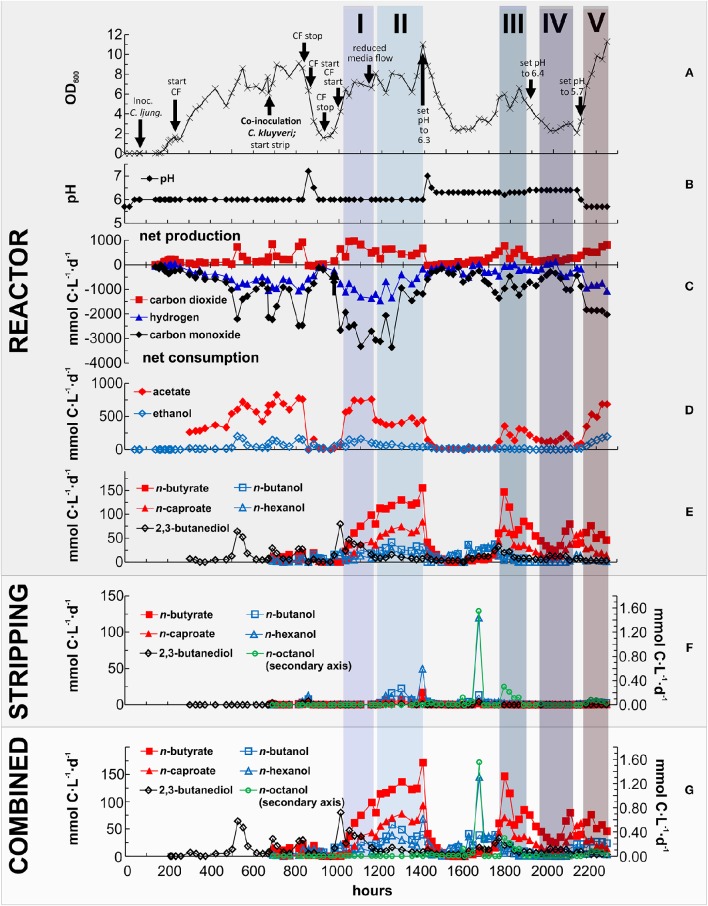
Carboxydotrophic bacteria (CTB) have received attention due to their ability to synthesize commodity chemicals from producer gas and synthesis gas (syngas). CTB have an important advantage of a high product selectivity compared to chemical catalysts. However, the product spectrum of wild-type CTB is narrow. Our objective was to investigate whether a strategy of combining two wild-type bacterial strains into a single, continuously fed bioprocessing step would be promising to broaden the product spectrum. Here, we have operated a syngas-fermentation process with and with in-line product extraction through gas stripping and product condensing within the syngas recirculation line. The main products from fermentation at a pH of 6.0 were ethanol and acetate at net volumetric production rates of 65.5 and 431 mmol C·L·d, respectively. An estimated 2/3 of total ethanol produced was utilized by to chain elongate with the reverse β-oxidation pathway, resulting in -butyrate and -caproate at net rates of 129 and 70 mmol C·L·d, respectively. likely reduced the produced carboxylates to their corresponding alcohols with the reductive power from syngas. This resulted in the longer-chain alcohols -butanol, -hexanol, and -octanol at net volumetric production rates of 39.2, 31.7, and 0.045 mmol C·L·d, respectively. The continuous production of the longer-chain alcohols occurred only within a narrow pH spectrum of 5.7-6.4 due to the pH discrepancy between the two strains. Regardless whether other wild-type strains could overcome this pH discrepancy, the specificity (mol carbon in product per mol carbon in all other liquid products) for each longer-chain alcohol may never be high in a single bioprocessing step. This, because two bioprocesses compete for intermediates (i.e., carboxylates): (1) chain elongation; and (2) biological reduction. This innate competition resulted in a mixture of -butanol and -hexanol with traces of -octanol.
羧营养型细菌(CTB)因其能够利用合成气和生产气合成商品化学品的能力而受到关注。与化学催化剂相比,CTB具有产品选择性高的重要优势。然而,野生型CTB的产品谱较窄。我们的目标是研究将两种野生型菌株组合到单一的连续进料生物处理步骤中的策略是否有望拓宽产品谱。在此,我们运行了一个合成气发酵过程,使用了[具体菌株名称1]和[具体菌株名称2],并通过气提和在合成气再循环管线内进行产品冷凝进行在线产品提取。在pH为6.0时,[具体菌株名称1]发酵的主要产物是乙醇和乙酸盐,净体积生产率分别为65.5和431 mmol C·L⁻¹·d⁻¹。估计所产生乙醇总量的2/3被[具体菌株名称2]利用,通过反向β-氧化途径进行链延长,分别产生丁酸和己酸,净速率分别为129和70 mmol C·L⁻¹·d⁻¹。[具体菌株名称2]可能利用合成气的还原力将产生的羧酸盐还原为相应的醇。这导致了长链醇丁醇、己醇和辛醇的产生,净体积生产率分别为39.2、31.7和0.045 mmol C·L⁻¹·d⁻¹。由于两种菌株之间的pH差异,长链醇的连续生产仅在5.7 - 6.4的狭窄pH范围内发生。无论其他野生型菌株是否能够克服这种pH差异,在单个生物处理步骤中,每种长链醇的特异性(产物中每摩尔碳与所有其他液体产物中每摩尔碳的比例)可能永远不会很高。这是因为两个生物过程竞争中间体(即羧酸盐):(1)链延长;以及(2)生物还原。这种内在竞争导致了丁醇和己醇的混合物以及微量的辛醇。