Benito-Vaquerizo Sara, Diender Martijn, Parera Olm Ivette, Martins Dos Santos Vitor A P, Schaap Peter J, Sousa Diana Z, Suarez-Diez Maria
Laboratory of Systems and Synthetic Biology, Wageningen University & Research, Stippeneng 4, 6708 WE Wageningen, The Netherlands.
Laboratory of Microbiology, Wageningen University & Research, Stippeneng 4, 6708 WE Wageningen, The Netherlands.
Comput Struct Biotechnol J. 2020 Oct 16;18:3255-3266. doi: 10.1016/j.csbj.2020.10.003. eCollection 2020.
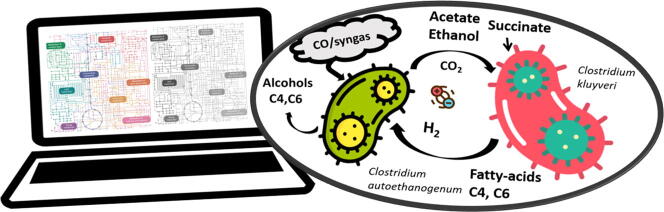
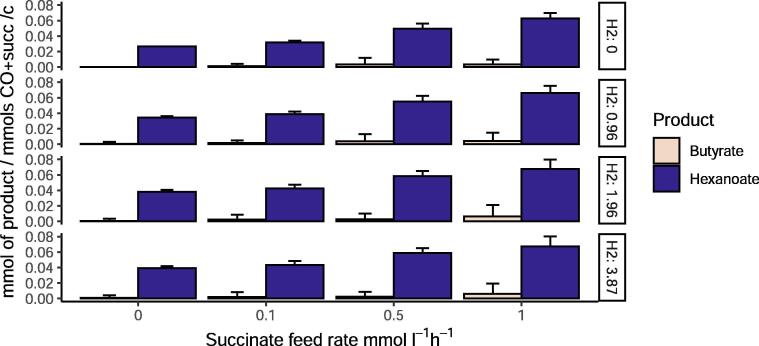
Microbial fermentation of synthesis gas (syngas) is becoming more attractive for sustainable production of commodity chemicals. To date, syngas fermentation focuses mainly on the use of species for the production of small organic molecules such as ethanol and acetate. The co-cultivation of syngas-fermenting microorganisms with chain-elongating bacteria can expand the range of possible products, allowing, for instance, the production of medium-chain fatty acids (MCFA) and alcohols from syngas. To explore these possibilities, we report herein a genome-scale, constraint-based metabolic model to describe growth of a co-culture of and on syngas for the production of valuable compounds. Community flux balance analysis was used to gain insight into the metabolism of the two strains and their interactions, and to reveal potential strategies enabling production of butyrate and hexanoate. The model suggests that one strategy to optimize the production of medium-chain fatty-acids from syngas would be the addition of succinate. According to the prediction, addition of succinate would increase the pool of crotonyl-CoA and the ethanol/acetate uptake ratio in , resulting in a flux of up to 60 of electrons into hexanoate. Another potential way to further optimize butyrate and hexanoate production would be an increase of ethanol production. Blocking either acetaldehyde dehydrogenase or formate dehydrogenase (ferredoxin) activity or formate transport, in the metabolic model could potentially lead to an up to 150 increase in ethanol production.
合成气的微生物发酵对于可持续生产商品化学品正变得越来越有吸引力。迄今为止,合成气发酵主要集中于利用某些物种来生产乙醇和乙酸盐等小分子有机化合物。将合成气发酵微生物与链延长细菌共培养可以扩大可能产物的范围,例如能够从合成气生产中链脂肪酸(MCFA)和醇类。为了探索这些可能性,我们在此报告一个基于约束的全基因组代谢模型,用于描述某菌株与另一菌株在合成气上共培养以生产有价值化合物的生长情况。利用群落通量平衡分析来深入了解这两种菌株的代谢及其相互作用,并揭示能够实现丁酸盐和己酸盐生产的潜在策略。该模型表明,从合成气优化生产中链脂肪酸的一种策略是添加琥珀酸盐。根据预测,添加琥珀酸盐会增加巴豆酰辅酶A池以及某菌株中乙醇/乙酸盐的摄取比例,从而导致高达60%的电子通量进入己酸盐。进一步优化丁酸盐和己酸盐生产的另一种潜在方法是增加某菌株的乙醇产量。在该菌株的代谢模型中,阻断乙醛脱氢酶或甲酸脱氢酶(铁氧化还原蛋白)活性或甲酸转运,可能会使乙醇产量最多提高150%。