Burns Ryan D, Brusseau Timothy A
Department of Health, Kinesiology, and Recreation, University of Utah, 250 S. 1850 E., HPER North, RM 241, Salt Lake City, UT 84112, USA.
Department of Health, Kinesiology, and Recreation, University of Utah, 250 S. 1850 E. Rm 200, Salt Lake City, UT 84112, USA.
Prev Med Rep. 2016 Nov 9;5:21-26. doi: 10.1016/j.pmedr.2016.11.004. eCollection 2017 Mar.
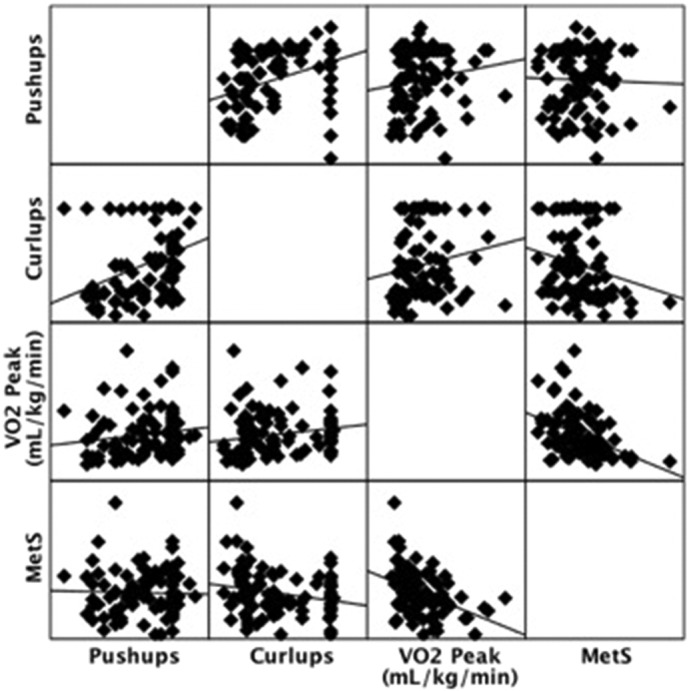
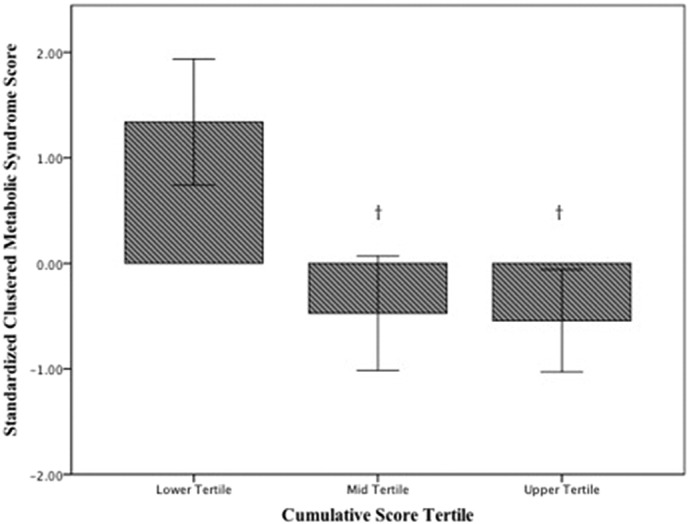
The predictive relationship between muscular strength and endurance and cardio-metabolic health, independent from aerobic fitness, is not clear in disadvantaged Hispanic children. The purpose of this study was to examine the predictive relationship between muscular strength and endurance and clustered cardio-metabolic risk, controlling for aerobic fitness, in Hispanic children from low-income schools. Participants were 320 Hispanic children (Mean age = 10.1 ± 1.1 years; 164 girls, 156 boys) recruited during the 2014-2015 and 2015-2016 academic years from five low-income schools from the state of Utah in the U.S. Muscular strength and endurance was assessed using the push-up and curl-up tests and estimated VO was calculated from the Progressive Aerobic Cardiovascular Endurance Run. A clustered metabolic syndrome composite score (MetS) was calculated from cardio-metabolic health measurements consisting of HDL cholesterol, triglycerides, waist circumference, blood glucose, and mean arterial pressure (MAP). Multi-level general linear mixed effects models were used to examine the predictive relationship between muscular strength and endurance and MetS, controlling for the effect of aerobic fitness and the clustering of children within classrooms and schools. Children who were in the middle and upper tertiles for muscular strength and endurance associated with a lower (more favorable) MetS score (middle tertile: β = - 2.59, 95% C.I. [- 4.23, - 0.95], < 0.05; upper tertile: β = - 1.57, 95% C.I. [- 3.20, - 0.16], < 0.05). The results suggest that higher levels of muscular strength and endurance relate to lower cardio-metabolic risk, independent of aerobic fitness, in Hispanic children from low-income schools.
在处境不利的西班牙裔儿童中,肌肉力量和耐力与心血管代谢健康之间的预测关系尚不清楚,且该关系独立于有氧适能。本研究的目的是在来自低收入学校的西班牙裔儿童中,检验肌肉力量和耐力与聚集性心血管代谢风险之间的预测关系,并对有氧适能进行控制。研究对象为2014 - 2015学年和2015 - 2016学年从美国犹他州五所低收入学校招募的320名西班牙裔儿童(平均年龄 = 10.1 ± 1.1岁;164名女孩,156名男孩)。使用俯卧撑和仰卧起坐测试评估肌肉力量和耐力,并通过渐进性有氧心血管耐力跑计算估计的VO。根据由高密度脂蛋白胆固醇、甘油三酯、腰围、血糖和平均动脉压(MAP)组成的心血管代谢健康测量值计算聚集性代谢综合征综合评分(MetS)。采用多水平一般线性混合效应模型来检验肌肉力量和耐力与MetS之间的预测关系,并控制有氧适能的影响以及儿童在教室和学校内的聚集情况。肌肉力量和耐力处于中等和上三分位数的儿童,其MetS评分较低(更有利)(中等三分位数:β = - 2.59,95%置信区间[- 4.23,- 0.95],P < 0.05;上三分位数:β = - 1.57,95%置信区间[- 3.20,- 0.16],P < 0.05)。结果表明,在来自低收入学校的西班牙裔儿童中,较高水平的肌肉力量和耐力与较低的心血管代谢风险相关,且独立于有氧适能。