Harvard T.H. Chan School of Public Health, Boston, Massachusetts.
Cambridge Health Alliance, Harvard Medical School, Cambridge, Massachusetts.
JAMA Netw Open. 2019 Feb 1;2(2):e188341. doi: 10.1001/jamanetworkopen.2018.8341.
Cardiovascular disease (CVD) remains the leading cause of mortality worldwide. Robust evidence indicates an association of increased physical fitness with a lower risk of CVD events and improved longevity; however, few have studied simple, low-cost measures of functional status.
To evaluate the association between push-up capacity and subsequent CVD event incidence in a cohort of active adult men.
DESIGN, SETTING, AND PARTICIPANTS: Retrospective longitudinal cohort study conducted between January 1, 2000, and December 31, 2010, in 1 outpatient clinics in Indiana of male firefighters aged 18 years or older. Baseline and periodic physical examinations, including tests of push-up capacity and exercise tolerance, were performed between February 2, 2000, and November 12, 2007. Participants were stratified into 5 groups based on number of push-ups completed and were followed up for 10 years. Final statistical analyses were completed on August 11, 2018.
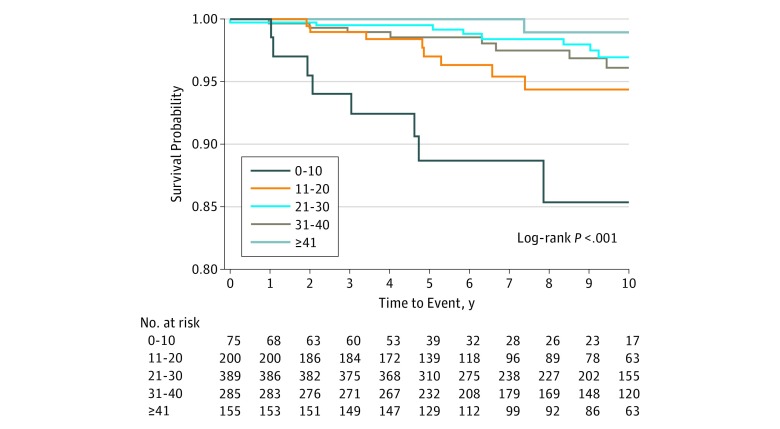
Cardiovascular disease-related outcomes through 2010 included incident diagnoses of coronary artery disease and other major CVD events. Incidence rate ratios (IRRs) were computed, and logistic regression models were used to model the time to each outcome from baseline, adjusting for age and body mass index (BMI) (calculated as weight in kilograms divided by height in meters squared). Kaplan-Meier estimates for cumulative risk were computed for the push-up categories.
A total of 1562 participants underwent baseline examination, and 1104 with available push-up data were included in the final analyses. Mean (SD) age of the cohort at baseline was 39.6 (9.2) years, and mean (SD) BMI was 28.7 (4.3). During the 10-year follow up, 37 CVD-related outcomes (8601 person-years) were reported in participants with available push-up data. Significant negative associations were found between increasing push-up capacity and CVD events. Participants able to complete more than 40 push-ups were associated with a significantly lower risk of incident CVD event risk compared with those completing fewer than 10 push-ups (IRR, 0.04; 95% CI, 0.01-0.36).
The findings suggest that higher baseline push-up capacity is associated with a lower incidence of CVD events. Although larger studies in more diverse cohorts are needed, push-up capacity may be a simple, no-cost measure to estimate functional status.
心血管疾病(CVD)仍然是全球主要的死亡原因。强有力的证据表明,身体活动能力的提高与 CVD 事件风险降低和寿命延长有关;然而,很少有研究关注简单、低成本的功能状态测量方法。
评估在一个活跃的成年男性队列中,俯卧撑能力与随后 CVD 事件发生率之间的关联。
设计、地点和参与者:这是一项回顾性纵向队列研究,于 2000 年 1 月 1 日至 2010 年 12 月 31 日在印第安纳州的一个门诊诊所进行,研究对象为年龄在 18 岁及以上的男性消防员。在 2000 年 2 月 2 日至 2007 年 11 月 12 日期间进行了基线和定期体检,包括俯卧撑能力和运动耐量测试。根据完成的俯卧撑次数将参与者分为 5 组,并随访 10 年。最终的统计分析于 2018 年 8 月 11 日完成。
截至 2010 年,与 CVD 相关的结局包括冠心病和其他主要 CVD 事件的诊断。计算了发病率比(IRR),并使用逻辑回归模型从基线开始对每种结局的时间进行建模,同时调整了年龄和体重指数(BMI)(体重以千克为单位,除以身高以米为单位)。为俯卧撑类别计算了累积风险的 Kaplan-Meier 估计值。
共有 1562 名参与者接受了基线检查,其中 1104 名参与者有可用的俯卧撑数据,纳入了最终分析。队列的平均(SD)年龄为 39.6(9.2)岁,平均(SD)BMI 为 28.7(4.3)。在 10 年的随访中,在有可用俯卧撑数据的参与者中报告了 37 例与 CVD 相关的结局(8601 人年)。研究发现,俯卧撑能力的增加与 CVD 事件呈显著负相关。与完成少于 10 个俯卧撑的参与者相比,能够完成 40 个以上俯卧撑的参与者发生 CVD 事件的风险显著降低(IRR,0.04;95%CI,0.01-0.36)。
研究结果表明,较高的基线俯卧撑能力与 CVD 事件发生率较低有关。尽管需要更大规模、更多样化的队列研究,但俯卧撑能力可能是一种简单、无成本的功能状态评估方法。