Zhan Jiaxin, Qin Shanshan, Lu Lili, Hu Xiamin, Zhou Jun, Sun Yeying, Yang Jian, Liu Ying, Wang Zunzhe, Tan Ning, Chen Jiyan, Zhang Chunxiang
Guangdong Key Laboratory of Coronary artery disease, Guangdong Cardiovascular Institute and Guangdong General Hospital, Guangzhou, 510100, China.
Department of Biomedical Engineering, School of Medicine, The University of Alabama at Birmingham, Birmingham, AL 35233, USA.
Aging (Albany NY). 2016 Nov 26;8(12):3298-3310. doi: 10.18632/aging.101118.
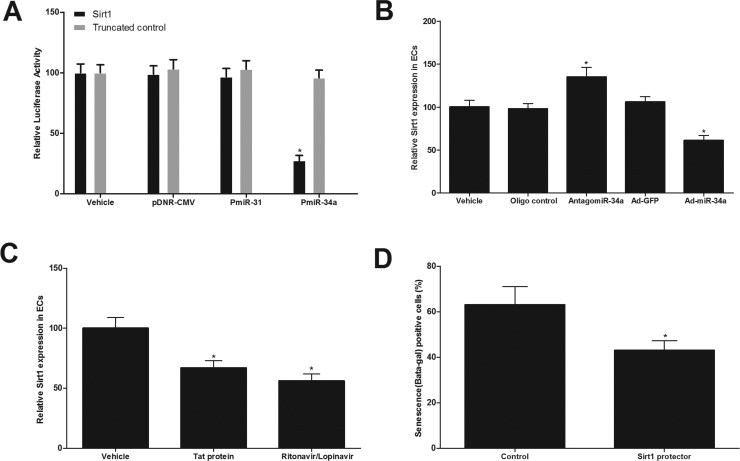
Both HIV and antiretroviral therapy could induce vascular aging with unclear mechanisms. In this study, via microarray analysis, we identified, for the first time, that miR-34a expression was significantly increased in both HIV-infected, and antiretroviral agents-treated vessels and vascular endothelial cells (ECs) from these vessels. In cultured ECs, miR-34a expression was significantly increased by HIV-Tat protein and by the antiretroviral agents, lopinavir/ritonavir. Both HIV-Tat protein and antiretroviral agents could induce EC senescence, which was inhibited by miR-34a inhibition. In contrast, EC senescence was exacerbated by miR-34a overexpression. In addition, the vascular ECs isolated from miR-34a knockout mice were resistant to HIV and antiretroviral agents-mediated senescence. In vivo, miR-34a expression in mouse vascular walls and their ECs was increased by antiretroviral therapy and by HIV-1 Tat transgenic approach. miR-34a inhibition could effectively inhibit both HIV-Tat protein and antiretroviral therapy-induced vascular aging in mice. The increased miR-34a was induced via p53, whereas Sirt1 was a downstream target gene of miR-34a in both HIV-Tat protein and antiretroviral agents-treated ECs and vessels. The study has demonstrated that miR-34a is a common link in both HIV and antiretroviral therapy-mediated vascular aging.
人类免疫缺陷病毒(HIV)和抗逆转录病毒疗法均可引发血管老化,但其机制尚不清楚。在本研究中,我们通过微阵列分析首次发现,在受HIV感染的血管以及接受抗逆转录病毒药物治疗的血管和这些血管的血管内皮细胞(ECs)中,miR-34a的表达均显著增加。在培养的ECs中,HIV-Tat蛋白和抗逆转录病毒药物洛匹那韦/利托那韦均可显著增加miR-34a的表达。HIV-Tat蛋白和抗逆转录病毒药物均可诱导EC衰老,而miR-34a抑制可抑制这种衰老。相反,miR-34a过表达会加剧EC衰老。此外,从miR-34a基因敲除小鼠分离出的血管ECs对HIV和抗逆转录病毒药物介导的衰老具有抗性。在体内,抗逆转录病毒疗法和HIV-1 Tat转基因方法均可增加小鼠血管壁及其ECs中miR-34a的表达。miR-34a抑制可有效抑制HIV-Tat蛋白和抗逆转录病毒疗法诱导的小鼠血管老化。miR-34a的增加是通过p53诱导的,而在HIV-Tat蛋白和抗逆转录病毒药物处理的ECs和血管中,Sirt1是miR-34a的下游靶基因。该研究表明,miR-34a是HIV和抗逆转录病毒疗法介导的血管老化的共同关联因素。