Maess Burkhard, Mamashli Fahimeh, Obleser Jonas, Helle Liisa, Friederici Angela D
MEG and Cortical Networks Group, Max Planck Institute for Human Cognitive and Brain Sciences Leipzig, Germany.
MEG and Cortical Networks Group, Max Planck Institute for Human Cognitive and Brain SciencesLeipzig, Germany; Department of Neuropsychology, Max Planck Institute for Human Cognitive and Brain SciencesLeipzig, Germany; Department of Neurology, Massachusetts General Hospital, Athinoula A. Martinos Center for Biomedical Imaging, Harvard Medical SchoolBoston, MA, USA.
Front Hum Neurosci. 2016 Nov 15;10:591. doi: 10.3389/fnhum.2016.00591. eCollection 2016.
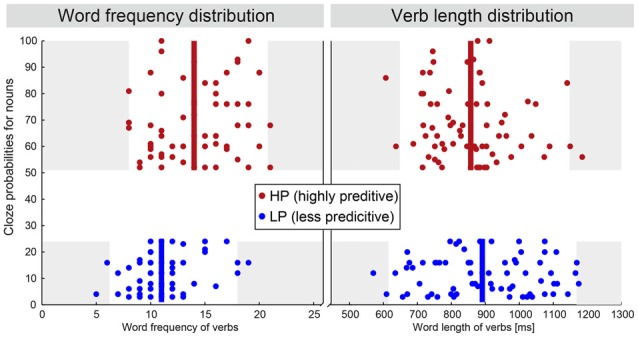
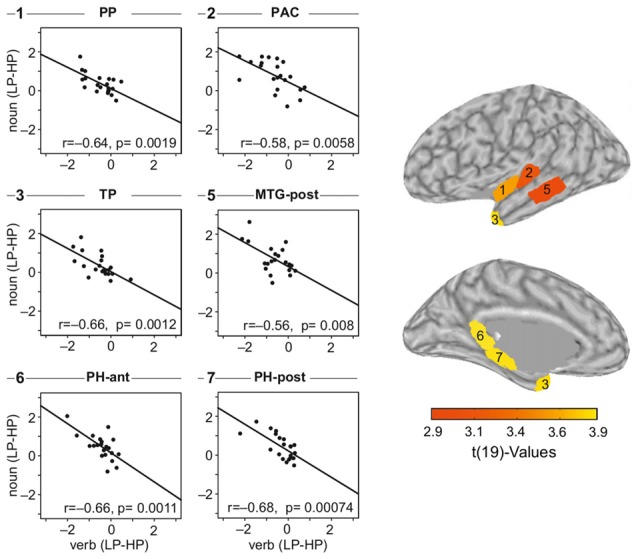
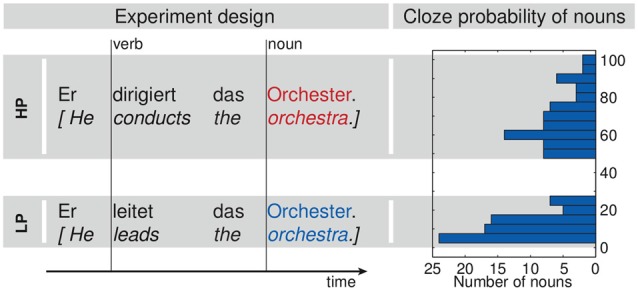
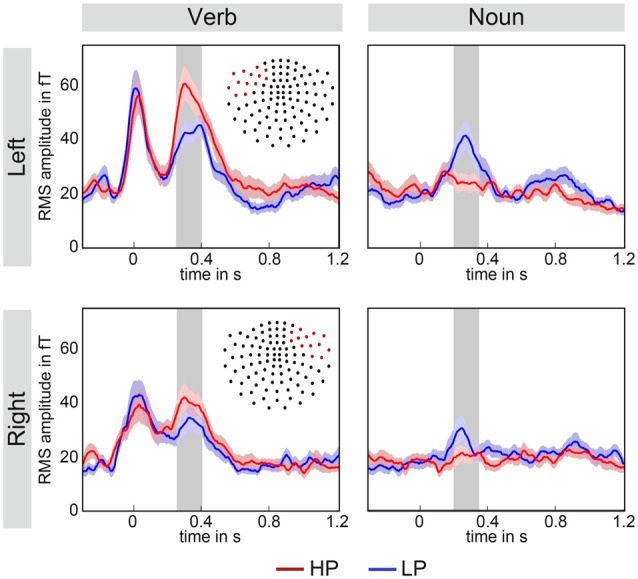
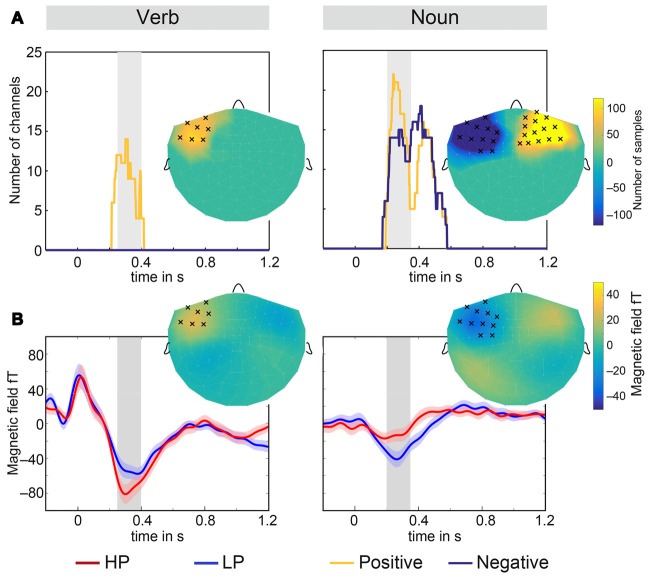
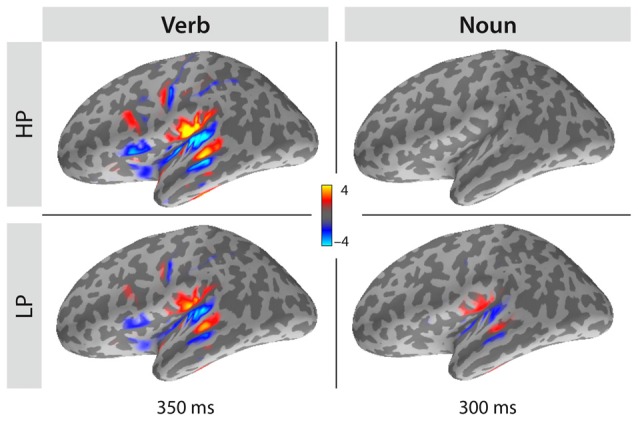
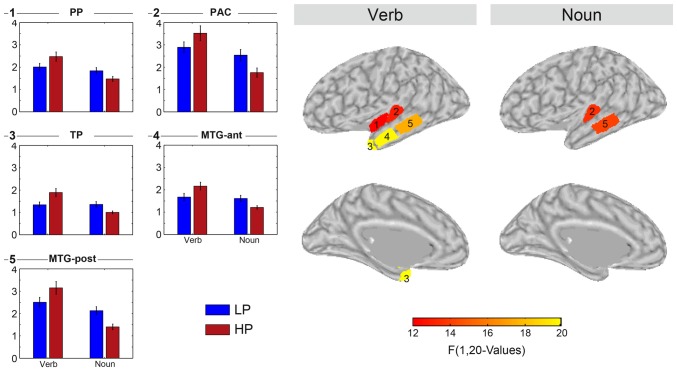
There is broad agreement that context-based predictions facilitate lexical-semantic processing. A robust index of semantic prediction during language comprehension is an evoked response, known as the N400, whose amplitude is modulated as a function of semantic context. However, the underlying neural mechanisms that utilize relations of the prior context and the embedded word within it are largely unknown. We measured magnetoencephalography (MEG) data while participants were listening to simple German sentences in which the verbs were either highly predictive for the occurrence of a particular noun (i.e., provided context) or not. The identical set of nouns was presented in both conditions. Hence, differences for the evoked responses of the nouns can only be due to differences in the earlier context. We observed a reduction of the N400 response for highly predicted nouns. Interestingly, the opposite pattern was observed for the preceding verbs: highly predictive (that is more informative) verbs yielded stronger neural magnitude compared to less predictive verbs. A negative correlation between the N400 effect of the verb and that of the noun was found in a distributed brain network, indicating an integral relation between the predictive power of the verb and the processing of the subsequent noun. This network consisted of left hemispheric superior and middle temporal areas and a subcortical area; the parahippocampus. Enhanced activity for highly predictive relative to less predictive verbs, likely reflects establishing semantic features associated with the expected nouns, that is a pre-activation of the expected nouns.
人们普遍认为,基于语境的预测有助于词汇语义处理。语言理解过程中语义预测的一个可靠指标是诱发反应,即N400,其振幅会根据语义语境进行调节。然而,利用先前语境与其中嵌入词之间关系的潜在神经机制在很大程度上尚不清楚。我们在参与者听简单德语句子时测量了脑磁图(MEG)数据,这些句子中的动词对特定名词的出现要么具有高度预测性(即提供语境),要么没有。在两种情况下都呈现了相同的一组名词。因此,名词诱发反应的差异只能归因于早期语境的差异。我们观察到,对于高度可预测的名词,N400反应有所降低。有趣的是,对于前面的动词,观察到了相反的模式:与预测性较低的动词相比,高度可预测(即信息更多)的动词产生了更强的神经信号强度。在一个分布式脑网络中发现动词的N400效应与名词的N400效应之间存在负相关,这表明动词的预测能力与后续名词的处理之间存在整体关系。这个网络由左半球的颞上回和颞中回区域以及一个皮质下区域——海马旁回组成。相对于预测性较低的动词,高度可预测动词的活动增强,这可能反映了与预期名词相关的语义特征的建立,即预期名词的预激活。