
用于液体测量的配方制备设备的准确性。
Accuracy of formula preparation equipment for liquid measurement.
作者信息
Evans Sharon, Ashmore Catherine, Daly Anne, MacDonald Anita
机构信息
Dietetic Department, Birmingham Children's Hospital, Steelhouse Lane, Birmingham, UK.
出版信息
Mol Genet Metab Rep. 2014 Apr 2;1:141-147. doi: 10.1016/j.ymgmr.2014.02.004. eCollection 2014.
BACKGROUND
Modular specialist feeds may consist of a number of individual liquid ingredients. Accurate feed preparation is dependent on competent liquid measurement. We investigate the accuracy of two measuring jugs (one retail mix-and-measure; and one produced to laboratory standards); and the influence of volume and technique on accuracy.
MATERIALS AND METHODS
20 health professionals aged 18-60 y (mean: 46 y) measured 3 different volumes of water with each of two measuring jugs. For each volume with each jug, 2 measurements in randomised order were made: 1) eye-level with the jug, and 2) standing upright (total of 12 measurements). Measured quantities were weighed and the difference between measured and target volumes calculated.
RESULTS
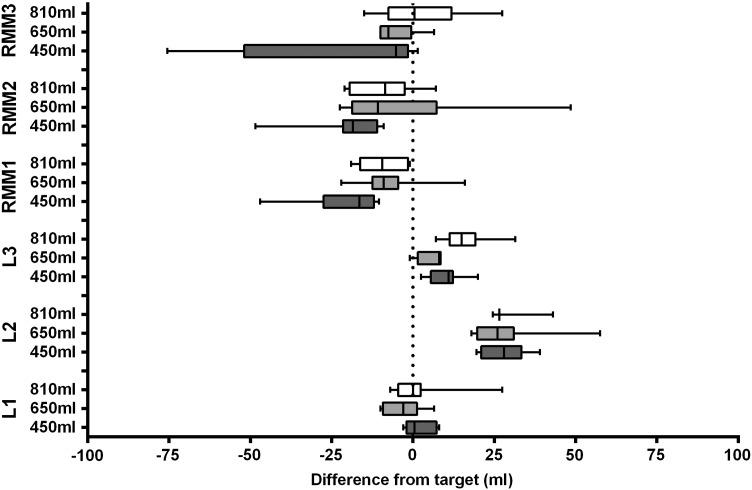
The laboratory jug was more accurate (mean difference 9.3 ml, range - 30.5 to 57.5 ml, std error mean 1.59) than the retail jug (mean difference - 17.7 ml, range - 92.0 to 48.5 ml, std error mean 1.59). Accuracy improved with increased volume (450 ml: mean difference - 9.4 ml, range - 75.5 to 49.5 ml, std error mean 1.95; and 810 ml: mean difference - 0.7 ml; range - 92.0 to 43.0 ml, std error mean 1.95).
CONCLUSIONS
Accurate measurement of liquid ingredients is difficult to achieve even for trained professionals. The cumulative effect of many different liquid measurement errors (inappropriate jug type, inaccurate volume measured and poor technique) may lead to clinically important errors in the preparation of modular specialist feeds.
背景
模块化专用配方食品可能由多种单独的液体成分组成。精确配制食品依赖于准确的液体测量。我们研究了两种量杯(一种为零售用的混合测量量杯;另一种为符合实验室标准的量杯)的准确性;以及体积和测量方法对准确性的影响。
材料与方法
20名年龄在18至60岁(平均46岁)的健康专业人员使用两种量杯分别测量3种不同体积的水。对于每种量杯的每种体积,按随机顺序进行2次测量:1)与量杯平视;2)直立状态(共12次测量)。对测量的量进行称重,并计算测量值与目标体积之间的差值。
结果
实验室量杯比零售量杯更准确(平均差值9.3毫升,范围为-30.5至57.5毫升,标准误均值1.59),零售量杯的平均差值为-17.7毫升,范围为-92.0至48.5毫升,标准误均值1.59。随着体积增加,准确性提高(450毫升:平均差值-9.4毫升,范围为-75.5至49.5毫升,标准误均值1.95;810毫升:平均差值-0.7毫升,范围为-92.0至43.0毫升,标准误均值1.95)。
结论
即使对于训练有素的专业人员,精确测量液体成分也很难做到。许多不同液体测量误差(量杯类型不当、测量体积不准确和测量方法不佳)的累积效应可能会导致模块化专用配方食品配制过程中出现具有临床重要性的误差。


 Zotero 插件