McAlearney Ann Scheck, Sieck Cynthia J, Hefner Jennifer L, Aldrich Alison M, Walker Daniel M, Rizer Milisa K, Moffatt-Bruce Susan D, Huerta Timothy R
Research Division, Department of Family Medicine, The Ohio State University, Columbus, OH, United States.
Information Technology, Wexner Medical Center, Ohio State University, Columbus, OH, United States.
JMIR Res Protoc. 2016 Nov 29;5(4):e221. doi: 10.2196/resprot.6355.
For patients with complex care needs, engagement in disease management activities is critical. Chronic illnesses touch almost every person in the United States. The costs are real, personal, and pervasive. In response, patients often seek tools to help them manage their health. Patient portals, personal health records tethered to an electronic health record, show promise as tools that patients value and that can improve health. Although patient portals currently focus on the outpatient experience, the Ohio State University Wexner Medical Center (OSUWMC) has deployed a portal designed specifically for the inpatient experience that is connected to the ambulatory patient portal available after discharge. While this inpatient technology is in active use at only one other hospital in the United States, health care facilities are currently investing in infrastructure necessary to support large-scale deployment. Times of acute crisis such as hospitalization may increase a patient's focus on his/her health. During this time, patients may be more engaged with their care and especially interested in using tools to manage their health after discharge. Evidence shows that enhanced patient self-management can lead to better control of chronic illness. Patient portals may serve as a mechanism to facilitate increased engagement.
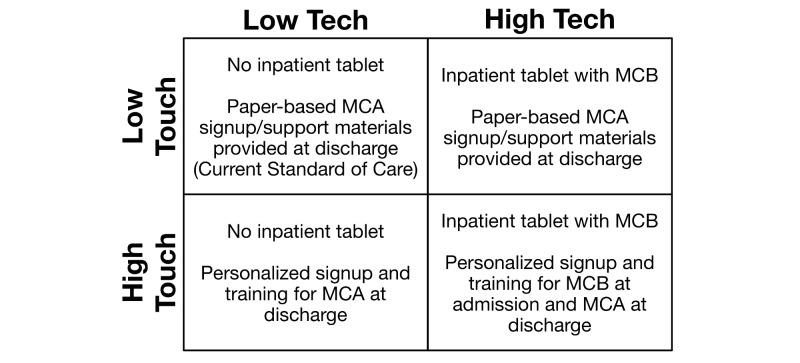
The specific aims of our study are (1) to investigate the independent effects of providing both High Tech and High Touch interventions on patient-reported outcomes at discharge, including patients' self-efficacy for managing chronic conditions and satisfaction with care; and (2) to conduct a mixed-methods analysis to determine how providing patients with access to MyChart Bedside (MCB, High Tech) and training/education on patient portals, and MyChart Ambulatory (MCA, High Touch) will influence engagement with the patient portal and relate to longer-term outcomes.
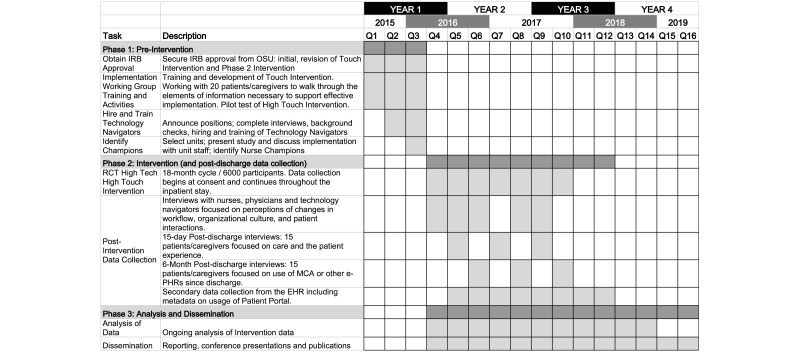
Our proposed 4-year study uses a mixed-methods research (MMR) approach to evaluate a randomized controlled trial studying the effectiveness of a High Tech intervention (MCB, the inpatient portal), and an accompanying High Touch intervention (training patients to use the portal to manage their care and conditions) in a sample of hospitalized patients with two or more chronic conditions. This study measures how access to a patient portal tailored to the inpatient stay can improve patient experience and increase patient engagement by (1) improving patients' perceptions of the process of care while in the hospital; (2) increasing patients' self-efficacy for managing chronic conditions; and (3) facilitating continued use of a patient portal for care management after discharge. In addition, we aim to enhance patients' use of the portal available to outpatients (MCA) once they are discharged.
This study has been funded by the Agency for Healthcare Research and Quality (AHRQ). Research is ongoing and expected to conclude in August 2019.
Providing patients real-time access to health information can be a positive force for change in the way care is provided. Meaningful use policies require minimum demonstrated use of patient portal technology, most often in the ambulatory setting. However, as the technology matures to bridge the care transition, there is a greater need to understand how patient portals transform care delivery. By working in concert with patients to address and extend current technologies, our study aims to advance efforts to increase patients' engagement in their care and develop a template for how other hospitals might integrate similar technologies.
对于有复杂护理需求的患者而言,参与疾病管理活动至关重要。慢性病几乎影响到美国的每一个人。其成本真实、涉及个人且普遍存在。作为回应,患者常常寻求工具来帮助他们管理自身健康。患者门户网站,即与电子健康记录相连的个人健康记录,有望成为患者重视且能改善健康状况的工具。尽管目前患者门户网站主要关注门诊体验,但俄亥俄州立大学韦克斯纳医学中心(OSUWMC)已部署了专门针对住院体验设计的门户网站,该网站与出院后可用的门诊患者门户网站相连。虽然这种住院技术目前仅在美国的另一家医院投入使用,但医疗保健机构目前正在投资支持大规模部署所需的基础设施。诸如住院等急性危机时期可能会增强患者对自身健康的关注。在此期间,患者可能会更积极地参与护理,尤其有兴趣在出院后使用工具来管理自身健康。有证据表明,增强患者自我管理能力可更好地控制慢性病。患者门户网站可能是促进参与度提高的一种机制。
我们研究的具体目标是:(1)调查提供高科技和高接触干预措施对出院时患者报告的结果的独立影响,包括患者管理慢性病的自我效能感和护理满意度;(2)进行混合方法分析,以确定为患者提供访问MyChart床边版(MCB,高科技)以及关于患者门户网站的培训/教育,以及MyChart门诊版(MCA,高接触)将如何影响对患者门户网站的参与度,并与长期结果相关联。
我们提议的为期4年的研究采用混合方法研究(MMR)方法,以评估一项随机对照试验,该试验研究高科技干预措施(MCB,住院患者门户网站)以及配套的高接触干预措施(培训患者使用门户网站管理其护理和病情)在患有两种或更多种慢性病的住院患者样本中的有效性。本研究通过以下方式衡量访问为住院期间量身定制的患者门户网站如何改善患者体验并提高患者参与度:(1)改善患者对住院期间护理过程的认知;(2)增强患者管理慢性病的自我效能感;(3)促进出院后继续使用患者门户网站进行护理管理。此外,我们旨在提高患者出院后对门诊患者可用的门户网站(MCA)的使用。
本研究已获得医疗保健研究与质量局(AHRQ)的资助。研究正在进行中,预计于2019年8月结束。
为患者提供实时健康信息可能成为改变护理提供方式的积极力量。有意义使用政策要求至少证明使用患者门户网站技术,且大多是在门诊环境中。然而,随着技术成熟以弥合护理过渡,更需要了解患者门户网站如何改变护理提供方式。通过与患者协同工作以应对并扩展现有技术,我们的研究旨在推进提高患者护理参与度的努力,并为其他医院整合类似技术制定模板。