Yu Lihui, Lu Ying, Han Xiaocui, Zhao Wenyue, Li Jiazhi, Mao Jun, Wang Bo, Shen Jie, Fan Shujun, Wang Lu, Wang Mei, Li Lianhong, Tang Jianwu, Song Bo
Department of Pathology, Dalian Medical University, Dalian, 116044, People's Republic of China.
Teaching Laboratory of Morphology, Dalian Medical University, No. 9 West Section, Lvshun South Road, Dalian, 116044, People's Republic of China.
Stem Cell Res Ther. 2016 Dec 1;7(1):180. doi: 10.1186/s13287-016-0438-5.
Colorectal cancer (CRC) is one of the most common malignancies in the world. microRNA-140-5p (miR-140) has been shown to be involved in cartilage development and osteoarthritis (OA) pathogenesis. Some contradictions still exist concerning the role of miR-140 in tumor progression and metastasis, and the underlying mechanism is uncertain.
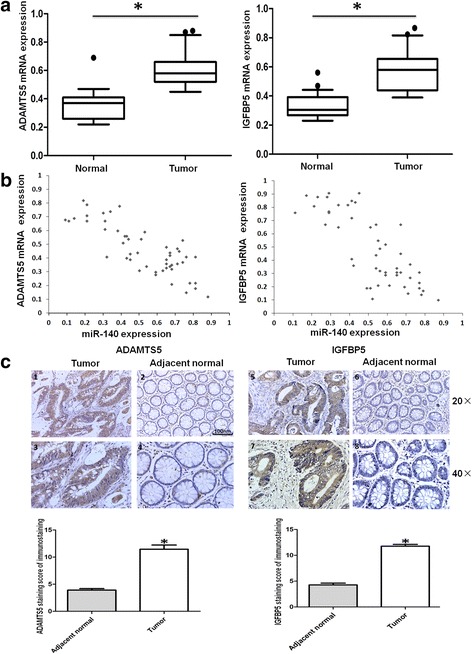
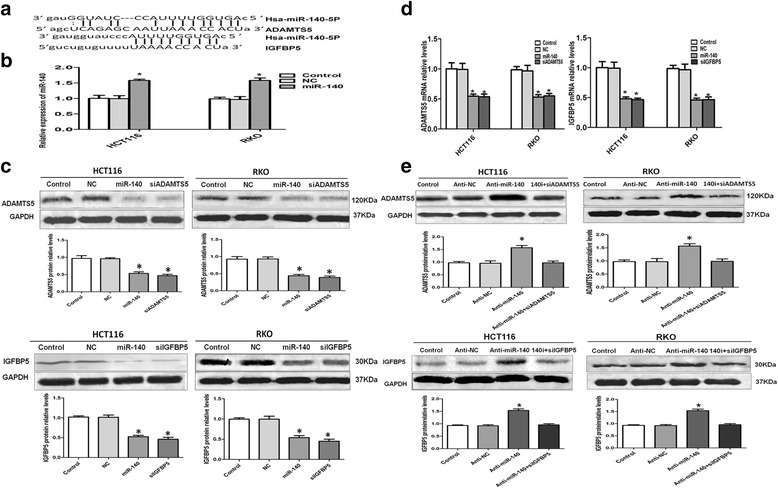
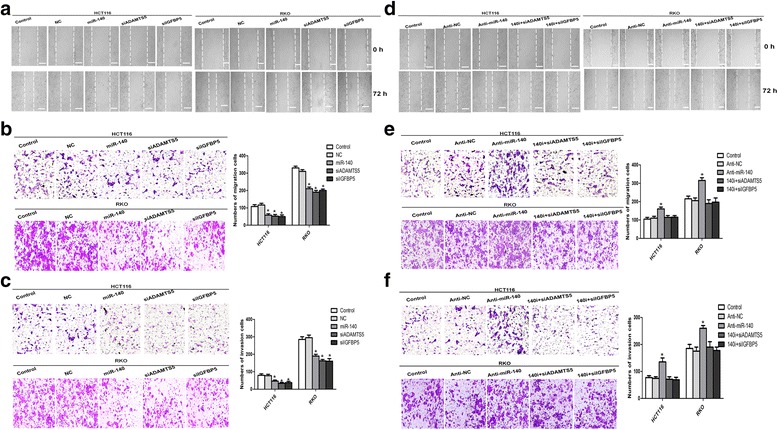
Immunohistochemistry was performed to determine the expressions of ADAMTS5 and IGFBP5 in CRC tissues. Human CRC cell lines HCT116 and RKO were transfected with miR-140 mimic, inhibitor, or small interfering RNA (siRNA) against ADAMTS5 or IGFBP5, respectively, using oligofectamine or lipofectamine 2000. Scratch-wound assay and transwell migration and invasion assays were used to evaluate the effects of miR-140 on the capabilities of migration and invasion. The levels of miR-140 and ADAMTS5 and IGFBP5 mRNA were measured by quantitative real-time polymerase chain reaction (qRT-PCR). Western blot was performed to examine the expression of ADAMTS5 and IGFBP5 proteins.
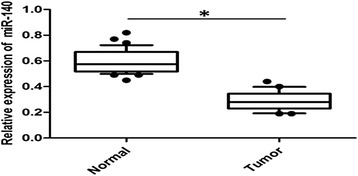
miR-140 was significantly reduced, whereas ADAMTS5 and IGFBP5 were upregulated, in the human CRC tissues compared to the corresponding normal colorectal mucosa. miR-140 downregulation and ADAMTS5 or IGFBP5 overexpression were associated with the advanced TNM stage and distant metastasis of CRC. There was a reverse correlation between miR-140 levels and ADAMTS5 and IGFBP5 expression in CRC tissues. ADAMTS5 and IGFBP5 were downregulated by miR-140 at both the protein and mRNA levels in the CRC cell lines. The gain-of- and loss-of-function studies showed that miR-140 inhibited CRC cell migratory and invasive capacities at least partially via downregulating the expression of ADAMTS5 and IGFBP5.
These findings suggest that miR-140 suppresses CRC progression and metastasis, possibly through downregulating ADAMTS5 and IGFBP5. miR-140 might be a potential therapeutic candidate for the treatment of CRC.
结直肠癌(CRC)是世界上最常见的恶性肿瘤之一。微小RNA-140-5p(miR-140)已被证明参与软骨发育和骨关节炎(OA)发病机制。关于miR-140在肿瘤进展和转移中的作用仍存在一些矛盾,其潜在机制尚不清楚。
采用免疫组织化学法检测结直肠癌组织中ADAMTS5和IGFBP5的表达。分别使用寡聚转染胺或脂质体2000将miR-140模拟物、抑制剂或针对ADAMTS5或IGFBP5的小干扰RNA(siRNA)转染人结直肠癌细胞系HCT116和RKO。采用划痕试验、Transwell迁移和侵袭试验评估miR-140对迁移和侵袭能力的影响。通过定量实时聚合酶链反应(qRT-PCR)检测miR-140、ADAMTS5和IGFBP5 mRNA的水平。进行蛋白质印迹法检测ADAMTS5和IGFBP5蛋白的表达。
与相应的正常结直肠黏膜相比,人结直肠癌组织中miR-140显著降低,而ADAMTS5和IGFBP5上调。miR-140下调以及ADAMTS5或IGFBP5过表达与结直肠癌的晚期TNM分期和远处转移相关。结直肠癌组织中miR-140水平与ADAMTS5和IGFBP5表达呈负相关。在结直肠癌细胞系中,miR-140在蛋白质和mRNA水平均下调ADAMTS5和IGFBP5。功能获得和功能缺失研究表明,miR-140至少部分通过下调ADAMTS5和IGFBP5的表达来抑制结直肠癌细胞的迁移和侵袭能力。
这些发现表明,miR-140可能通过下调ADAMTS5和IGFBP5来抑制结直肠癌的进展和转移。miR-140可能是治疗结直肠癌的潜在候选药物。