Rivera Andrew, Nan Hongmei, Li Tricia, Qureshi Abrar, Cho Eunyoung
Harvard Medical School, Boston, Massachusetts.
Department of Epidemiology, Richard M. Fairbanks School of Public Health, Indiana University, Indianapolis, Indiana.
Cancer Epidemiol Biomarkers Prev. 2016 Dec;25(12):1550-1558. doi: 10.1158/1055-9965.EPI-16-0303.
Alcohol consumption is associated with increased risk of numerous cancers, but existing evidence for an association with melanoma is equivocal. No study has evaluated the association with different anatomic locations of melanoma.
We used data from three large prospective cohort studies to investigate whether alcohol intake was associated with risk of melanoma. Alcohol intake was assessed repeatedly by food-frequency questionnaires. A Cox proportional hazards model was used to calculate multivariate-adjusted hazard ratios (HRs).
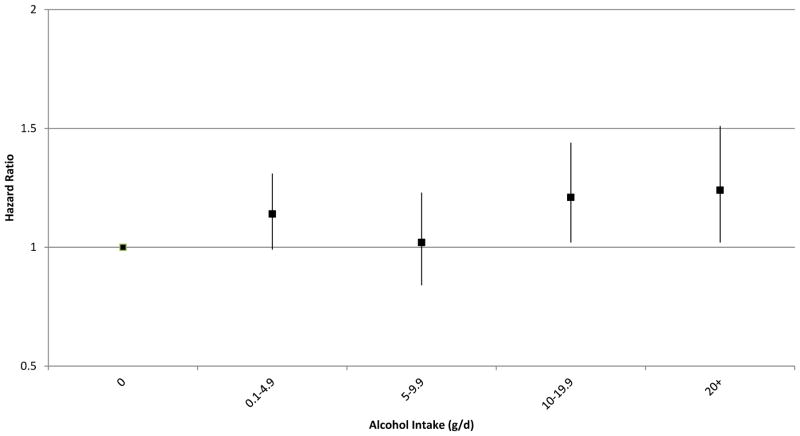
A total of 1,374 cases of invasive melanoma were documented during 3,855,706 person-years of follow-up. There was an association between higher alcohol intake and incidence of invasive melanoma (pooled multivariate HR 1.14 [95% confidence interval (CI), 1.00-1.29] per drink/day; P = 0.04). Among alcoholic beverages, white wine consumption was associated with an increased risk of melanoma (pooled multivariate HR 1.13 [95% CI, 1.04-1.24] per drink/day; P <0.01) after adjusting for other alcoholic beverages. The association between alcohol consumption and melanoma risk was stronger for melanoma in relatively UV-spared sites (trunk) versus more UV-exposed sites (head, neck, or extremities). Compared with nondrinkers, the pooled multivariate-adjusted HRs for ≥20 g/day of alcohol were 1.02 (95% CI, 0.64-1.62; P = 0.25) for melanomas of the head, neck, and extremities and 1.73 (95% CI, 1.25-2.38; P = 0.02) for melanomas of the trunk.
Alcohol intake was associated with a modest increase in the risk of melanoma, particularly in UV-protected sites.
These findings further support American Cancer Society Guidelines for Cancer Prevention to limit alcohol intake. Cancer Epidemiol Biomarkers Prev; 25(12); 1550-8. ©2016 AACR.
饮酒与多种癌症风险增加相关,但现有证据表明饮酒与黑色素瘤的关联并不明确。尚无研究评估饮酒与黑色素瘤不同解剖部位的关联。
我们使用来自三项大型前瞻性队列研究的数据,以调查饮酒是否与黑色素瘤风险相关。通过食物频率问卷多次评估饮酒量。采用Cox比例风险模型计算多变量调整风险比(HR)。
在3855706人年的随访期间,共记录了1374例侵袭性黑色素瘤病例。饮酒量增加与侵袭性黑色素瘤发病率之间存在关联(每增加一杯/天,合并多变量HR为1.14 [95%置信区间(CI),1.00 - 1.29];P = 0.04)。在调整其他酒精饮料后,饮用白葡萄酒与黑色素瘤风险增加相关(每增加一杯/天,合并多变量HR为1.13 [95% CI,1.04 - 1.24];P <0.01)。与紫外线暴露较多的部位(头部、颈部或四肢)相比,饮酒与黑色素瘤风险的关联在紫外线暴露相对较少的部位(躯干)更强。与不饮酒者相比,对于头部、颈部和四肢的黑色素瘤,每天饮酒≥20克的合并多变量调整HR为1.02(95% CI,0.64 - 1.62;P = 0.25),而对于躯干的黑色素瘤,该HR为1.73(95% CI,1.25 - 2.38;P = 0.02)。
饮酒与黑色素瘤风险适度增加相关,尤其是在紫外线防护部位。
这些发现进一步支持了美国癌症协会癌症预防指南中限制饮酒的建议。癌症流行病学、生物标志物与预防;25(12);1550 - 8。©2016美国癌症研究协会。