Hirai-Yuki Asuka, Hensley Lucinda, Whitmire Jason K, Lemon Stanley M
Lineberger Comprehensive Cancer Center, the University of North Carolina at Chapel Hill, Chapel Hill, North Carolina, USA.
Department of Microbiology & Immunology, the University of North Carolina at Chapel Hill, Chapel Hill, North Carolina, USA.
mBio. 2016 Dec 6;7(6):e01998-16. doi: 10.1128/mBio.01998-16.
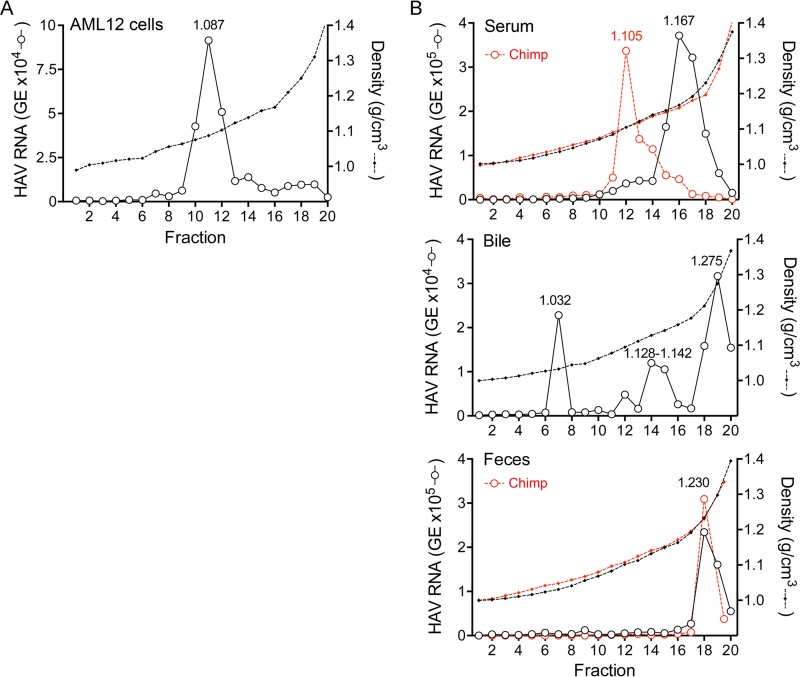
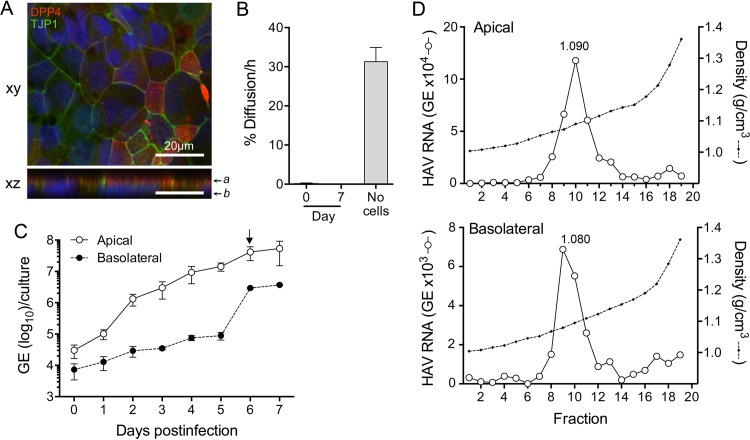
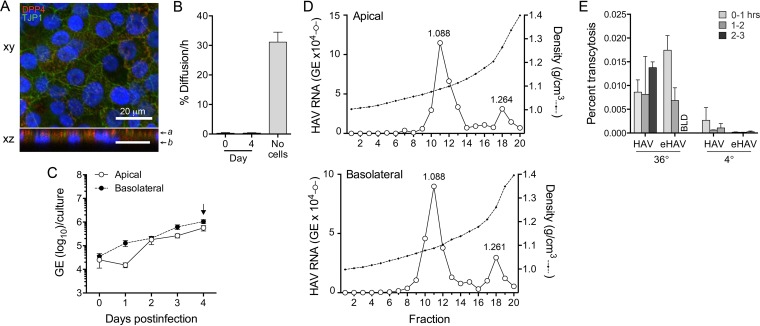
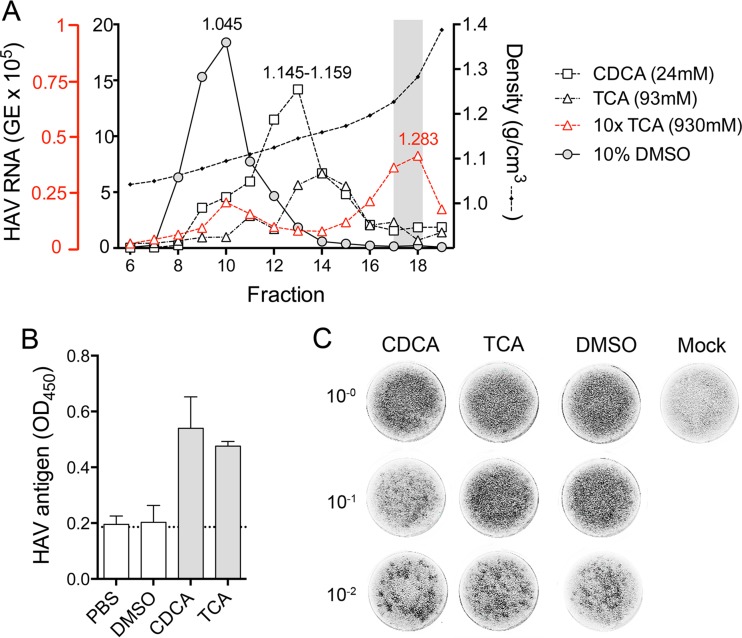
Hepatitis A virus (HAV) is an unusual picornavirus that is released from cells cloaked in host-derived membranes. These quasi-enveloped virions (eHAV) are the only particle type circulating in blood during infection, whereas only nonenveloped virions are shed in feces. The reason for this is uncertain. Hepatocytes, the only cell type known to support HAV replication in vivo, are highly polarized epithelial cells with basolateral membranes facing onto hepatic (blood) sinusoids and apical membranes abutting biliary canaliculi from which bile is secreted to the gut. To assess whether eHAV and nonenveloped virus egress from cells via vectorially distinct pathways, we studied infected polarized cultures of Caco-2 and HepG2-N6 cells. Most (>99%) progeny virions were released apically from Caco-2 cells, whereas basolateral (64%) versus apical (36%) release was more balanced with HepG2-N6 cells. Both apically and basolaterally released virions were predominantly enveloped, with no suggestion of differential vectorial release of eHAV versus naked virions. Basolateral to apical transcytosis of either particle type was minimal (<0.02%/h) in HepG2-N6 cells, arguing against this as a mechanism for differences in membrane envelopment of serum versus fecal virus. High concentrations of human bile acids converted eHAV to nonenveloped virions, whereas virus present in bile from HAV-infected Ifnar1 Ifngr1 and Mavs mice banded over a range of densities extending from that of eHAV to that of nonenveloped virions. We conclude that nonenveloped virions shed in feces are derived from eHAV released across the canalicular membrane and stripped of membranes by the detergent action of bile acids within the proximal biliary canaliculus.
HAV is a hepatotropic, fecally/orally transmitted picornavirus that can cause severe hepatitis in humans. Recent work reveals that it has an unusual life cycle. Virus is found in cell culture supernatant fluids in two mature, infectious forms: one wrapped in membranes (quasi-enveloped) and another that is nonenveloped. Membrane-wrapped virions circulate in blood during acute infection and are resistant to neutralizing antibodies, likely facilitating HAV dissemination within the liver. On the other hand, virus shed in feces is nonenveloped and highly stable, facilitating epidemic spread and transmission to naive hosts. Factors controlling the biogenesis of these two distinct forms of the virus in infected humans are not understood. Here we characterize vectorial release of quasi-enveloped virions from polarized epithelial cell cultures and provide evidence that bile acids strip membranes from eHAV following its secretion into the biliary tract. These results enhance our understanding of the life cycle of this unusual picornavirus.
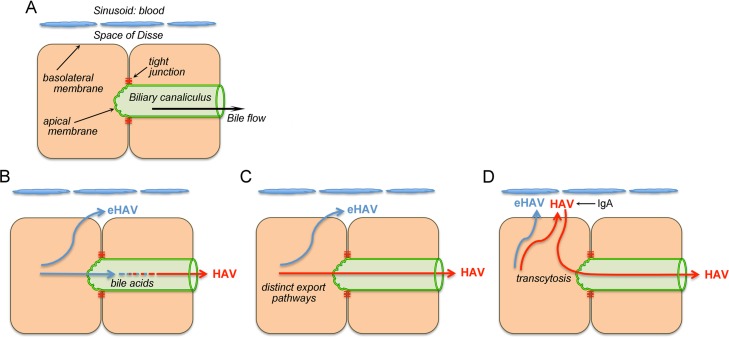
甲型肝炎病毒(HAV)是一种不同寻常的小核糖核酸病毒,它从包裹着宿主来源膜的细胞中释放出来。这些准包膜病毒粒子(eHAV)是感染期间血液中循环的唯一粒子类型,而只有无包膜病毒粒子从粪便中排出。其原因尚不确定。肝细胞是已知在体内支持HAV复制的唯一细胞类型,是高度极化的上皮细胞,其基底外侧膜面向肝(血)窦,顶端膜邻接胆小管,胆汁从胆小管分泌到肠道。为了评估eHAV和无包膜病毒是否通过不同的向量途径从细胞中释放出来,我们研究了Caco-2和HepG2-N6细胞的感染极化培养物。大多数(>99%)子代病毒粒子从Caco-2细胞顶端释放,而HepG2-N6细胞的基底外侧(64%)与顶端(36%)释放更为平衡。顶端和基底外侧释放的病毒粒子主要是包膜的,没有迹象表明eHAV与裸露病毒粒子有不同的向量释放。在HepG2-N6细胞中,两种粒子类型从基底外侧到顶端的跨细胞转运极少(<0.02%/小时),这表明这不是血清病毒与粪便病毒膜包裹差异的机制。高浓度的人胆汁酸将eHAV转化为无包膜病毒粒子,而来自感染HAV的Ifnar1 Ifngr1和Mavs小鼠胆汁中的病毒在一系列密度范围内聚集,从eHAV的密度到无包膜病毒粒子的密度。我们得出结论,粪便中排出的无包膜病毒粒子来源于通过胆小管膜释放的eHAV,并在近端胆小管内被胆汁酸的去污剂作用剥去膜。
HAV是一种嗜肝、经粪口传播的小核糖核酸病毒,可导致人类严重肝炎。最近的研究表明它有一个不同寻常的生命周期。在细胞培养上清液中发现病毒有两种成熟的感染形式:一种包裹在膜中(准包膜),另一种是无包膜的。膜包裹的病毒粒子在急性感染期间在血液中循环,并且对中和抗体有抗性,这可能促进HAV在肝脏内的传播。另一方面,粪便中排出的病毒是无包膜的且高度稳定,有利于流行传播和传播给未感染的宿主。在受感染的人类中控制这两种不同形式病毒生物发生的因素尚不清楚。在这里,我们描述了准包膜病毒粒子从极化上皮细胞培养物中的向量释放,并提供证据表明胆汁酸在eHAV分泌到胆道后将其膜剥离。这些结果增强了我们对这种不同寻常的小核糖核酸病毒生命周期的理解。