Neville Anthony, Iniesta Javier, Palomo Jose M
Department of Biocatalysis, Institute of Catalysis (CSIC), Marie Curie 2, Cantoblanco, Campus UAM, 28049 Madrid, Spain.
Molecules. 2016 Dec 6;21(12):1680. doi: 10.3390/molecules21121680.
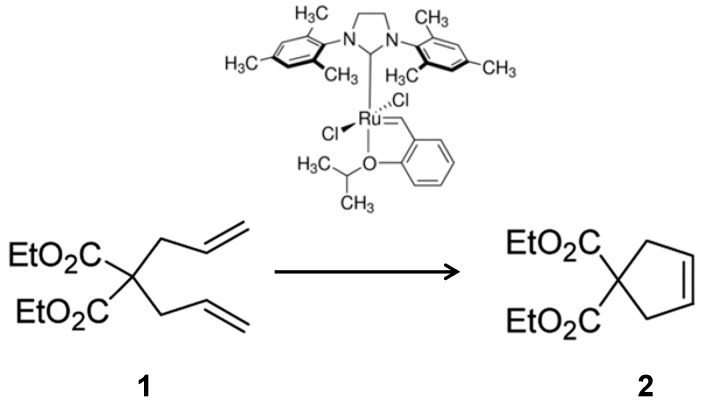
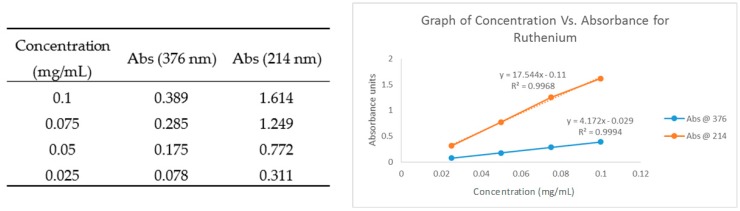
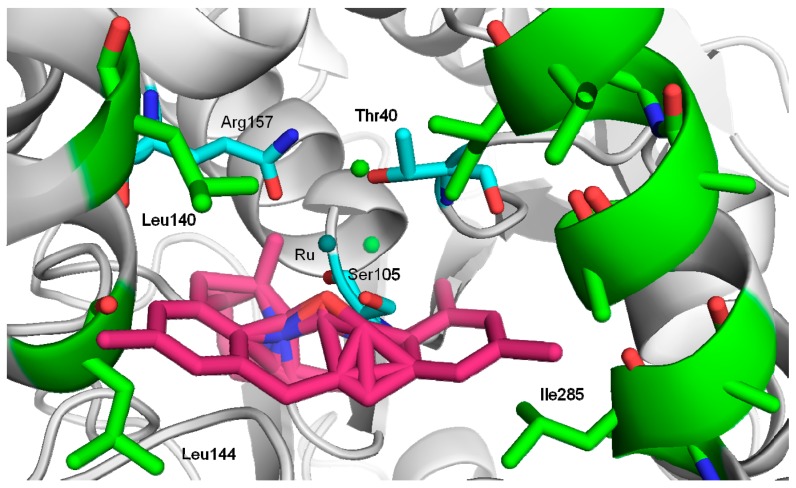
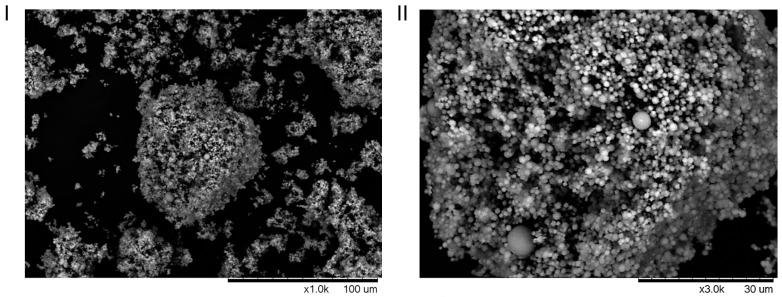
Heterogeneous catalysts have been synthesi zed by the conjugation of Hoveyda-Grubbs second-generation catalyst with a lipase. The catalytic properties of the organometallic compound in solution were firstly optimized, evaluating the activity of Ru in the ring-closing metathesis of diethyldiallymalonate at 25 °C at different solvents and in the presence of different additives. The best result was found using tetrahydrofuran as a solvent. Some additives such as phenylboronic acid or polyetheneglycol slightly improved the activity of the Ru catalyst whereas others, such as pyridine or dipeptides affected it negatively. The organometallic compound immobilized on functionalized-surface materials activated with boronic acid or epoxy groups (around 50-60 µg per mg support) and showed 50% conversion at 24 h in the ring-closing metathesis. Cross-linked enzyme aggregates (CLEA's) of the Hoveyda-Grubbs second-generation catalyst with lipase (CAL-B) were prepared, although low Ru catalyst was found to be translated in low conversion. Therefore, a sol-gel preparation of the Hoveyda-Grubbs second-generation and CAL-B was performed. This catalyst exhibited good activity in the metathesis of diethyldiallymalonate in toluene and in aqueous media. Finally, a new sustainable approach was used by the conjugation lipase-Grubbs in solid phase in aqueous media. Two strategies were used: one using lipase previously covalently immobilized on an epoxy-Sepharose support (hydrophilic matrix) and then conjugated with grubbs; and in the second, the free lipase was incubated with organometallic in aqueous solution and then immobilized on epoxy-Sepharose. The different catalysts showed excellent conversion values in the ring-closing metathesis of diethyldiallymalonate in aqueous media at 25 °C.
通过将霍维达-格鲁布斯第二代催化剂与脂肪酶结合,合成了多相催化剂。首先优化了有机金属化合物在溶液中的催化性能,在25℃下于不同溶剂中以及在不同添加剂存在的情况下,评估了钌在二乙基二烯丙基丙二酸酯闭环复分解反应中的活性。以四氢呋喃为溶剂时得到了最佳结果。一些添加剂,如苯硼酸或聚乙二醇,能略微提高钌催化剂的活性,而其他添加剂,如吡啶或二肽,则对其活性有负面影响。固定在经硼酸或环氧基团活化的功能化表面材料上的有机金属化合物(每毫克载体约50 - 60微克),在闭环复分解反应中24小时转化率为50%。制备了霍维达-格鲁布斯第二代催化剂与脂肪酶(CAL-B)的交联酶聚集体(CLEA),尽管发现低含量的钌催化剂导致低转化率。因此,进行了霍维达-格鲁布斯第二代催化剂和CAL-B的溶胶-凝胶制备。该催化剂在甲苯和水介质中对二乙基二烯丙基丙二酸酯的复分解反应表现出良好的活性。最后,在水介质中采用了一种新的可持续方法,即脂肪酶-格鲁布斯在固相中结合。使用了两种策略:一种是先将脂肪酶共价固定在环氧-琼脂糖载体(亲水性基质)上,然后与格鲁布斯结合;另一种是将游离脂肪酶与有机金属在水溶液中孵育,然后固定在环氧-琼脂糖上。不同的催化剂在25℃水介质中对二乙基二烯丙基丙二酸酯的闭环复分解反应中显示出优异的转化率。