Taylor Caroline M, Northstone Kate, Wernimont Susan M, Emmett Pauline M
Centre for Child and Adolescent Health, School of Social and Community Medicine, University of Bristol, Bristol, United Kingdom;
National Institute for Health Research Collaboration for Leadership in Applied Health Research and Care West, Bristol, United Kingdom; and.
Am J Clin Nutr. 2016 Dec;104(6):1647-1656. doi: 10.3945/ajcn.116.137356. Epub 2016 Nov 9.
Picky eating (PE) is characterized by an unwillingness to eat certain foods and by strong food preferences. PE may result in lower intakes of energy and nutrients, which may compromise health.
We quantified nutrient and food group intakes in children identified as picky eaters or nonpicky eaters and compared intakes between groups and with United Kingdom reference nutrient intakes.
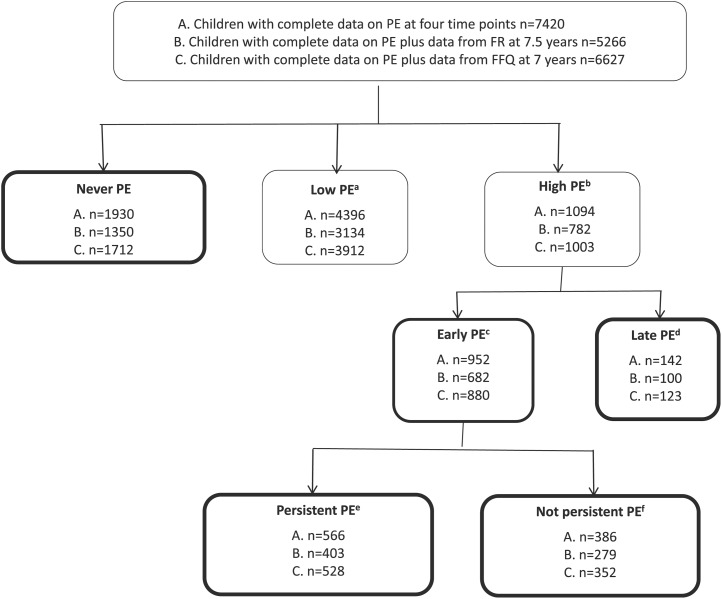
PE was identified in an observational cohort (Avon Longitudinal Study of Parents and Children) from questionnaires administered when children were aged 2, 3, 4.5, and 5.5 y. Dietary intake was assessed at 3.5 and 7.5 y with a 3-d food record. The dietary assessment at 3.5 y compared picky eaters with nonpicky eaters identified at age 3 y, and the assessment at 7.5 y compared longitudinally defined PE groups.
Picky eaters aged 3 y had lower mean carotene, iron, and zinc intakes than nonpicky eaters. There were similar differences between the longitudinally defined PE groups. Iron and zinc intakes were most likely to be below recommended amounts, with free sugar intake much higher than recommended. There were no significant differences in energy intakes between the groups, and intakes were adequate relative to estimated average requirements. Nutrient differences were explained by lower intakes of meat, fish, vegetables, and fruits in picky eaters than in nonpicky eaters. There were higher intakes of sugary foods and drinks in older picky eaters.
PE did not result in compromised macronutrient intakes, although intakes of zinc and iron were more likely to be below recommendations for picky eaters than for nonpicky eaters. Emphasis should be placed on allaying parental concerns about picky eaters being prone to inadequate nutrient intakes and on encouraging all parents to extend their child's diet to include more nutrient-rich items, especially fruits and vegetables, and less nutrient-poor sugary foods.
挑食的特点是不愿意吃某些食物以及有强烈的食物偏好。挑食可能导致能量和营养素摄入较低,进而可能损害健康。
我们对被认定为挑食者和非挑食者的儿童的营养素和食物组摄入量进行了量化,并比较了两组之间的摄入量以及与英国参考营养素摄入量的差异。
通过对2岁、3岁、4.5岁和5.5岁儿童进行问卷调查,在一项观察性队列研究(阿冯父母与儿童纵向研究)中识别出挑食情况。在3.5岁和7.5岁时通过3天食物记录评估饮食摄入量。3.5岁时的饮食评估比较了3岁时识别出的挑食者和非挑食者,7.5岁时的评估比较了纵向定义的挑食组。
3岁的挑食者平均胡萝卜素、铁和锌摄入量低于非挑食者。纵向定义的挑食组之间也存在类似差异。铁和锌的摄入量最有可能低于推荐量,而游离糖摄入量远高于推荐量。两组之间的能量摄入量没有显著差异,并且相对于估计的平均需求量,摄入量是充足的。挑食者比非挑食者肉类、鱼类、蔬菜和水果摄入量较低,这解释了营养素差异。年龄较大的挑食者含糖食物和饮料的摄入量较高。
挑食并未导致宏量营养素摄入受损,尽管挑食者的锌和铁摄入量比非挑食者更有可能低于推荐量。应强调消除父母对挑食者容易营养摄入不足的担忧,并鼓励所有父母扩大孩子的饮食范围,以纳入更多营养丰富的食物,尤其是水果和蔬菜,减少营养贫乏的含糖食物。