Kai Satoru, Nagino Koji, Ito Takayoshi, Oi Rie, Nishimura Kazushi, Morita Shuhei, Yaoi Riyo
Division of Physical Therapy, Department of Rehabilitation Sciences, Faculty of Allied Health Sciences, Kansai University of Welfare Sciences, 3-11-1 Asahigaoka, Kashiwara City, Osaka 582-0026, Japan.
Rehabil Res Pract. 2016;2016:6209671. doi: 10.1155/2016/6209671. Epub 2016 Nov 10.
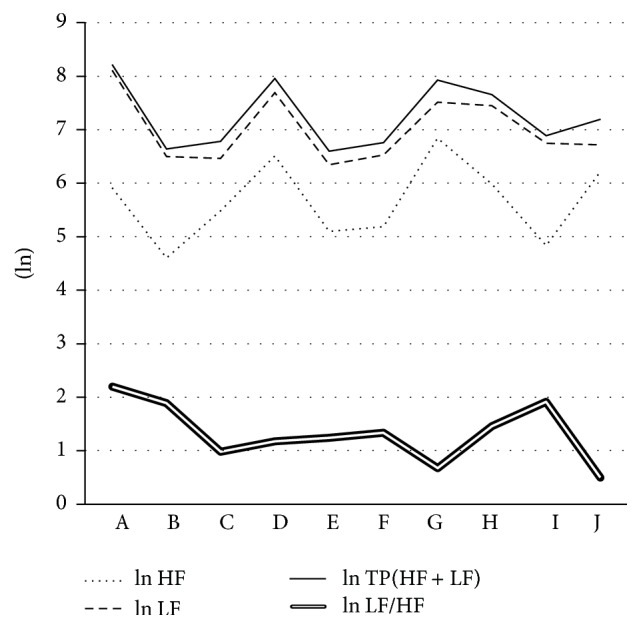
The purpose of this study was to examine the effects of moderate intensity interval training from the change of the autonomic nervous activity. Ten male volunteers aged 21-22 years were studied. After 10-minute rest in a seated position, the subjects were asked to perform the strength of moderate cycling exercise in ergometer. Cycling rate was done in 50 times/min. Load resistance of the ergometer was set to 2.0 kgm. Subjects paused the exercise when the heart rate becomes 120 beats/min. Subjects have resumed the exercise when the heart rate returns to the value at rest. This trial was repeated twice. The experiment was ended when the heart rate of the subjects has returned to resting level. When the heart rate during exercise is maintained to less than 120 beats/min, sympathetic nerve activity during exercise did not work actively compared to the baseline. Vagus nerve activity after exercise cessation exceeds the baseline. It is clarified that the exercise as well as activating the vagus nerve activity stimulates the total autonomic nervous activity. It has revealed that at the time of interval training at moderate load the vagus nerve activity can be carried out.
本研究的目的是从自主神经活动变化的角度来研究中等强度间歇训练的效果。对10名年龄在21 - 22岁的男性志愿者进行了研究。在坐位休息10分钟后,让受试者在测力计上进行中等强度的骑行运动。骑行频率为每分钟50次。测力计的负荷阻力设定为2.0 kgm。当心率达到120次/分钟时,受试者暂停运动。当心率恢复到静息值时,受试者继续运动。此试验重复两次。当受试者的心率恢复到静息水平时,实验结束。当运动期间心率维持在120次/分钟以下时,与基线相比,运动期间交感神经活动未积极发挥作用。运动停止后迷走神经活动超过基线。结果表明,运动在激活迷走神经活动的同时也刺激了总的自主神经活动。研究还揭示,在中等负荷间歇训练时,迷走神经活动能够得以进行。