Dai Xin, Wang Haina, Zhang Zhenfeng, Li Kuan, Zhang Xiaoling, Mora-López Marielos, Jiang Chengying, Liu Chang, Wang Li, Zhu Yaxin, Hernández-Ascencio Walter, Dong Zhiyang, Huang Li
State Key Laboratory of Microbial Resources, Institute of Microbiology, Chinese Academy of SciencesBeijing, China; College of Life Sciences, University of Chinese Academy of SciencesBeijing, China.
State Key Laboratory of Microbial Resources, Institute of Microbiology, Chinese Academy of Sciences Beijing, China.
Front Microbiol. 2016 Nov 30;7:1902. doi: 10.3389/fmicb.2016.01902. eCollection 2016.
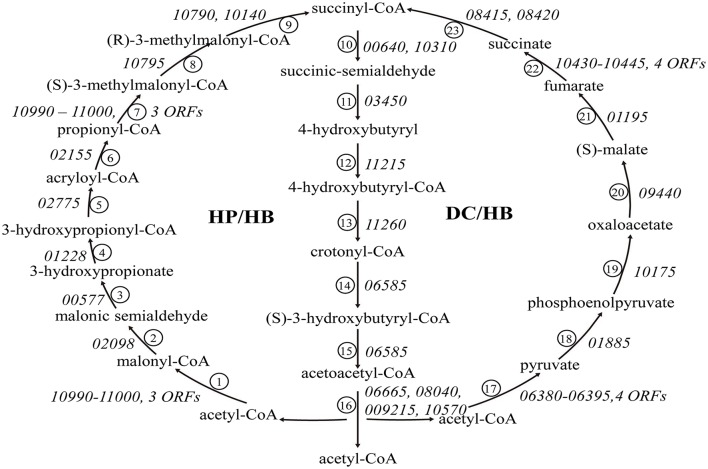
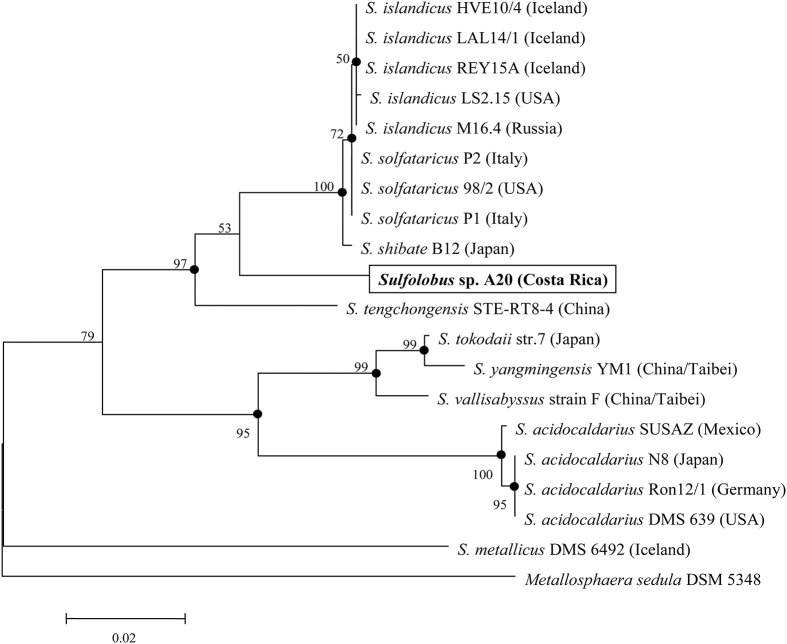
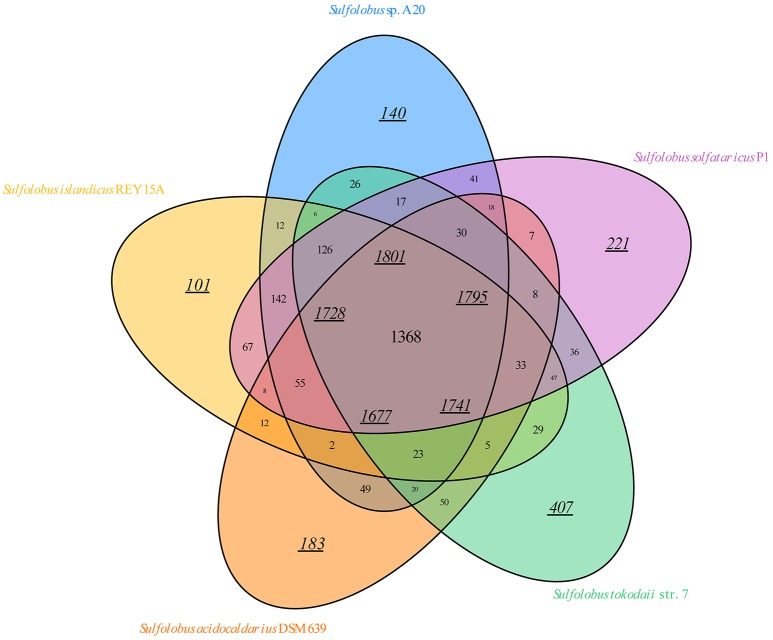
The genome of sp. A20 isolated from a hot spring in Costa Rica was sequenced. This circular genome of the strain is 2,688,317 bp in size and 34.8% in G+C content, and contains 2591 open reading frames (ORFs). Strain A20 shares ~95.6% identity at the 16S rRNA gene sequence level and <30% DNA-DNA hybridization (DDH) values with the most closely related known species (i.e., and ), suggesting that it represents a novel species. Comparison of the genome of strain A20 with those of the type strains of , and , which were isolated from geographically separated areas, identified 1801 genes conserved among all species analyzed (core genes). Comparative genome analyses show that central carbon metabolism in is highly conserved, and enzymes involved in the Entner-Doudoroff pathway, the tricarboxylic acid cycle and the CO fixation pathways are predominantly encoded by the core genes. All species encode genes required for the conversion of ammonium into glutamate/glutamine. Some strains have gained the ability to utilize additional nitrogen source such as nitrate (i.e., strain REY15A, LAL14/1, M14.25, and M16.27) or urea (i.e., HEV10/4, strain7, and DSM 6482). The strategies for sulfur metabolism are most diverse and least understood. encodes sulfur oxygenase/reductase (SOR), whereas both and contain genes for sulfur reductase (SRE). However, neither SOR nor SRE genes exist in the genome of strain A20, raising the possibility that an unknown pathway for the utilization of elemental sulfur may be present in the strain. The ability of to utilize nitrate or sulfur is encoded by a gene cluster flanked by IS elements or their remnants. These clusters appear to have become fixed at a specific genomic site in some strains and lost in other strains during the course of evolution. The versatility in nitrogen and sulfur metabolism may represent adaptation of to thriving in different habitats.
对从哥斯达黎加一处温泉中分离出的A20菌株的基因组进行了测序。该菌株的环状基因组大小为2,688,317 bp,G+C含量为34.8%,包含2591个开放阅读框(ORF)。A20菌株在16S rRNA基因序列水平上与最密切相关的已知物种(即[具体物种1]和[具体物种2])的同一性约为95.6%,DNA-DNA杂交(DDH)值<30%,这表明它代表一个新物种。将A20菌株的基因组与从地理上分离的地区分离出的[具体物种1]、[具体物种2]和[具体物种3]的模式菌株的基因组进行比较,确定了在所有分析的[具体物种]中保守的1801个基因(核心基因)。比较基因组分析表明,[具体物种]中的中心碳代谢高度保守,参与Entner-Doudoroff途径、三羧酸循环和CO固定途径的酶主要由核心基因编码。所有[具体物种]都编码将铵转化为谷氨酸/谷氨酰胺所需的基因。一些[具体物种]菌株获得了利用额外氮源(如硝酸盐,即[具体菌株1]REY15A、LAL14/1、M14.25和M16.27)或尿素(即[具体菌株2]HEV10/4、[具体菌株3]7和[具体菌株4]DSM 6482)的能力。硫代谢的策略最为多样且了解最少。[具体物种1]编码硫氧化酶/还原酶(SOR),而[具体物种2]和[具体物种3]都含有硫还原酶(SRE)的基因。然而,A20菌株的基因组中既不存在SOR基因也不存在SRE基因,这增加了该菌株可能存在未知的元素硫利用途径的可能性。[具体物种]利用硝酸盐或硫的能力由一个侧翼为IS元件或其残余物的基因簇编码。这些基因簇在进化过程中似乎在一些菌株的特定基因组位点固定下来,而在其他菌株中丢失。氮和硫代谢的多样性可能代表[具体物种]对在不同生境中茁壮成长的适应。