Metavarayuth Kamolrat, Sitasuwan Pongkwan, Luckanagul Jittima Amie, Feng Sheng, Wang Qian
Department of Chemistry and Biochemistry University of South Carolina 631 Sumter Street Columbia SC 29208 USA.
Department of Food and Pharmaceutical Chemistry Faculty of Pharmaceutical Sciences Chulalongkorn University 254 Phayathai Rd., Wangmai Pathumwan Bangkok 10330 Thailand.
Adv Sci (Weinh). 2015 Jun 25;2(10):1500026. doi: 10.1002/advs.201500026. eCollection 2015 Oct.
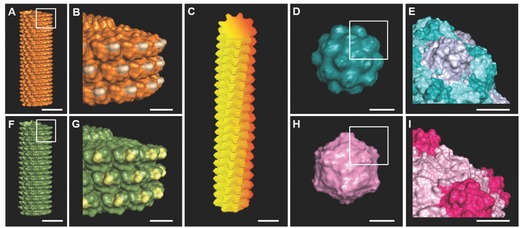
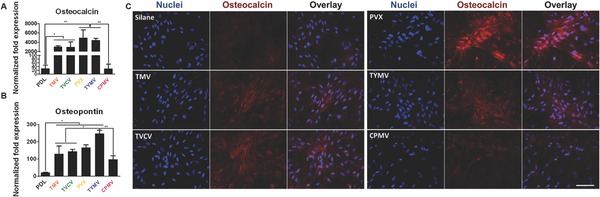
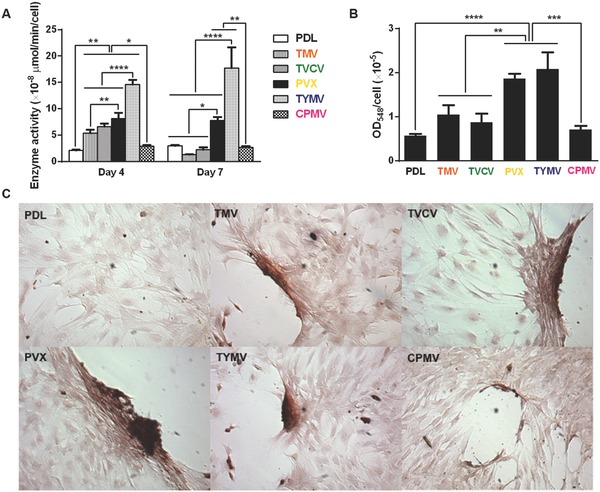
There are few methodologies that allow manipulating a biomaterial surface at nanometer scale, which controllably influence different cellular functions. In this study, virus nanoparticles with different structural features are selected to prepare 2D substrates with defined nanoscale topographies and the cellular responses are investigated. It is demonstrated that the viral nanoparticle based substrates could accelerate and enhance osteogenesis of bone derived mesenchymal stem cells as indicated by the upregulation of osteogenic markers, including bone morphogenetic protein-2, osteocalcin, and osteopontin, at both gene and protein expression levels. Moreover, alkaline phosphatase activity and calcium mineralization, both indicators for a -successful bone formation, are also increased in cells grown on these nanoscale possessed substrates. These discoveries and developments present a new paradigm for nanoscale engineering of a biomaterial surface.
能够在纳米尺度上操控生物材料表面并可控地影响不同细胞功能的方法很少。在本研究中,选择具有不同结构特征的病毒纳米颗粒来制备具有明确纳米级形貌的二维基质,并研究细胞反应。结果表明,基于病毒纳米颗粒的基质可以加速和增强骨源性间充质干细胞的成骨作用,这在基因和蛋白质表达水平上均表现为成骨标志物(包括骨形态发生蛋白-2、骨钙素和骨桥蛋白)的上调。此外,在这些具有纳米级形貌的基质上生长的细胞中,碱性磷酸酶活性和钙矿化(两者均为成功骨形成的指标)也有所增加。这些发现和进展为生物材料表面的纳米尺度工程提供了一种新的范例。