Kaminski Juliana, Miasaki Fabíola Yukiko, Paz-Filho Gilberto, Graf Hans, Carvalho Gisah Amaral de
Serviço de Endocrinologia e Metabologia (SEMPR), Departamento de Medicina Interna, Hospital das Clínicas da Universidade Federal do Paraná (HC-UFPR), Curitiba, PR, Brasil.
Genome Sciences Department, The John Curtin School of Medical Research, The Australian National University, Canberra, ACT, Australia.
Arch Endocrinol Metab. 2016 Nov-Dec;60(6):562-572. doi: 10.1590/2359-3997000000192. Epub 2016 Aug 25.
To compare the effects of a unique fixed combination levothyroxine/liothyronine (LT4/LT3) therapy in patients with primary hypothyroidism.
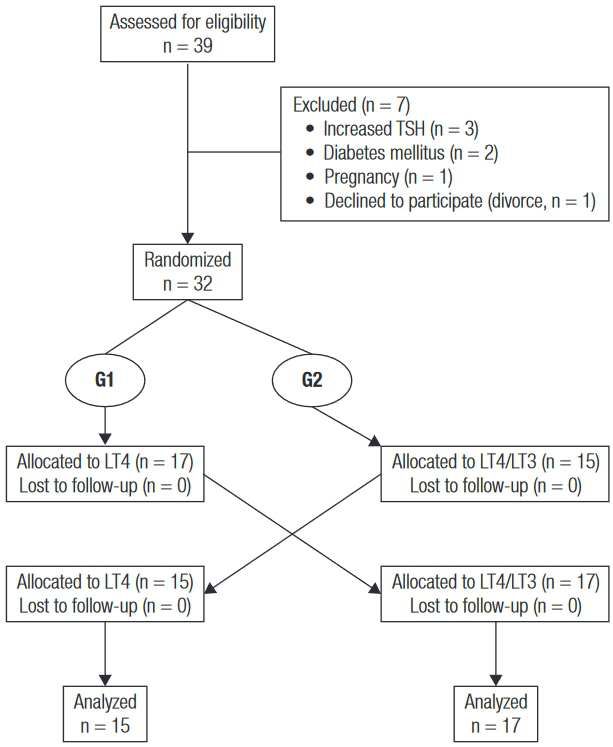
This is a randomized, double-blind, crossover study. Adults with primary hypothyroidism (n = 32, age 42.6 ± 13.3, 30 females) on stable doses of LT4 for ≥ 6 months (125 or 150 μg/day) were randomized to continue LT4 treatment (G1) or to start LT4/LT3 therapy (75/15 μg/day; G2). After 8 weeks, participants switched treatments for 8 more weeks. Thyroid function, lipid profile, plasma glucose, body weight, electrocardiogram, vital signs, and quality of life (QoL) were evaluated at weeks 0, 8 and 16.
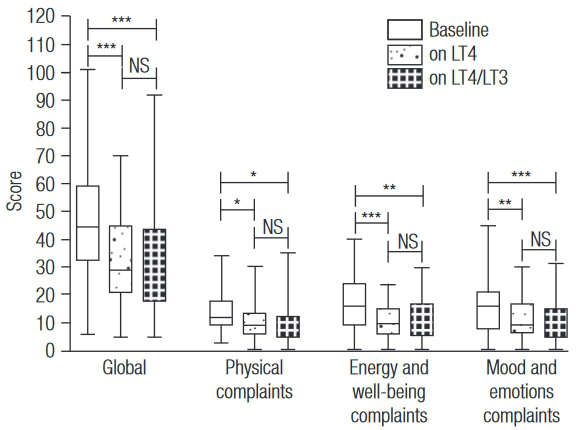
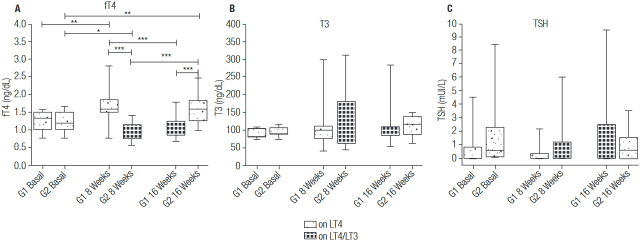
Free T4 levels were significantly lower while on LT4/LT3 (G1: 1.07 ± 0.29 vs. 1.65 ± 0.46; G2: 0.97 ± 0.26 vs. 1.63 ± 0.43 ng/dL; P < 0.001). TSH and T3 levels were not affected by type of therapy. More patients on LT4/LT3 had T3 levels above the upper limit (15% vs. 3%). The combination therapy led to an increase in heart rate, with no significant changes in electrocardiogram or arterial blood pressure. Lipid profile, body weight and QoL remained unchanged.
The combination therapy yielded significantly lower free T4 levels, with no changes in TSH or T3 levels. More patients on LT4/T3 had elevated T3 levels, with no significant alterations in the evaluated outcomes. No clear clinical benefit of the studied formulation could be observed. Future trials need to evaluate different formulations and the impact of the combined therapy in select populations with genetic polymorphisms.
比较左旋甲状腺素/碘塞罗宁(LT4/LT3)独特固定组合疗法对原发性甲状腺功能减退患者的疗效。
这是一项随机、双盲、交叉研究。稳定服用LT4剂量≥6个月(125或150μg/天)的原发性甲状腺功能减退成人患者(n = 32,年龄42.6±13.3,女性30例)被随机分为继续LT4治疗组(G1)或开始LT4/LT3治疗组(75/15μg/天;G2)。8周后,参与者再换用另一种治疗8周。在第0、8和16周评估甲状腺功能、血脂谱、血糖、体重、心电图、生命体征和生活质量(QoL)。
服用LT4/LT3时游离T4水平显著降低(G1:1.07±0.29对1.65±0.46;G2:0.97±0.26对1.63±0.43 ng/dL;P < 0.001)。TSH和T3水平不受治疗类型影响。更多服用LT4/LT3的患者T3水平高于上限(15%对3%)。联合治疗导致心率增加,心电图或动脉血压无显著变化。血脂谱、体重和生活质量保持不变。
联合治疗使游离T4水平显著降低,TSH或T3水平无变化。更多服用LT4/T3的患者T3水平升高,评估结果无显著改变。未观察到所研究制剂有明显的临床益处。未来试验需要评估不同制剂以及联合治疗对具有基因多态性的特定人群的影响。