Yoneyama Keisuke, Akashi Tomoyoshi, Aoki Toshio
Department of Applied Biological Sciences, Nihon University, Fujisawa, Kanagawa, 252-0880 Japan.
Department of Applied Biological Sciences, Nihon University, Fujisawa, Kanagawa, 252-0880 Japan
Plant Cell Physiol. 2016 Dec;57(12):2497-2509. doi: 10.1093/pcp/pcw178.
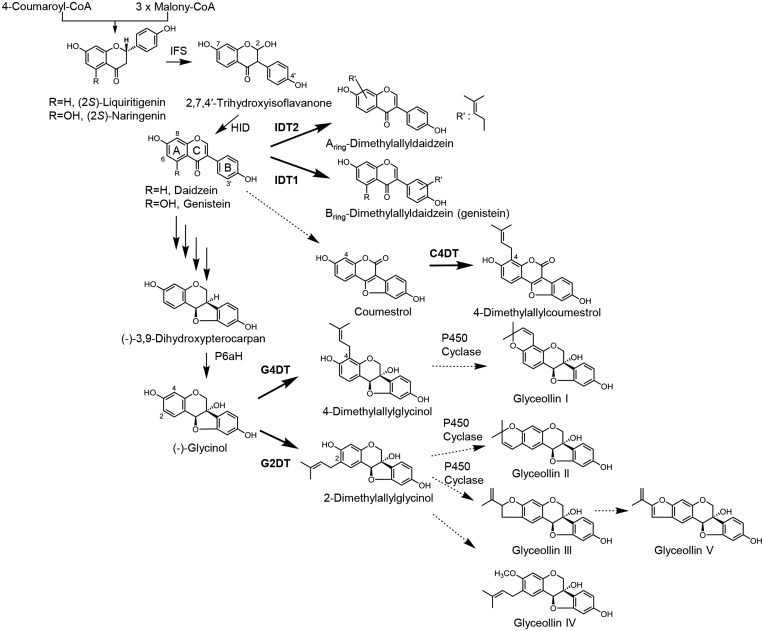
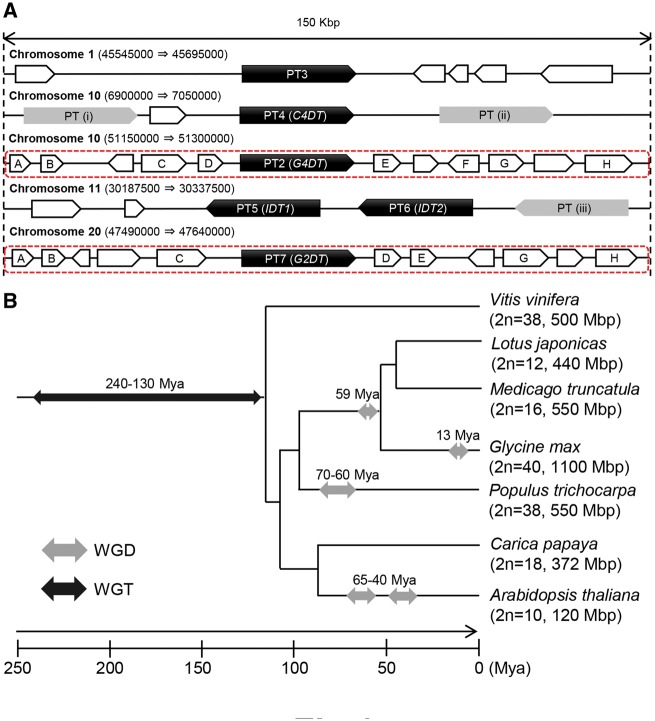
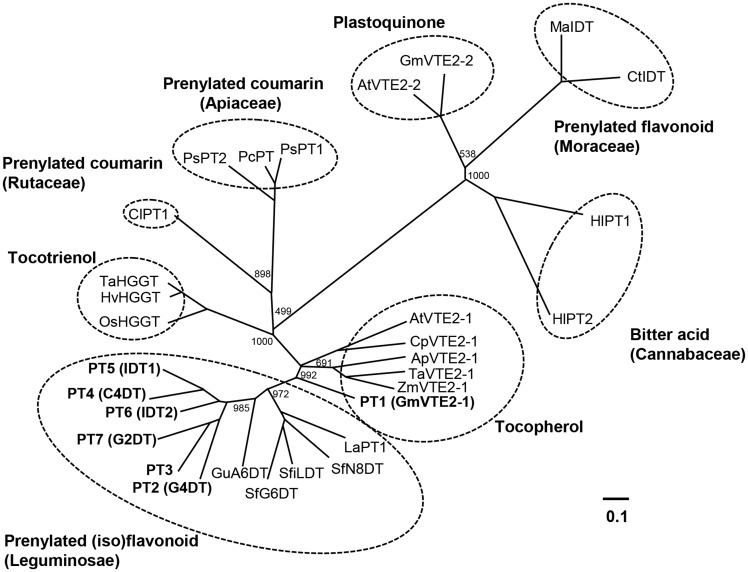
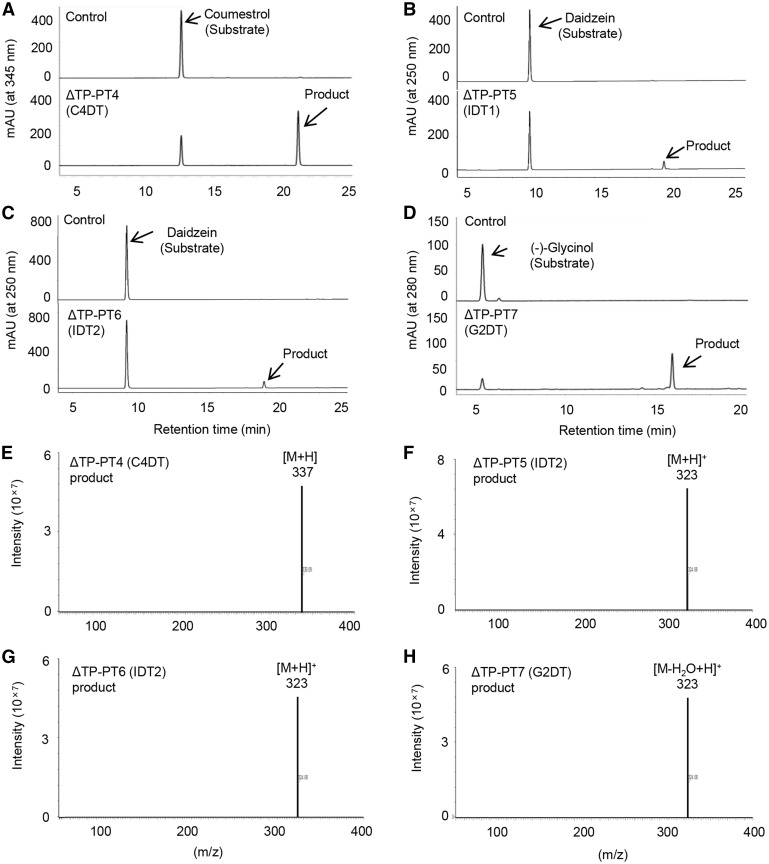
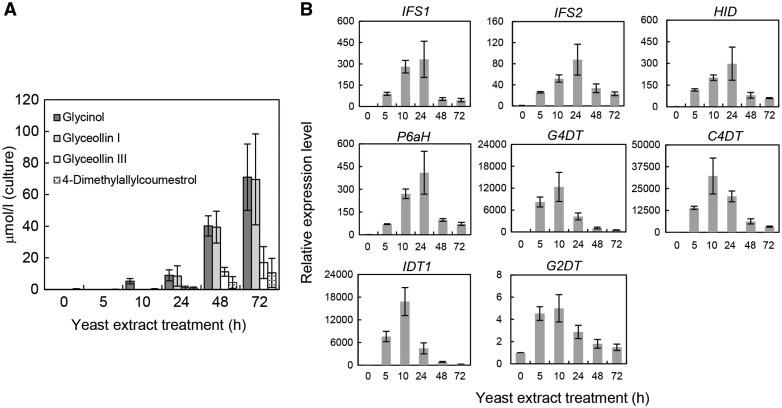
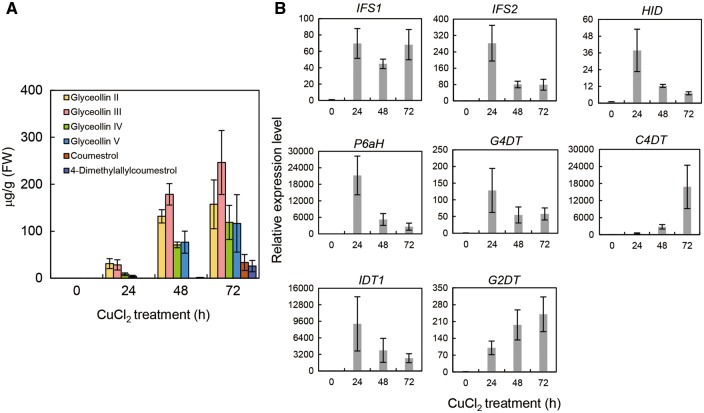
Soybean (Glycine max) accumulates several prenylated isoflavonoid phytoalexins, collectively referred to as glyceollins. Glyceollins (I, II, III, IV and V) possess modified pterocarpan skeletons with C moieties from dimethylallyl diphosphate, and they are commonly produced from (6aS, 11aS)-3,9,6a-trihydroxypterocarpan [(-)-glycinol]. The metabolic fate of (-)-glycinol is determined by the enzymatic introduction of a dimethylallyl group into C-4 or C-2, which is reportedly catalyzed by regiospecific prenyltransferases (PTs). 4-Dimethylallyl (-)-glycinol and 2-dimethylallyl (-)-glycinol are precursors of glyceollin I and other glyceollins, respectively. Although multiple genes encoding (-)-glycinol biosynthetic enzymes have been identified, those involved in the later steps of glyceollin formation mostly remain unidentified, except for (-)-glycinol 4-dimethylallyltransferase (G4DT), which is involved in glyceollin I biosynthesis. In this study, we identified four genes that encode isoflavonoid PTs, including (-)-glycinol 2-dimethylallyltransferase (G2DT), using homology-based in silico screening and biochemical characterization in yeast expression systems. Transcript analyses illustrated that changes in G2DT gene expression were correlated with the induction of glyceollins II, III, IV and V in elicitor-treated soybean cells and leaves, suggesting its involvement in glyceollin biosynthesis. Moreover, the genomic signatures of these PT genes revealed that G4DT and G2DT are paralogs derived from whole-genome duplications of the soybean genome, whereas other PT genes [isoflavone dimethylallyltransferase 1 (IDT1) and IDT2] were derived via local gene duplication on soybean chromosome 11.
大豆(Glycine max)会积累多种异戊烯基化异黄酮植保素,统称为大豆抗毒素。大豆抗毒素(I、II、III、IV和V)具有经修饰的紫檀烷骨架,带有来自二甲基烯丙基二磷酸的C基团,它们通常由(6aS,11aS)-3,9,6a-三羟基紫檀烷[(-)-大豆醇]产生。(-)-大豆醇的代谢命运由二甲基烯丙基基团在C-4或C-2位置的酶促引入决定,据报道这是由区域特异性异戊烯基转移酶(PTs)催化的。4-二甲基烯丙基(-)-大豆醇和2-二甲基烯丙基(-)-大豆醇分别是大豆抗毒素I和其他大豆抗毒素的前体。尽管已经鉴定出多个编码(-)-大豆醇生物合成酶的基因,但除了参与大豆抗毒素I生物合成的(-)-大豆醇4-二甲基烯丙基转移酶(G4DT)外,参与大豆抗毒素形成后期步骤的基因大多仍未被鉴定。在本研究中,我们通过基于同源性的电子筛选和酵母表达系统中的生化特性鉴定,确定了四个编码异黄酮PTs的基因,包括(-)-大豆醇2-二甲基烯丙基转移酶(G2DT)。转录分析表明,G2DT基因表达的变化与诱导剂处理的大豆细胞和叶片中大豆抗毒素II、III、IV和V的诱导相关,表明其参与大豆抗毒素生物合成。此外,这些PT基因的基因组特征表明,G4DT和G2DT是源自大豆基因组全基因组复制的旁系同源基因,而其他PT基因[异黄酮二甲基烯丙基转移酶1(IDT1)和IDT2]是通过大豆11号染色体上的局部基因复制产生的。