Uehiro Natsue, Sato Fumiaki, Pu Fengling, Tanaka Sunao, Kawashima Masahiro, Kawaguchi Kosuke, Sugimoto Masahiro, Saji Shigehira, Toi Masakazu
Department of Breast Surgery, Graduate School of Medicine, Kyoto University, Kyoto, Japan.
Department of Target Therapy Oncology, Graduate School of Medicine, Kyoto University, Kyoto, Japan.
Breast Cancer Res. 2016 Dec 19;18(1):129. doi: 10.1186/s13058-016-0788-z.
Circulating cell-free DNA (cfDNA) has recently been recognized as a resource for biomarkers of cancer progression, treatment response, and drug resistance. However, few have demonstrated the usefulness of cfDNA for early detection of cancer. Although aberrant DNA methylation in cfDNA has been reported for more than a decade, its diagnostic accuracy remains unsatisfactory for cancer screening. Thus, the aim of the present study was to develop a highly sensitive cfDNA-based system for detection of primary breast cancer (BC) using epigenetic biomarkers and digital PCR technology.
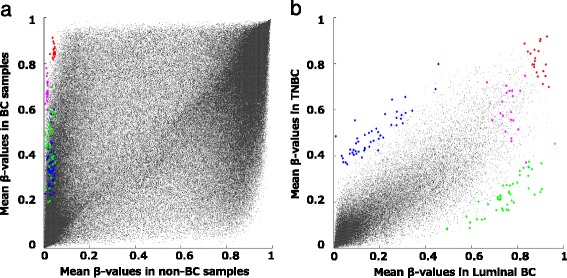
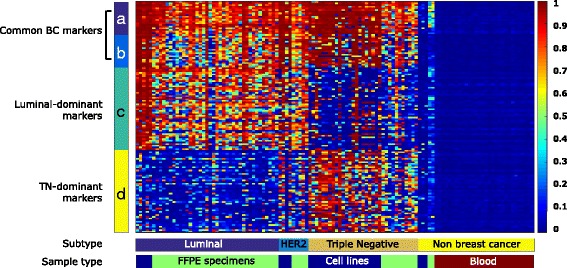
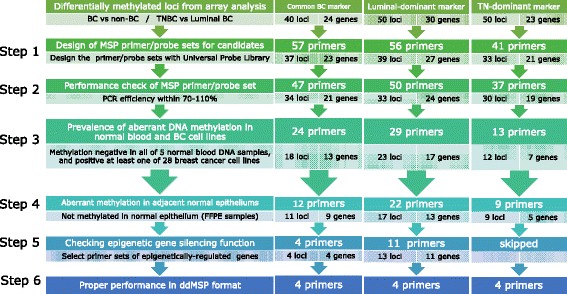
Array-based genome-wide DNA methylation analysis was performed using 56 microdissected breast tissue specimens, 34 cell lines, and 29 blood samples from healthy volunteers (HVs). Epigenetic markers for BC detection were selected, and a droplet digital methylation-specific PCR (ddMSP) panel with the selected markers was established. The detection model was constructed by support vector machine and evaluated using cfDNA samples.
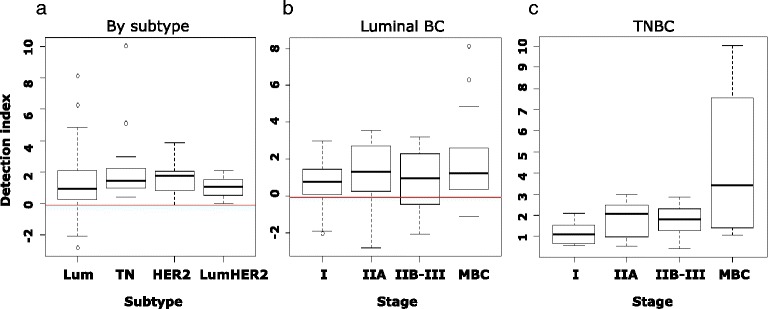
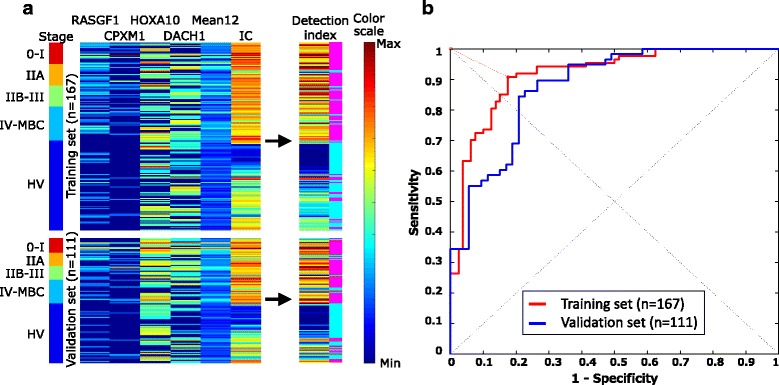
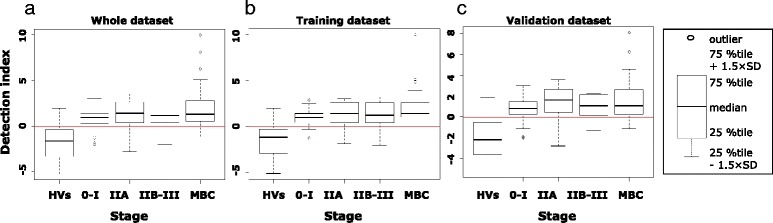
The methylation array analysis identified 12 novel epigenetic markers (JAK3, RASGRF1, CPXM1, SHF, DNM3, CAV2, HOXA10, B3GNT5, ST3GAL6, DACH1, P2RX3, and chr8:23572595) for detecting BC. We also selected four internal control markers (CREM, GLYATL3, ELMOD3, and KLF9) that were identified as infrequently altered genes using a public database. A ddMSP panel using these 16 markers was developed and detection models were constructed with a training dataset containing cfDNA samples from 80 HVs and 87 cancer patients. The best detection model adopted four methylation markers (RASGRF1, CPXM1, HOXA10, and DACH1) and two parameters (cfDNA concentration and the mean of 12 methylation markers), and, and was validated in an independent dataset of 53 HVs and 58 BC patients. The area under the receiver operating characteristic curve for cancer-normal discrimination was 0.916 and 0.876 in the training and validation dataset, respectively. The sensitivity and the specificity of the model was 0.862 (stages 0-I 0.846, IIA 0.862, IIB-III 0.818, metastatic BC 0.935) and 0.827, respectively.
Our epigenetic-marker-based system distinguished BC patients from HVs with high accuracy. As detection of early BC using this system was comparable with that of mammography screening, this system would be beneficial as an optional method of screening for BC.
循环游离DNA(cfDNA)最近被认为是癌症进展、治疗反应和耐药性生物标志物的一个来源。然而,很少有人证明cfDNA在癌症早期检测中的有用性。尽管cfDNA中的异常DNA甲基化已有十多年的报道,但其诊断准确性在癌症筛查中仍不尽人意。因此,本研究的目的是开发一种基于cfDNA的高灵敏度系统,利用表观遗传生物标志物和数字PCR技术检测原发性乳腺癌(BC)。
使用56个显微切割的乳腺组织标本、34个细胞系和29份来自健康志愿者(HV)的血液样本进行基于芯片的全基因组DNA甲基化分析。选择用于BC检测的表观遗传标志物,并建立一个包含所选标志物的液滴数字甲基化特异性PCR(ddMSP)检测板。通过支持向量机构建检测模型,并使用cfDNA样本进行评估。
甲基化芯片分析确定了12个用于检测BC的新表观遗传标志物(JAK3、RASGRF1、CPXM1、SHF、DNM3、CAV2、HOXA10、B3GNT5、ST3GAL6、DACH1、P2RX3和chr8:23572595)。我们还选择了四个内部对照标志物(CREM、GLYATL3、ELMOD3和KLF9),这些标志物通过公共数据库被确定为很少发生改变的基因。开发了一个使用这16个标志物的ddMSP检测板,并使用一个包含来自80名HV和87名癌症患者的cfDNA样本的训练数据集构建检测模型。最佳检测模型采用四个甲基化标志物(RASGRF1、CPXM1、HOXA10和DACH1)和两个参数(cfDNA浓度和12个甲基化标志物的平均值),并在一个包含53名HV和58名BC患者的独立数据集中进行验证。在训练和验证数据集中,癌症与正常鉴别曲线下面积分别为0.