Paul Birinder Singh, Singh Amandeep, Jain Dinesh, Singh Gagandeep, Kaushal Sandeep, Paul Gunchan, Kaura Karan
Department of Neurology, Dayanand Medical College and Hospital, Ludhiana, Punjab, India.
Department of Medicine, Dayanand Medical College and Hospital, Ludhiana, Punjab, India.
Ann Indian Acad Neurol. 2016 Oct-Dec;19(4):451-455. doi: 10.4103/0972-2327.194419.
Fatigue is one of the most frequent nonmotor manifestations in Parkinson's disease (PD), having a major effect on quality of life but is not reported in Indian patients.
To evaluate the frequency of fatigue in a cohort of PD population and its correlation with disease.
Fatigue Severity Scale (FSS) was translated and validated in local vernacular language. All patients of PD visiting neurology outpatient department of a tertiary care hospital.
A total of 150 patients were screened, and 104 were included in this study. They were divided into - Group I with fatigue (score of >4 in each item) and Group II without fatigue.
Data were analyzed by SPSS software version 20.0. Spearman correlation was used to evaluate the convergent validity of the FSS-Ind score with PD-related variables. The principal components analysis was applied to detect the domain structure of the FSS.
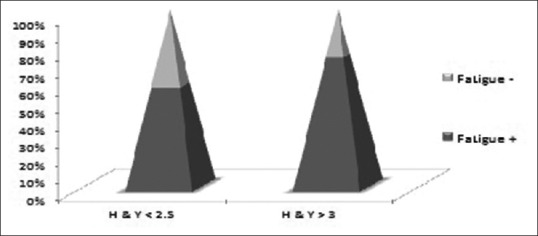
Of the total 104 patients, 68 (65.3%) patients experienced fatigue. The duration of disease was significantly more ( = 0.021) in Group I (4.39 ± 3.8 years) than in the Group II (3.13 ± 1.6 years). The severity of disease also showed a positive correlation with fatigue with 50.9% patients in H and Y stage >3 experiencing fatigue. 69.1% patients of tremor phenotype experienced fatigue as compared to 32.3% of rigid phenotype. There was no relation of fatigue with age, gender, H and Y stage, levodopa equivalent dose and mean Unified PD Rating Scale motor III score.
Translated version of the FSS, FSS-Ind has high internal consistency and validity which supports its application as an effective tool in detecting fatigue in patients with PD. Fatigue in PD was related to duration and phenotype of the disease.
疲劳是帕金森病(PD)最常见的非运动症状之一,对生活质量有重大影响,但印度患者中尚未见相关报道。
评估一组帕金森病患者中疲劳的发生率及其与疾病的相关性。
疲劳严重程度量表(FSS)被翻译成当地白话并进行了验证。所有在三级医院神经内科门诊就诊的帕金森病患者。
共筛查150例患者,104例纳入本研究。他们被分为两组:第一组为有疲劳症状的患者(各项目得分>4分),第二组为无疲劳症状的患者。
采用SPSS 20.0软件进行数据分析。采用Spearman相关性分析评估FSS-Ind评分与帕金森病相关变量的收敛效度。应用主成分分析检测FSS的领域结构。
在104例患者中,68例(65.3%)出现疲劳症状。第一组患者(4.39±3.8年)的病程明显长于第二组(3.13±1.6年)(P=0.021)。疾病严重程度也与疲劳呈正相关,Hoehn和Yahr分期>3期的患者中有50.9%出现疲劳症状。震颤型患者中有69.1%出现疲劳症状,而强直型患者中这一比例为32.3%。疲劳与年龄、性别、Hoehn和Yahr分期、左旋多巴等效剂量及统一帕金森病评定量表运动Ⅲ评分均无相关性。
FSS的翻译版本FSS-Ind具有较高的内部一致性和效度,支持其作为检测帕金森病患者疲劳的有效工具。帕金森病中的疲劳与疾病的病程和表型有关。