Nikolaidis Pantelis Theodoros, Buśko Krzysztof, Clemente Filipe Manuel, Tasiopoulos Ioannis, Knechtle Beat
Exercise Physiology Laboratory, Nikaia, Greece.
Department of Biomechanics, Institute of Sport-National Research Institute, Warsaw, Poland.
Open Access J Sports Med. 2016 Dec 7;7:177-186. doi: 10.2147/OAJSM.S120344. eCollection 2016.
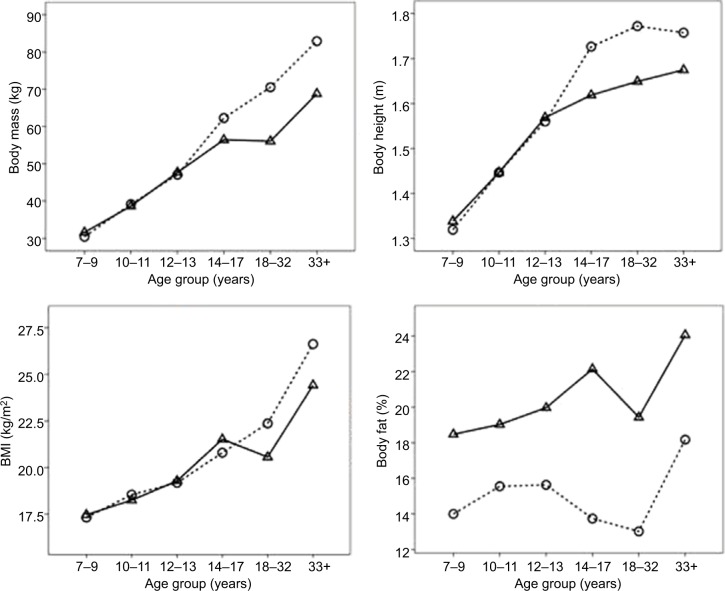
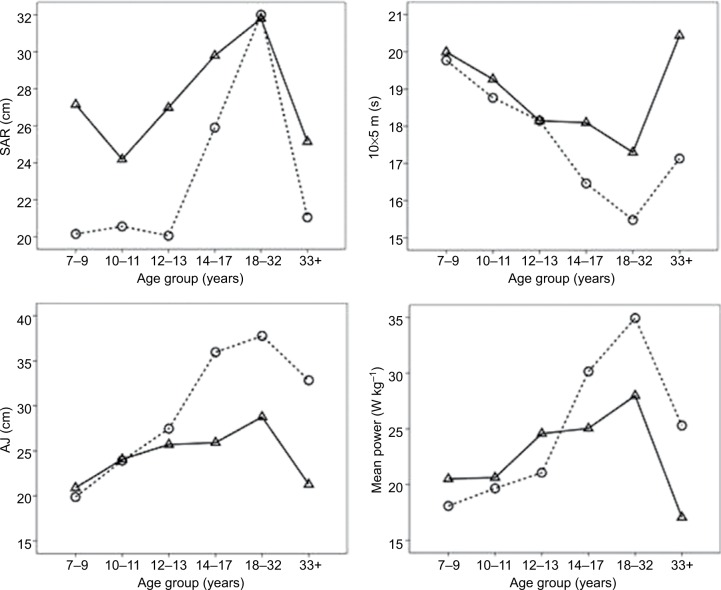
Anthropometry and neuromuscular fitness have been shown to relate with taekwondo (TKD) performance; however, little information is available on the variation of these fitness components by sex and age in athletes practicing this sport. The aim of the present study was to examine the anthropometry and neuromuscular fitness of TKD athletes by sex and age. A total of 393 athletes (7-48 years old), separated into six age groups (7-9, 10-11, 12-13, 14-17, 18-32, and 33+), were examined for anthropometry and performed a series of neuromuscular fitness tests (flexibility, agility, muscle power, and isometric strength). An age × sex interaction on body mass, body height, and body fat percentage (BF, ≤0.003, η≥0.045), but not on body mass index (=0.172, η=0.020), was shown, where a larger increase in body mass and body height from 12-13 to 14-17 groups was observed in males than in females, and the sex difference in BF increased from 12-13 to 14-17 age group. An age × sex interaction on sit-and-reach (SAR) test, mean power output in the Bosco test, and Abalakov jump (≤0.038, η≥0.031) was observed with larger differences between 12-13 and 18-32 groups in males than in females. In SAR, it was remarkable that the male athletes achieved similar scores as female athletes in the 18-32 group. An age × sex group interaction on measures of isometric muscle strength (right and left handgrip, trunk, and legs) was also shown (≤0.002, η≥0.068), where larger differences in male than female athletes were observed between the 12-13 and 14-17 groups. From a practical perspective, coaches can use these findings as reference for the evaluation of their athletes. Because the anthropometric characteristics and neuromuscular fitness varied by sex (i.e., highest scores in males, except flexibility) and age (i.e., highest scores in the 18-32 age group) with unique sport-specific patterns in TKD athletes, these findings would be important for the development of specific training programs.
人体测量学和神经肌肉适能已被证明与跆拳道(TKD)表现相关;然而,关于从事这项运动的运动员中这些适能成分随性别和年龄的变化情况,目前可用信息较少。本研究的目的是按性别和年龄检查跆拳道运动员的人体测量学和神经肌肉适能。共有393名运动员(7至48岁),分为六个年龄组(7至9岁、10至11岁、12至13岁、14至17岁、18至32岁和33岁以上),接受了人体测量,并进行了一系列神经肌肉适能测试(柔韧性、敏捷性、肌肉力量和等长力量)。结果显示,在体重、身高和体脂百分比(BF,≤0.003,η≥0.045)方面存在年龄×性别交互作用,但在体重指数方面不存在(=0.172,η=0.020),其中男性从12至13岁组到14至17岁组的体重和身高增幅大于女性,且BF的性别差异从12至13岁组到14至17岁年龄组有所增加。在坐立前屈(SAR)测试、博斯科测试中的平均功率输出和阿巴拉克夫跳方面观察到年龄×性别交互作用(≤0.038,η≥0.031),男性12至13岁组和18至32岁组之间的差异大于女性。在SAR测试中,值得注意的是,18至32岁组的男性运动员得分与女性运动员相似。在等长肌肉力量测量(右手握力、左手握力、躯干和腿部)方面也显示出年龄×性别组交互作用(≤0.002,η≥0.068),其中12至13岁组和14至17岁组之间男性运动员的差异大于女性运动员。从实际角度来看,教练可以将这些发现作为评估其运动员的参考。由于跆拳道运动员的人体测量特征和神经肌肉适能因性别(即除柔韧性外男性得分最高)和年龄(即18至32岁年龄组得分最高)而异,且具有独特的特定运动模式,这些发现对于制定特定训练计划具有重要意义。