Nikolaidis Pantelis Theodoros, Rosemann Thomas, Knechtle Beat
Exercise Physiology Laboratory, Nikaia, Greece.
Laboratory of Exercise Testing, Hellenic Air Force Academy, Acharnes, Greece.
Front Physiol. 2018 Nov 2;9:1563. doi: 10.3389/fphys.2018.01563. eCollection 2018.
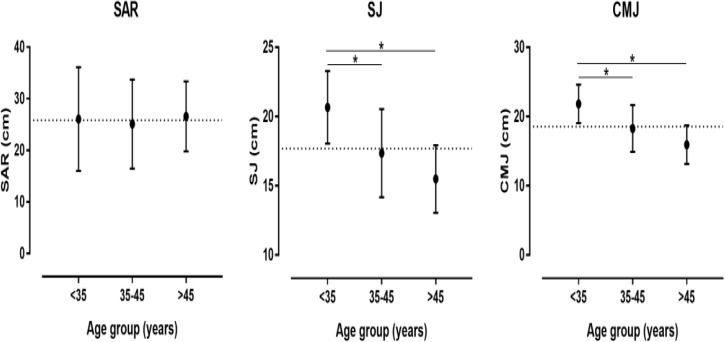
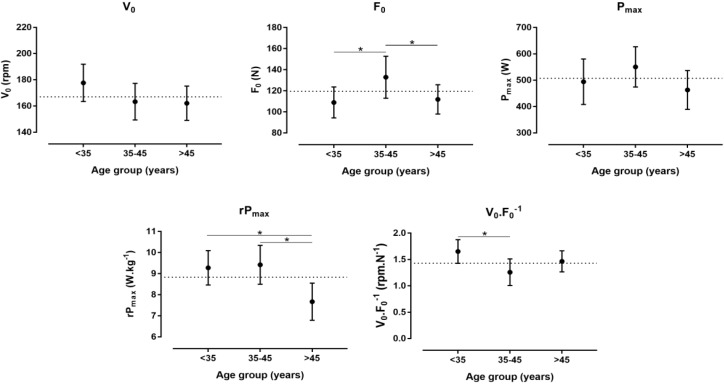
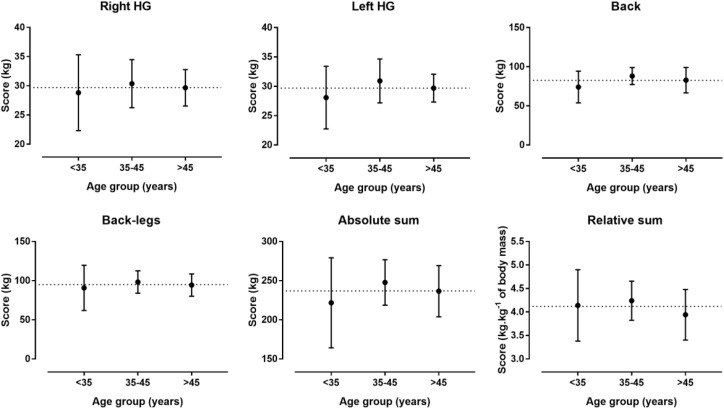
Physical fitness components that relate with performance in marathon running, e.g., aerobic capacity and body composition, have been studied extensively. On the other hand, data on components of the health-related physical fitness, such as flexibility and muscle strength, were missing in this sport. Therefore, the aim of the present study was to profile force-velocity (F-v) characteristics, muscle strength and flexibility in female recreational marathon runners and to examine their relationship with age, race time and anthropometric characteristics (body fat percentage, fat-free mass - FFM, and total thigh muscle cross-sectional area - CSA). Thirty three female marathon runners (age 40.0 ± 8.9 years, body fat percentage 19.5 ± 4.6% and personal record 4:34 ± 0:39 h:min), separated into three age groups (<35, 35-45 and >45 years) and three performance groups (race time <4:15 h:min, 4:15-4:45 h:min and >4:45 h:min), performed sit-and-reach test (SAR), isometric muscle strength tests, squat jump, countermovement jump and F-v test on a cycle ergometer. The main findings of the present study were that (i) participants had moderate scores of body composition and physical fitness considering norms of the general population, (ii) the <35 age group had better jumping ability than 35-45 and >45 age group, and the older age group had lower F, Pmax and rPmax than their younger counterparts, (iii) the slowest performance group scored the highest in SAR, and (iv) isometric strength, F and Pmax correlated largely with body mass and FFM. Considering the lack of existing data on anaerobic power and neuromuscular fitness of female marathon runners, the findings reported in this study would be useful for strength and conditioning trainers to monitor the training of their athletes. Even if these parameters were not related to race time, they should be monitored regularly as they were either component of health-related physical fitness (muscle strength and flexibility) or could help runners (anaerobic power) under specific circumstances such as ascends during a race.
与马拉松跑成绩相关的身体素质成分,如有氧能力和身体成分,已经得到了广泛研究。另一方面,这项运动中与健康相关的身体素质成分,如柔韧性和肌肉力量的数据却缺失。因此,本研究的目的是剖析女性业余马拉松跑者的力-速度(F-v)特征、肌肉力量和柔韧性,并研究它们与年龄、比赛时间和人体测量特征(体脂百分比、去脂体重 - FFM和大腿总肌肉横截面积 - CSA)之间的关系。33名女性马拉松跑者(年龄40.0 ± 8.9岁,体脂百分比19.5 ± 4.6%,个人最好成绩4:34 ± 0:39小时:分钟),分为三个年龄组(<35岁、35 - 45岁和>45岁)和三个成绩组(比赛时间<4:15小时:分钟、4:15 - 4:45小时:分钟和>4:45小时:分钟),进行了坐位体前屈测试(SAR)、等长肌肉力量测试、深蹲跳、反向纵跳和在自行车测力计上的F-v测试。本研究的主要发现是:(i)考虑到一般人群的标准,参与者的身体成分和身体素质得分中等;(ii)<35岁年龄组的跳跃能力优于35 - 45岁和>45岁年龄组,且年龄较大的组的F、Pmax和rPmax低于较年轻的组;(iii)成绩最慢的组在SAR测试中得分最高;(iv)等长力量、F和Pmax与体重和FFM有很大相关性。鉴于缺乏关于女性马拉松跑者无氧功率和神经肌肉适应性的现有数据,本研究报告的结果将有助于力量和体能训练教练监测其运动员的训练。即使这些参数与比赛时间无关,也应定期监测,因为它们要么是与健康相关的身体素质成分(肌肉力量和柔韧性),要么在特定情况下(如比赛中的爬坡)对跑步者有帮助(无氧功率)。