Kelly Clare, Castellanos F Xavier, Tomaselli Olivia, Lisdahl Krista, Tamm Leanne, Jernigan Terry, Newman Erik, Epstein Jeffery N, Molina Brooke S G, Greenhill Laurence L, Potkin Steven G, Hinshaw Stephen, Swanson James M
School of Psychology, Trinity College Dublin, Dublin, Ireland; Department of Psychiatry, School of Medicine, Trinity College Dublin, Dublin, Ireland; Trinity College Institute of Neuroscience, Trinity College Dublin, Dublin, Ireland; Center for Neurodevelopmental Disorders, Child Study Center, New York University Langone Medical Center, New York, NY, USA.
Center for Neurodevelopmental Disorders, Child Study Center, New York University Langone Medical Center, New York, NY, USA; Nathan S. Kline Institute for Psychiatric Research, Orangeburg, NY, USA.
Neuroimage Clin. 2016 Sep 15;13:188-200. doi: 10.1016/j.nicl.2016.09.012. eCollection 2017.
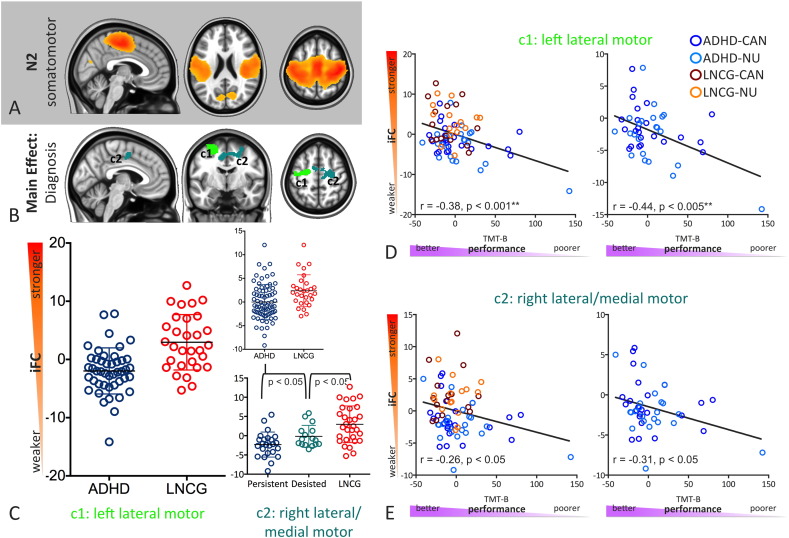
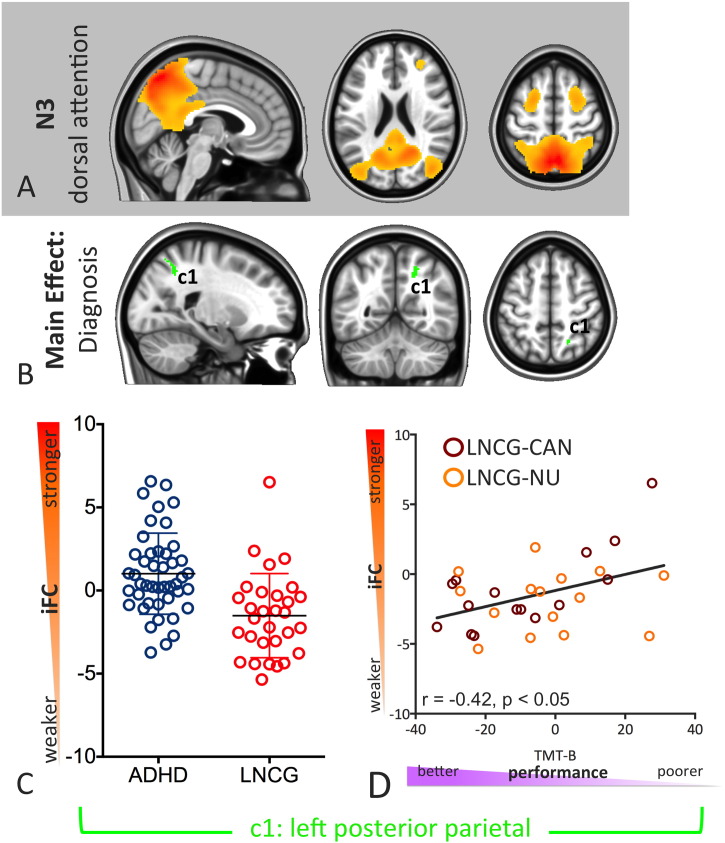
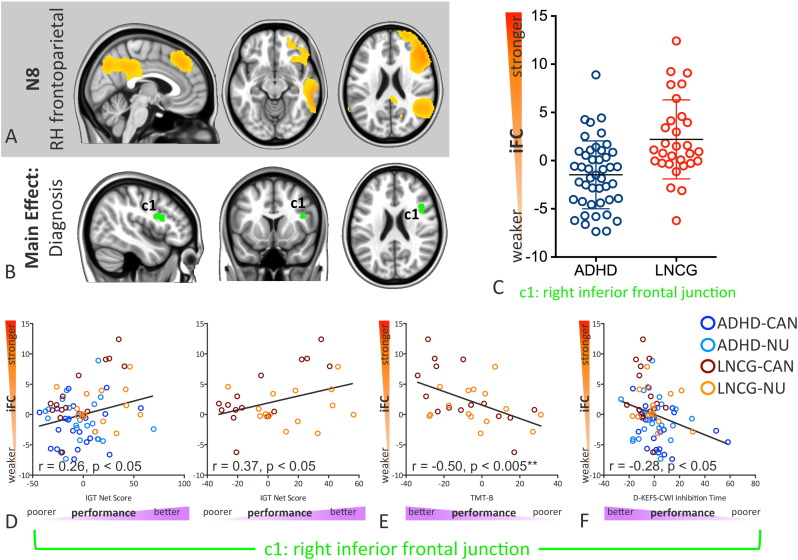
One of the most salient long-term implications of a childhood diagnosis of ADHD is an increased risk for substance use, abuse, or dependence in adolescence and adulthood. The extent to which cannabis use affects ADHD-related alterations in brain functional organization is unknown, however. To address this research gap, we recruited a sample of 75 individuals aged 21-25 years with and without a childhood diagnosis of ADHD Combined Type, who were either frequent users or non-users of cannabis. These participants have been followed longitudinally since age 7-9.9 years as part of a large multi-site longitudinal study of ADHD, the Multimodal Treatment Study of Children with ADHD (MTA). We examined task-independent intrinsic functional connectivity (iFC) within 9 functional networks using a 2 × 2 design, which compared four groups of participants: (1) individuals with a childhood diagnosis of ADHD who currently use cannabis ( = 23); (2) individuals with ADHD who do not currently use cannabis ( = 22); (3) comparisons who currently use cannabis ( = 15); and (4) comparisons who do not currently use cannabis ( = 15). The main effects of childhood ADHD were primarily weakened iFC in networks supporting executive function and somatomotor control. Contrary to expectations, effects of cannabis use were distinct from those of diagnostic group and no interactions were observed. Exploratory brain-behavior analyses suggested that ADHD-related effects were primarily linked with poorer neurocognitive performance. Deficits in the integrity of functional networks supporting executive function and somatomotor control are consistent with the phenotypic and neurocognitive features of ADHD. Our data suggest that cannabis use does not exacerbate ADHD-related alterations, but this finding awaits replication in a larger sample. Longitudinal neuroimaging studies are urgently required to delineate the neurodevelopmental cascade that culminates in positive and negative outcomes for those diagnosed with ADHD in childhood.
儿童期被诊断为注意力缺陷多动障碍(ADHD)最显著的长期影响之一是在青少年期和成年期出现物质使用、滥用或依赖的风险增加。然而,大麻使用对与ADHD相关的大脑功能组织改变的影响程度尚不清楚。为了填补这一研究空白,我们招募了75名年龄在21至25岁之间的个体,他们有的在儿童期被诊断为ADHD合并型,有的则未被诊断,且他们要么是大麻频繁使用者,要么是非使用者。这些参与者从7至9.9岁起就作为一项大型多中心ADHD纵向研究——儿童ADHD多模式治疗研究(MTA)的一部分被纵向跟踪。我们采用2×2设计,在9个功能网络中检查了任务无关的内在功能连接(iFC),该设计比较了四组参与者:(1)儿童期被诊断为ADHD且目前使用大麻的个体(n = 23);(2)患有ADHD但目前不使用大麻的个体(n = 22);(3)目前使用大麻的对照者(n = 15);以及(4)目前不使用大麻的对照者(n = 15)。儿童期ADHD的主要影响主要是支持执行功能和躯体运动控制的网络中iFC减弱。与预期相反,大麻使用的影响与诊断组的影响不同,未观察到相互作用。探索性脑行为分析表明,与ADHD相关的影响主要与较差的神经认知表现有关。支持执行功能和躯体运动控制的功能网络完整性缺陷与ADHD的表型和神经认知特征一致。我们的数据表明,大麻使用不会加剧与ADHD相关的改变,但这一发现有待在更大样本中重复验证。迫切需要进行纵向神经影像学研究,以描绘出导致儿童期被诊断为ADHD的个体出现积极和消极结果的神经发育级联反应。