Oliveira Raphael Gonçalves de, Guedes Dartagnan Pinto
Centro de Pesquisa em Ciências da Saúde, Universidade Norte do Paraná (UNOPAR), Londrina, Paraná, Brazil.
Centro de Ciências da Saúde, Universidade Estadual do Norte do Paraná (UENP), Jacarezinho, Paraná, Brazil.
PLoS One. 2016 Dec 20;11(12):e0168503. doi: 10.1371/journal.pone.0168503. eCollection 2016.
Metabolic syndrome (MetS) has been diagnosed in adolescents and among the associated factors are low levels of physical activity, sedentary behavior over long periods and low cardiorespiratory fitness. However, specifically in adolescents, studies present conflicting results. The aim of the present study was to conduct a systematic review and meta-analysis of observational studies, in order to map the association between physical activity, sedentary behavior, cardiorespiratory fitness and MetS in adolescents.
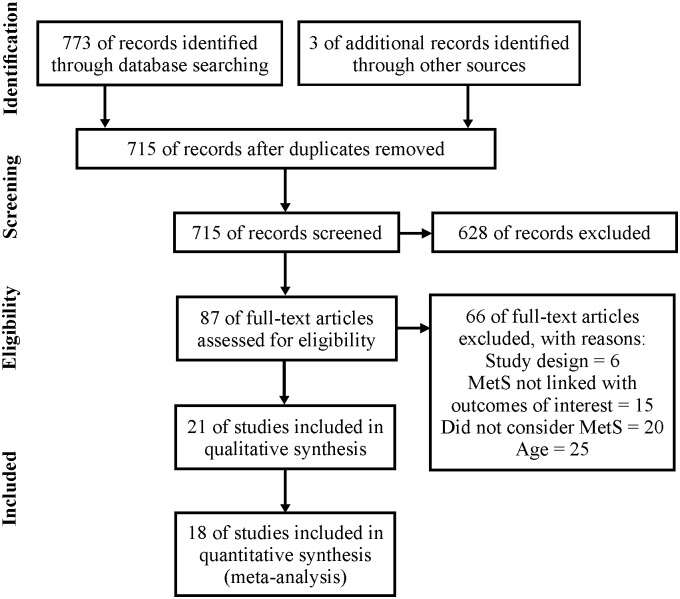
A search was performed in the databases PubMed, SPORTDiscus, LILACS and the Cochrane Library. For the meta-analysis, the odds ratio (OR) was calculated together with the respective confidence intervals (95% CI), in which the measures of effect were analyzed by dichotomous data (exposure variables) with MetS used as events.
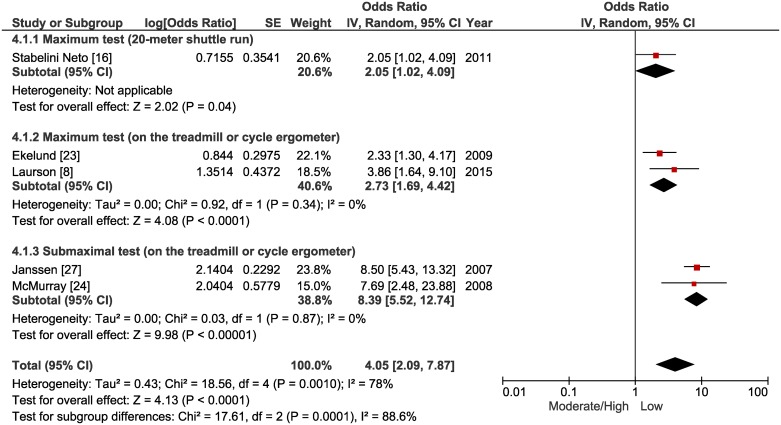
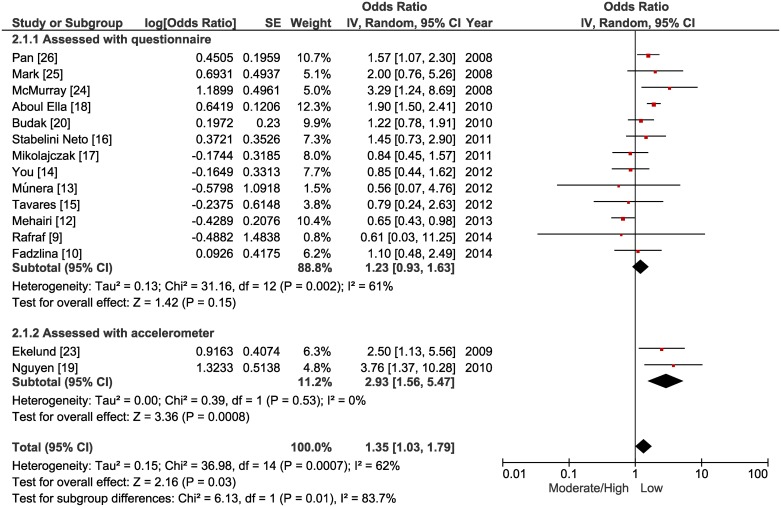
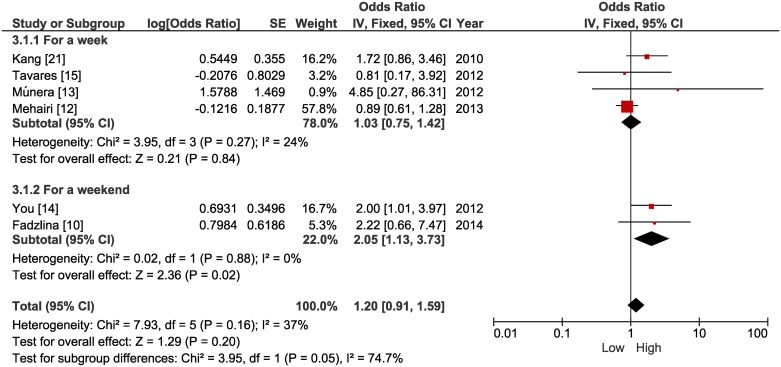
Eighteen studies were included in the meta-analysis. Primary analysis demonstrated that low levels of physical activity (OR = 1.35 [1.03 to 1.79]; p = 0.03) and low cardiorespiratory fitness (OR = 4.05 [2.09 to 7.87]; p < 0.01) were significantly associated with the development of MetS, while for sedentary behavior, represented by screen time > 2 hours/day, a significant association was not identified (OR = 1.20 [0.91 to 1.59]; p = 0.20). Subgroup analyses demonstrated that the association between low physical activity and MetS was dependent on the use of the accelerometry technique (OR = 2.93 [1.56 to 5.47]; p < 0.01). Screen time > 2 hours/day was significantly associated with MetS only on weekends (OR = 2.05 [1.13 to 3.73]; p = 0.02). With respect to cardiorespiratory fitness, a significant association with MetS was found independent of the maximal oxygen uptake (VO2max) measurement method.
Low levels of physical activity, low indices of cardiorespiratory fitness and sedentary behavior, represented by screen time > 2 hours/day on weekends, were significantly associated with the development of MetS in adolescence.
代谢综合征(MetS)已在青少年中被诊断出来,其相关因素包括身体活动水平低、长期久坐行为以及心肺适能低。然而,特别是在青少年中,研究结果相互矛盾。本研究的目的是对观察性研究进行系统综述和荟萃分析,以梳理青少年身体活动、久坐行为、心肺适能与代谢综合征之间的关联。
在PubMed、SPORTDiscus、LILACS和Cochrane图书馆数据库中进行检索。对于荟萃分析,计算比值比(OR)及其各自的置信区间(95%CI),其中效应量通过以代谢综合征为事件的二分数据(暴露变量)进行分析。
18项研究被纳入荟萃分析。初步分析表明,身体活动水平低(OR = 1.35 [1.03至1.79];p = 0.03)和心肺适能低(OR = 4.05 [2.09至7.87];p < 0.01)与代谢综合征的发生显著相关,而对于以每天屏幕时间>2小时为代表的久坐行为,未发现显著关联(OR = 1.20 [0.91至1.59];p = 0.20)。亚组分析表明,身体活动水平低与代谢综合征之间的关联取决于加速度计技术的使用(OR = 2.93 [1.56至5.47];p < 0.01)。仅在周末,每天屏幕时间>2小时与代谢综合征显著相关(OR = 2.05 [1.13至3.73];p = 0.02)。关于心肺适能,发现与代谢综合征的显著关联与最大摄氧量(VO2max)测量方法无关。
身体活动水平低、心肺适能指标低以及以周末每天屏幕时间>2小时为代表的久坐行为与青少年代谢综合征的发生显著相关。