Janssen Inger M, Scheibler Fueloep, Gerhardus Ansgar
Department of Epidemiology and International Public Health, University of Bielefeld, Bielefeld.
Department of Non-Drug Interventions, Institute for Quality and Efficiency in Health Care, Cologne.
Patient Prefer Adherence. 2016 Dec 13;10:2491-2500. doi: 10.2147/PPA.S122319. eCollection 2016.
The selection of important outcomes is a crucial decision for clinical research and health technology assessment (HTA), and there is ongoing debate about which stakeholders should be involved. Hemodialysis is a complex treatment for chronic kidney disease (CKD) and affects many outcomes. Apart from obvious outcomes, such as mortality, morbidity and health-related quality of life (HRQoL), others such as, concerning daily living or health care provision, may also be important. The aim of our study was to analyze to what extent the preferences for patient-relevant outcomes differed between various stakeholders. We compared preferences of stakeholders normally or occasionally involved in outcome prioritization (patients from a self-help group, clinicians and HTA authors) with those of a large reference group of patients.
The reference group consisted of 4,518 CKD patients investigated previously. We additionally recruited CKD patients via a regional self-help group, nephrologists via an online search and HTA authors via an expert database or personal contacts. All groups assessed the relative importance of the 23 outcomes by means of a discrete visual analog scale. We used descriptive statistics to rank outcomes and compare the results between groups.
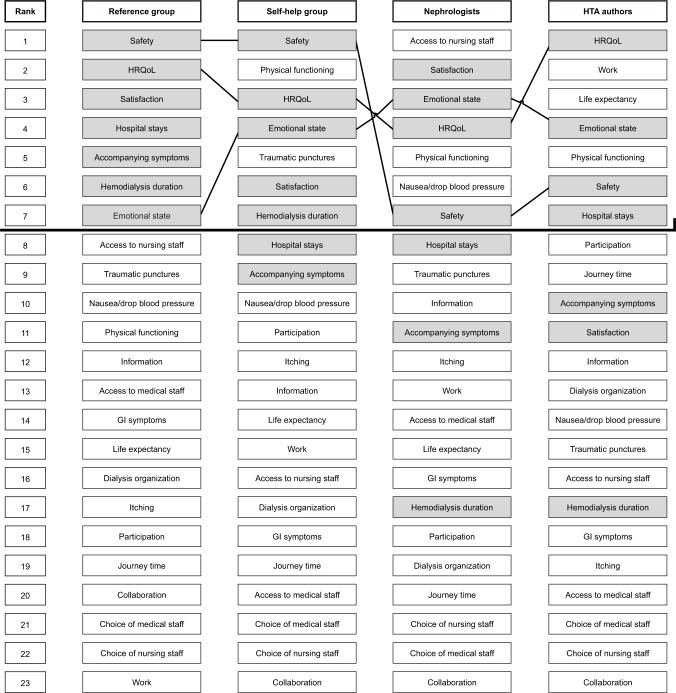
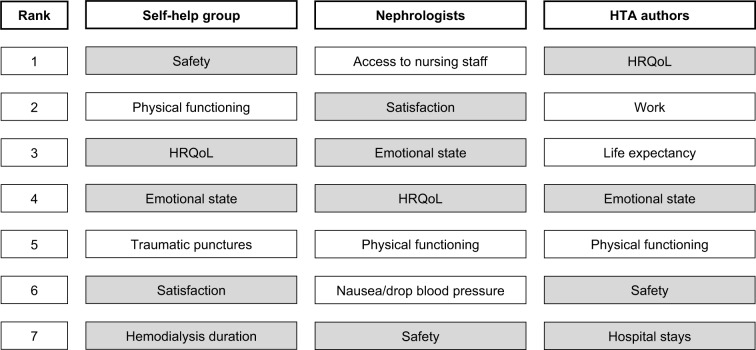
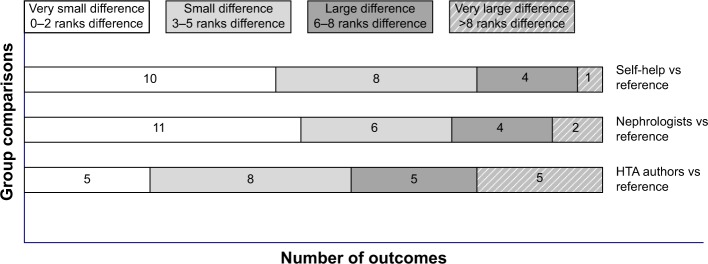
We received completed questionnaires from 49 self-help group patients, 19 nephrologists and 18 HTA authors. Only the following 3 outcomes were ranked within the top 7 outcomes by all 4 groups: safety, HRQoL and emotional state. The ratings by the self-help group were generally more concordant with the reference group ratings than those by nephrologists, while HTA authors showed the least concordance.
Preferences of CKD patients from a self-help group, nephrologists and HTA authors differ to a varying extent from those of a large reference group of patients with CKD. The preferences of all stakeholders should form the basis of a transparent approach so as to generate a valid list of important outcomes.
重要结局的选择是临床研究和卫生技术评估(HTA)的关键决策,关于应让哪些利益相关者参与这一问题,目前仍存在争议。血液透析是慢性肾脏病(CKD)的一种复杂治疗方式,会影响多种结局。除了死亡率、发病率和健康相关生活质量(HRQoL)等明显结局外,其他如日常生活或医疗保健方面的结局也可能很重要。我们研究的目的是分析不同利益相关者对患者相关结局的偏好存在多大差异。我们将通常或偶尔参与结局优先级确定的利益相关者(自助小组的患者、临床医生和HTA作者)的偏好与一个大型患者参考组的偏好进行了比较。
参考组由先前调查的451名CKD患者组成。我们还通过一个地区自助小组招募了CKD患者,通过在线搜索招募了肾病学家,并通过专家数据库或个人联系招募了HTA作者。所有组通过离散视觉模拟量表评估了23种结局的相对重要性。我们使用描述性统计对结局进行排名,并比较组间结果。
我们收到了49名自助小组患者、19名肾病学家和18名HTA作者填写完整的问卷。所有4个组都将其列为前7位结局的只有以下3种:安全性、HRQoL和情绪状态。与肾病学家相比,自助小组的评分总体上与参考组的评分更一致,而HTA作者的一致性最低。
自助小组的CKD患者、肾病学家和HTA作者的偏好与一个大型CKD患者参考组的偏好存在不同程度的差异。所有利益相关者的偏好都应构成一种透明方法的基础,以便生成一份有效的重要结局清单。