Schoot Tessa S, Goto Namiko A, van Marum Rob J, Hilbrands Luuk B, Kerckhoffs Angèle P M
Department of Nephrology, Radboud University Medical Center, Radboud Institute for Health Sciences, Nijmegen, the Netherlands.
Department of Nephrology, Jeroen Bosch Hospital, 's-Hertogenbosch, the Netherlands.
Int Urol Nephrol. 2022 Nov;54(11):2891-2900. doi: 10.1007/s11255-022-03208-2. Epub 2022 May 6.
In older patients, the choice between kidney transplantation (KT) and dialysis may be complicated because of a high prevalence of comorbidities and geriatric syndromes. Ideally, this decision-making process focusses on older patients' outcome priorities, which frequently include functional, psychological, and quality of life (QOL)-related outcomes.
This systematic review aims to summarize functional, psychological (including cognition), and QOL-related outcomes after start of kidney replacement therapy (KRT) in older adults.
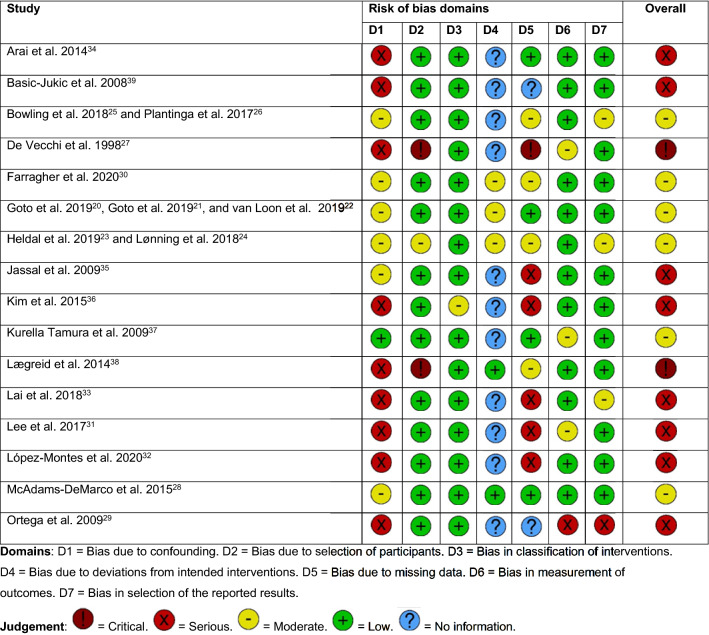
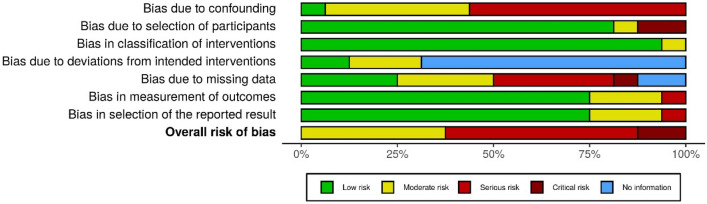
We searched PubMed and Embase for research that investigated change in these variables after start of KRT in patients aged ≥ 60 years. Data were extracted using the summary measures reported in the individual studies. Risk of bias was assessed with the ROBINS-I tool.
Sixteen observational studies (prospective n = 9, retrospective n = 7; KT-recipients n = 3, dialysis patients n = 13) were included. The results show that QOL improves in the majority of the older KT recipients. After start of dialysis, QOL improved or remained stable for most patients, but this seems less prevalent than after KT. Functional status decreases in a substantial part of the older dialysis patients. Furthermore, the incidence of serious fall injuries increases after start of dialysis. Nutritional status seems to improve after start of dialysis.
The interpretability and comparability of the included studies are limited by the heterogeneity in study designs and significant risk of bias in most studies. Despite this, our overview of functional, psychological (including cognition), and QOL-related outcomes is useful for older adults and their clinicians facing the decision between KT and dialysis.
在老年患者中,由于合并症和老年综合征的高患病率,肾移植(KT)和透析之间的选择可能会很复杂。理想情况下,这一决策过程应关注老年患者的结局优先级,这些优先级通常包括功能、心理和生活质量(QOL)相关的结局。
本系统评价旨在总结老年成人开始肾脏替代治疗(KRT)后的功能、心理(包括认知)和QOL相关结局。
我们在PubMed和Embase中检索了研究≥60岁患者开始KRT后这些变量变化的研究。使用各研究报告的汇总指标提取数据。采用ROBINS-I工具评估偏倚风险。
纳入了16项观察性研究(前瞻性研究n =9,回顾性研究n =7;KT受者n =3,透析患者n =13)结果显示,大多数老年KT受者的QOL有所改善。开始透析后,大多数患者的QOL有所改善或保持稳定,但这似乎不如KT后普遍常见。相当一部分老年透析患者的功能状态下降。此外,开始透析后严重跌倒损伤发生率增加。开始透析后营养状况似乎有所改善。
纳入研究的可解释性及可比性因研究设计的异质性以及大多数研究所存在的显著偏倚风险而受到限制。尽管如此,我们对功能、心理(包括认知)及QOL相关结局的概述,对于面临KT和透析决策选择的老年成人及其临床医生而言是有用的。