Nishio Shin-Ya, Usami Shin-Ichi
Department of Otorhinolaryngology, Shinshu University School of Medicine, Matsumoto City, Japan.
Hum Mutat. 2017 Mar;38(3):252-259. doi: 10.1002/humu.23160. Epub 2017 Jan 11.
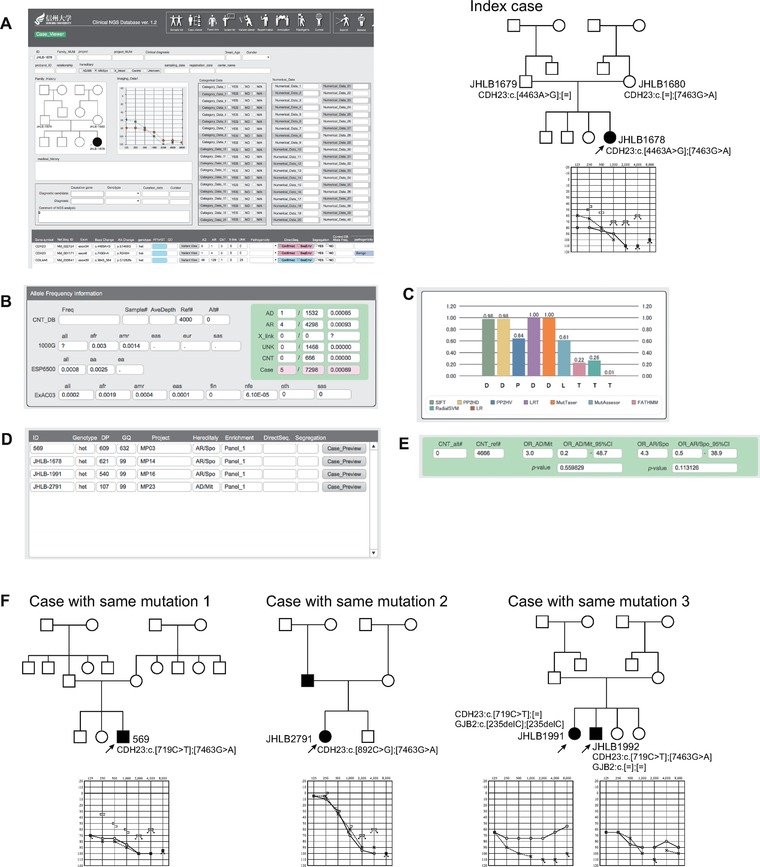
Recent advances in next-generation sequencing (NGS) have given rise to new challenges due to the difficulties in variant pathogenicity interpretation and large dataset management, including many kinds of public population databases as well as public or commercial disease-specific databases. Here, we report a new database development tool, named the "Clinical NGS Database," for improving clinical NGS workflow through the unified management of variant information and clinical information. This database software offers a two-feature approach to variant pathogenicity classification. The first of these approaches is a phenotype similarity-based approach. This database allows the easy comparison of the detailed phenotype of each patient with the average phenotype of the same gene mutation at the variant or gene level. It is also possible to browse patients with the same gene mutation quickly. The other approach is a statistical approach to variant pathogenicity classification based on the use of the odds ratio for comparisons between the case and the control for each inheritance mode (families with apparently autosomal dominant inheritance vs. control, and families with apparently autosomal recessive inheritance vs. control). A number of case studies are also presented to illustrate the utility of this database.
由于在变异致病性解读和大型数据集管理方面存在困难,包括多种公共人群数据库以及公共或商业疾病特异性数据库,新一代测序(NGS)的最新进展带来了新的挑战。在此,我们报告一种名为“临床NGS数据库”的新数据库开发工具,通过对变异信息和临床信息的统一管理来改进临床NGS工作流程。该数据库软件提供了两种变异致病性分类方法。其中第一种方法是基于表型相似性的方法。该数据库允许轻松地将每个患者的详细表型与同一基因突变在变异或基因水平的平均表型进行比较。还能够快速浏览具有相同基因突变的患者。另一种方法是基于使用比值比进行变异致病性分类的统计方法,用于每种遗传模式下病例与对照之间的比较(明显常染色体显性遗传家族与对照,以及明显常染色体隐性遗传家族与对照)。还展示了多个案例研究以说明该数据库的实用性。