Keane Sarah C, Summers Michael F
Howard Hughes Medical Institute, Department of Chemistry and Biochemistry, University of Maryland Baltimore County, 1000 Hilltop Circle, Baltimore, MD 21250, USA.
Viruses. 2016 Dec 21;8(12):338. doi: 10.3390/v8120338.
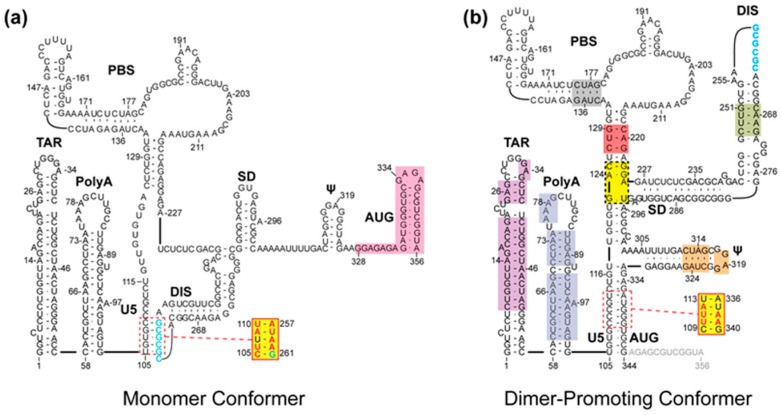
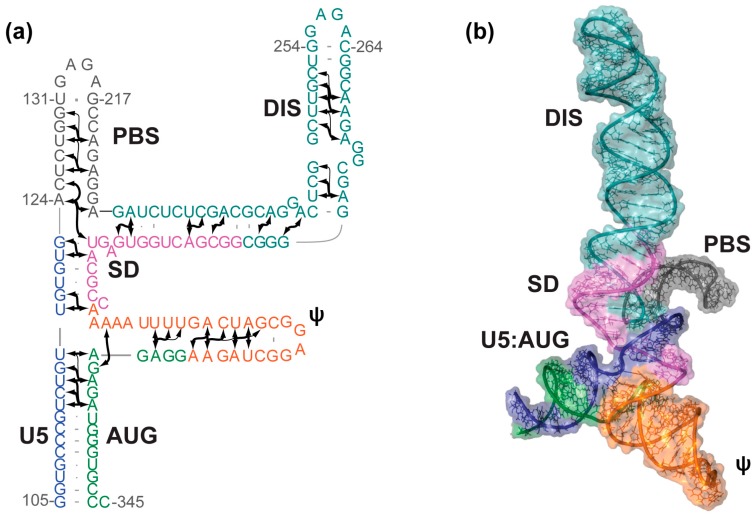
The 5'-leader of the human immunodeficiency virus type 1 (HIV-1) genome plays several critical roles during viral replication, including differentially establishing mRNA versus genomic RNA (gRNA) fates. As observed for proteins, the function of the RNA is tightly regulated by its structure, and a common paradigm has been that genome function is temporally modulated by structural changes in the 5'-leader. Over the past 30 years, combinations of nucleotide reactivity mapping experiments with biochemistry, mutagenesis, and phylogenetic studies have provided clues regarding the secondary structures of stretches of residues within the leader that adopt functionally discrete domains. More recently, nuclear magnetic resonance (NMR) spectroscopy approaches have been developed that enable direct detection of intra- and inter-molecular interactions within the intact leader, providing detailed insights into the structural determinants and mechanisms that regulate HIV-1 genome packaging and function.
人类免疫缺陷病毒1型(HIV-1)基因组的5'前导序列在病毒复制过程中发挥着几个关键作用,包括差异决定信使核糖核酸(mRNA)与基因组核糖核酸(gRNA)的命运。正如在蛋白质中观察到的那样,RNA的功能受到其结构的严格调控,一个常见的模式是基因组功能由5'前导序列中的结构变化进行时间调控。在过去30年中,核苷酸反应性图谱实验与生物化学、诱变和系统发育研究相结合,为前导序列中采用功能离散结构域的残基片段的二级结构提供了线索。最近,已经开发出核磁共振(NMR)光谱方法,能够直接检测完整前导序列内的分子内和分子间相互作用,从而深入了解调节HIV-1基因组包装和功能的结构决定因素和机制。