Mortensen Laust H, Rehnberg Johan, Dahl Espen, Diderichsen Finn, Elstad Jon Ivar, Martikainen Pekka, Rehkopf David, Tarkiainen Lasse, Fritzell Johan
Section of Social Medicine, University of Copenhagen, Copenhagen, Denmark.
Centre for Health Equity Studies (CHESS), Karolinska Institutet and Stockholm University, Sweden.
BMJ Open. 2016 Dec 23;6(12):e010974. doi: 10.1136/bmjopen-2015-010974.
Prior work has examined the shape of the income-mortality association, but work has not compared gradients between countries. In this study, we focus on changes over time in the shape of income-mortality gradients for 4 Nordic countries during a period of rising income inequality. Context and time differentials in shape imply that the relationship between income and mortality is not fixed.
Population-based cohort study of Denmark, Finland, Norway and Sweden.
We collected data on individuals aged 25 or more in 1995 (n=12.98 million individuals, 0.84 million deaths) and 2003 (n=13.08 million individuals, 0.90 million deaths). We then examined the household size equivalised disposable income at the baseline year in relation to the rate of mortality in the following 5 years.
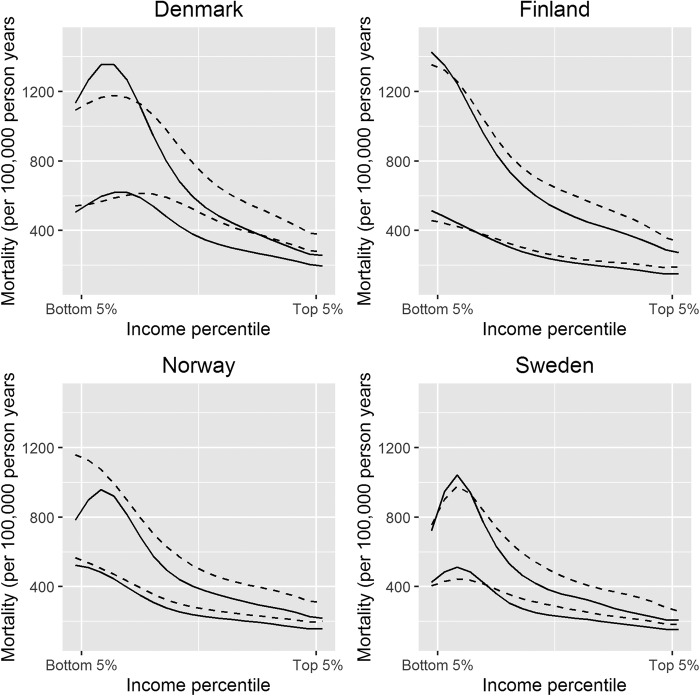
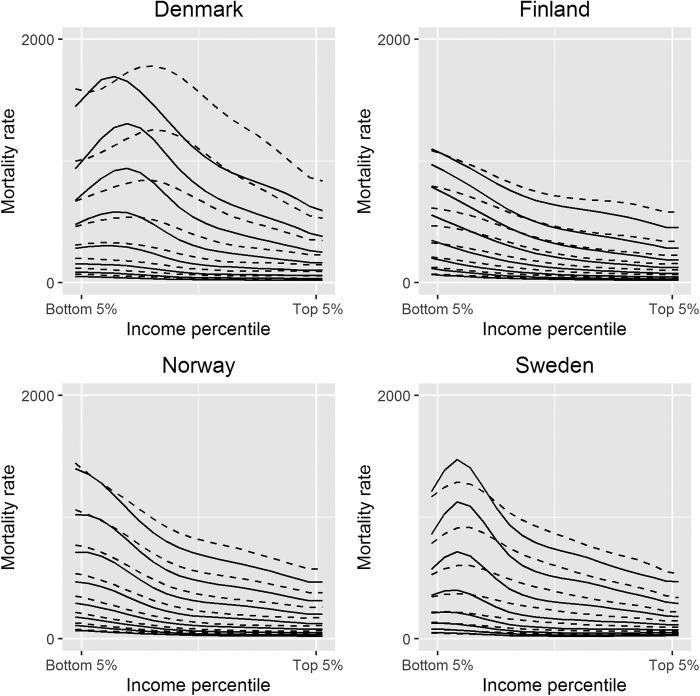
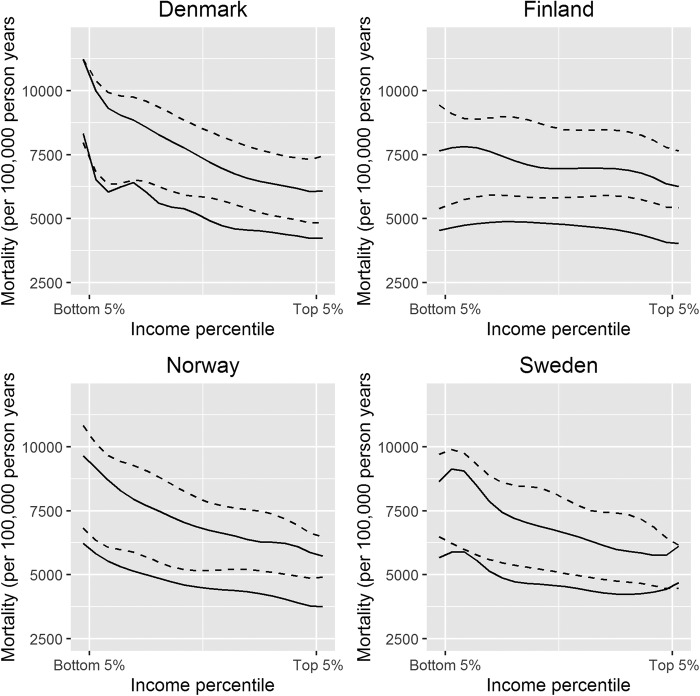
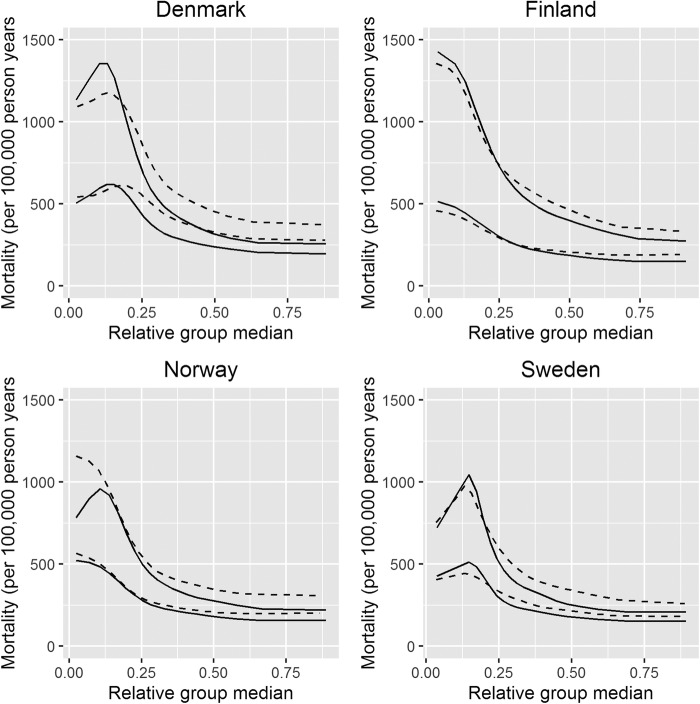
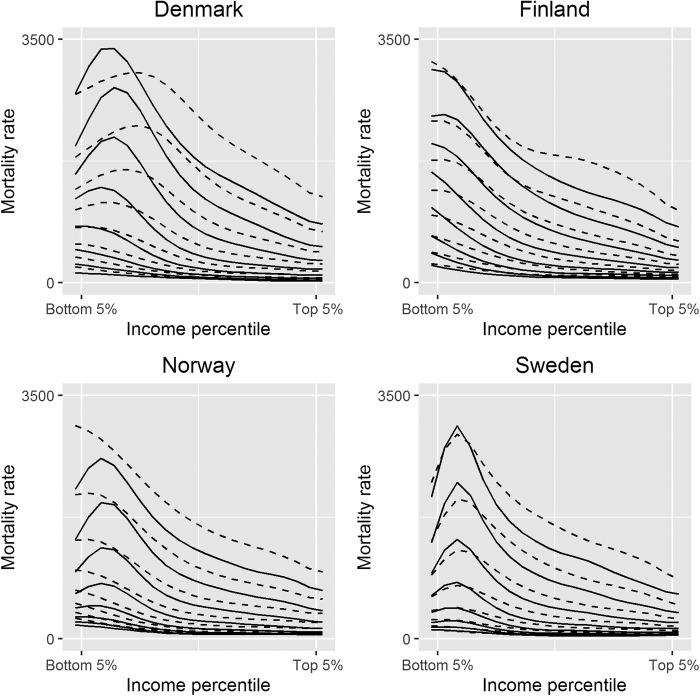
A steep income gradient in mortality in men and women across all age groups except the oldest old in Denmark, Finland, Norway and Sweden. From the 1990s to 2000s mortality dropped, but generally more so in the upper part of the income distribution than in the lower part. As a consequence, the shape of the income gradient in mortality changed. The shift in the shape of the association was similar in all 4 countries.
A non-linear gradient exists between income and mortality in most cases and because of a more rapid mortality decline among those with high income the income gradient has become steeper over time.
以往的研究探讨了收入与死亡率之间关联的形式,但尚未对不同国家之间的梯度进行比较。在本研究中,我们关注4个北欧国家在收入不平等加剧期间,收入-死亡率梯度形式随时间的变化。关联形式的背景和时间差异意味着收入与死亡率之间的关系并非固定不变。
基于丹麦、芬兰、挪威和瑞典人口的队列研究。
我们收集了1995年(n = 1298万例个体,84万例死亡)和2003年(n = 1308万例个体,90万例死亡)年龄在25岁及以上个体的数据。然后我们考察了基线年份的家庭规模等效可支配收入与随后5年的死亡率之间的关系。
在丹麦、芬兰、挪威和瑞典,除了最年长的老年人之外,所有年龄组的男性和女性死亡率均呈现出陡峭的收入梯度。从20世纪90年代到21世纪初,死亡率有所下降,但总体而言,收入分布较高部分的下降幅度大于较低部分。因此,死亡率的收入梯度形式发生了变化。所有4个国家的关联形式变化相似。
在大多数情况下,收入与死亡率之间存在非线性梯度,并且由于高收入人群的死亡率下降更快,随着时间的推移,收入梯度变得更加陡峭。