Marynissen S J J, Willems A L, Paepe D, Smets P M Y, Picavet P, Duchateau L, Daminet S
Department of Medicine and Clinical Biology of Small Animals, Faculty of Veterinary Medicine, Ghent University, Merelbeke, Belgium.
Hill's Pet Nutrition, Inc, Merelbeke, Belgium.
J Vet Intern Med. 2017 Jan;31(1):93-101. doi: 10.1111/jvim.14635. Epub 2016 Dec 25.
Up to 25% of elderly humans have proteinuria, often associated with underlying lesions. Data concerning the presence of proteinuria in elderly dogs is scarce.
To describe the presence and persistence of proteinuria and to compare urinary protein : creatinine ratio (UPC) between free catch and cystocentesis urine samples in apparently healthy elderly dogs.
Hundred apparently healthy elderly dogs.
Prospective study. Owners of 100 elderly dogs were asked to collect 2 free catch urine samples. Dogs were considered healthy based on owner's perception and an age chart, based on ideal bodyweight, was used to define dogs as senior or geriatric. UPC of urine collected by free catch and cystocentesis were compared. Overt proteinuria and borderline proteinuria were defined as UPC >0.5 and between 0.2 and 0.5, respectively, if examination of sediment did not explain proteinuria. Proteinuria was considered persistent if present at both sampling times.
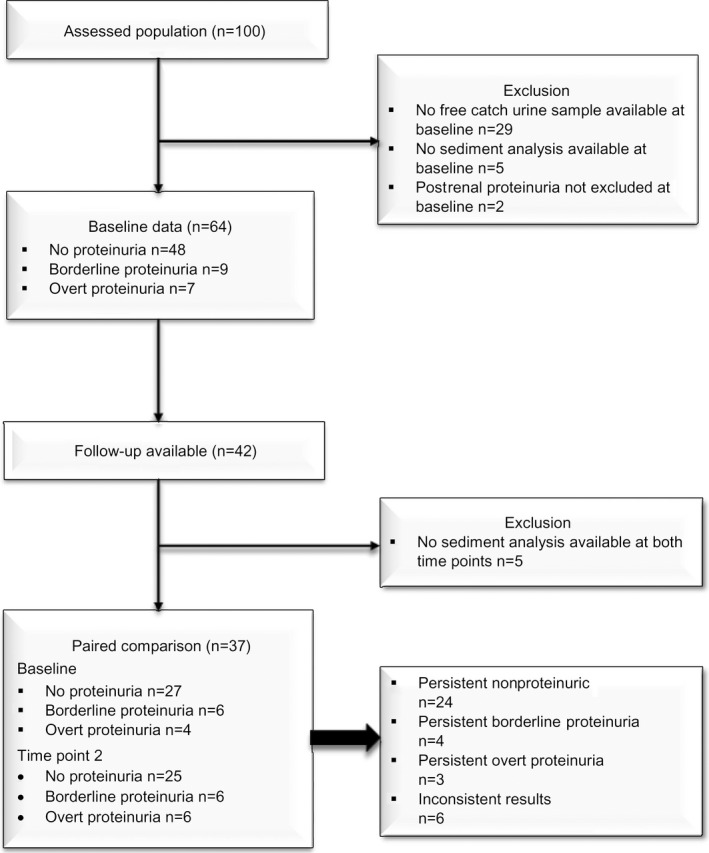
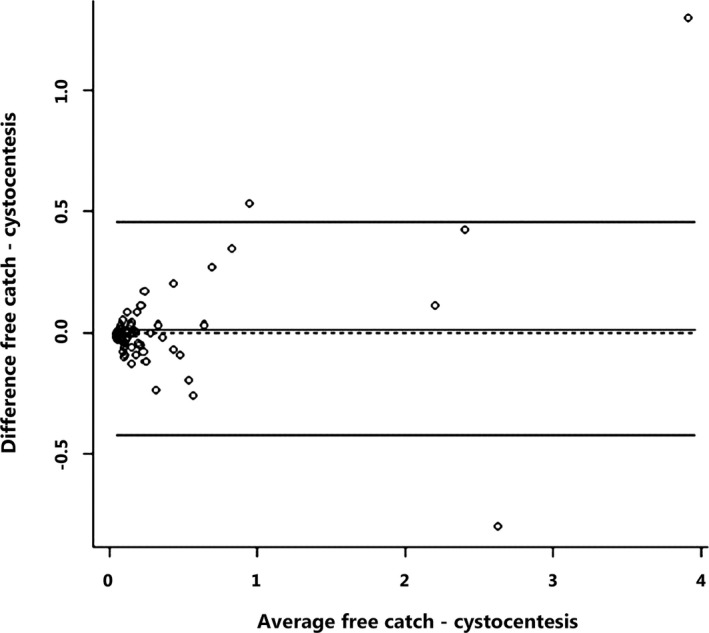
At baseline, 71 owners succeeded in collecting urine. Eleven percent of dogs had overt proteinuria, 14% were borderline proteinuric, and 75% nonproteinuric. Thirty-seven repeated urine samples, with a median time interval of 31 days (range 10-90), were available. Nineteen percent of dogs had a persistently increased UPC (>0.2), with persistent overt proteinuria present in 8%. A strong correlation (ρ = 0.88) was found between UPC of urine collected by free catch and cystocentesis.
As 19% of study dogs had persistent proteinuria, our findings emphasize that measurement of proteinuria should be part of geriatric health screening. For UPC in dogs, free catch urine provides a good alternative to cystocentesis.
高达25%的老年人存在蛋白尿,常与潜在病变相关。关于老年犬蛋白尿存在情况的数据稀缺。
描述蛋白尿的存在和持续性,并比较明显健康的老年犬自由采集尿样和膀胱穿刺尿样之间的尿蛋白:肌酐比值(UPC)。
100只明显健康的老年犬。
前瞻性研究。要求100只老年犬的主人采集2份自由采集的尿样。根据主人的认知判断犬只健康状况,并使用基于理想体重的年龄图表将犬只定义为老年或高龄。比较自由采集和膀胱穿刺采集尿液的UPC。如果沉淀物检查不能解释蛋白尿,则将显性蛋白尿和临界蛋白尿分别定义为UPC>0.5和介于0.2至0.5之间。如果两次采样时均存在蛋白尿,则认为蛋白尿持续存在。
基线时,71位主人成功采集到尿液。11%的犬有显性蛋白尿,14%为临界蛋白尿,75%无蛋白尿。可获得37份重复尿样,中位时间间隔为31天(范围10 - 90天)。19%的犬UPC持续升高(>0.2),其中8%存在持续的显性蛋白尿。自由采集和膀胱穿刺采集尿液的UPC之间存在强相关性(ρ = 0.88)。
由于19%的研究犬存在持续性蛋白尿,我们的研究结果强调蛋白尿测量应成为老年健康筛查的一部分。对于犬的UPC,自由采集尿液是膀胱穿刺的良好替代方法。