Meyer Sebastian, Held Leonhard
Institute of Medical Informatics, Biometry, and Epidemiology, Friedrich-Alexander-Universität Erlangen-Nürnberg,Waldstraße 6, DE-91054 Erlangen,
Epidemiology, Biostatistics and Prevention Institute, University of Zurich, Hirschengraben 84, CH-8001 Zürich, Switzerland.
Biostatistics. 2017 Apr 1;18(2):338-351. doi: 10.1093/biostatistics/kxw051.
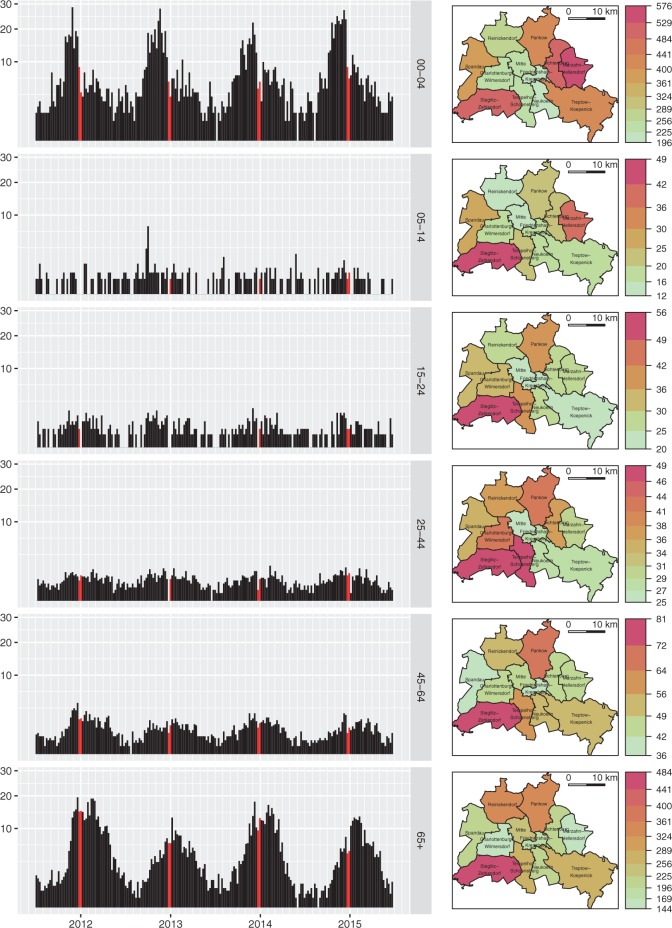
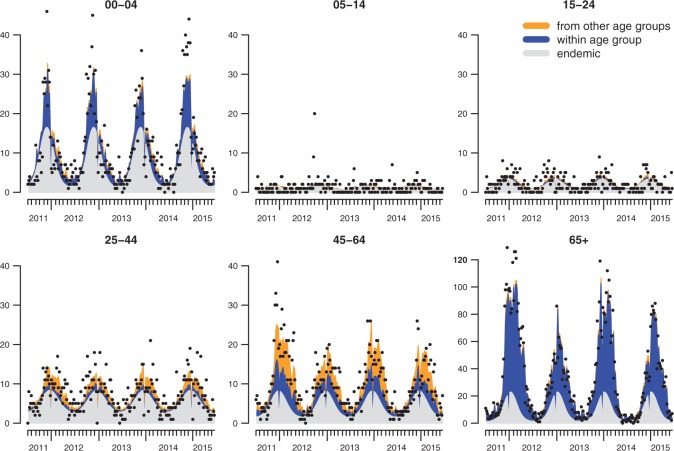
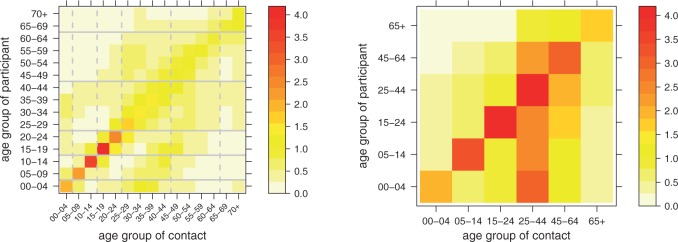
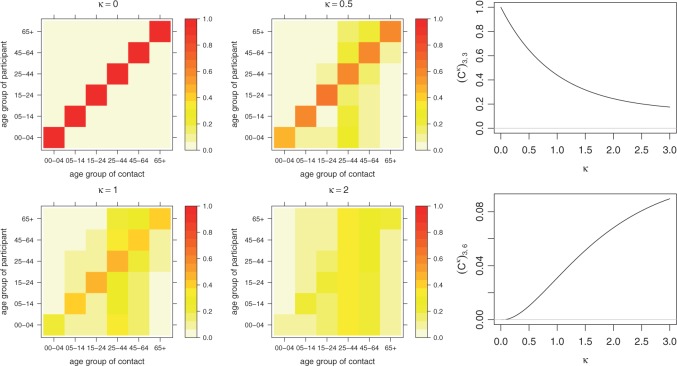
Routine public health surveillance of notifiable infectious diseases gives rise to weekly counts of reported cases-possibly stratified by region and/or age group. We investigate how an age-structured social contact matrix can be incorporated into a spatio-temporal endemic-epidemic model for infectious disease counts. To illustrate the approach, we analyze the spread of norovirus gastroenteritis over six age groups within the 12 districts of Berlin, 2011-2015, using contact data from the POLYMOD study. The proposed age-structured model outperforms alternative scenarios with homogeneous or no mixing between age groups. An extended contact model suggests a power transformation of the survey-based contact matrix toward more within-group transmission.
对法定传染病进行的常规公共卫生监测会产生每周报告病例数,可能会按地区和/或年龄组进行分层。我们研究了如何将年龄结构的社会接触矩阵纳入传染病病例数的时空地方病-流行病模型。为了说明该方法,我们利用POLYMOD研究的接触数据,分析了2011年至2015年期间诺如病毒胃肠炎在柏林12个区的六个年龄组中的传播情况。所提出的年龄结构模型优于年龄组之间均匀混合或无混合的替代方案。一个扩展的接触模型表明,基于调查的接触矩阵向更多组内传播的幂变换。