Chen Ling-Wei, Aris Izzuddin M, Bernard Jonathan Y, Tint Mya-Thway, Chia Airu, Colega Marjorelee, Gluckman Peter D, Shek Lynette Pei-Chi, Saw Seang-Mei, Chong Yap-Seng, Yap Fabian, Godfrey Keith M, van Dam Rob M, Chong Mary Foong-Fong, Lee Yung Seng
Department of Paediatrics, Yong Loo Lin School of Medicine, National University of Singapore, Singapore 119228, Singapore.
Singapore Institute for Clinical Sciences, Agency for Science, Technology and Research, Singapore 117609, Singapore.
Nutrients. 2016 Dec 22;9(1):2. doi: 10.3390/nu9010002.
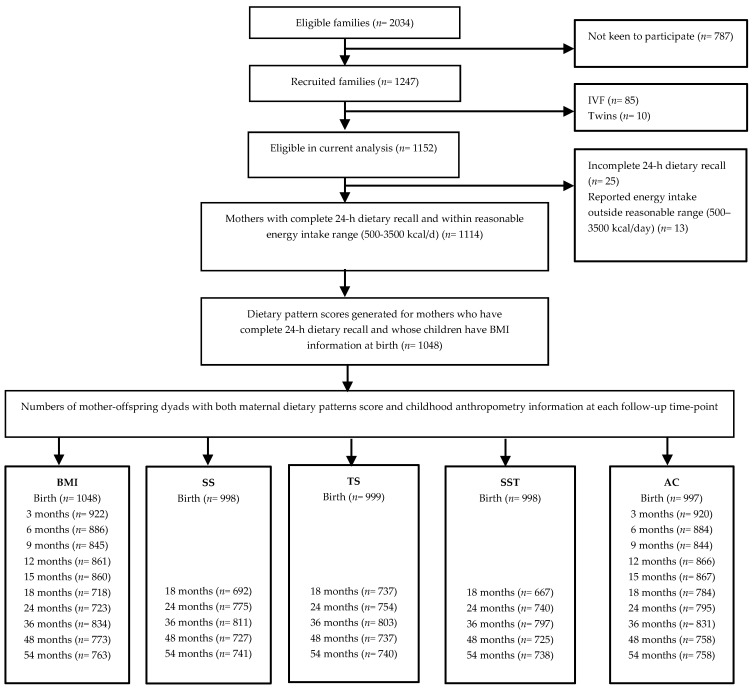
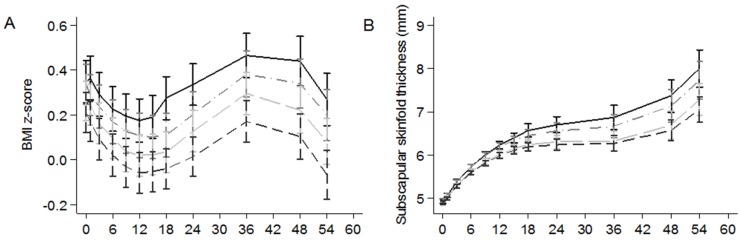
Most studies linking maternal diet with offspring adiposity have focused on single nutrients or foods, but a dietary pattern approach is more representative of the overall diet. We thus aimed to investigate the relations between maternal dietary patterns and offspring adiposity in a multi-ethnic Asian mother-offspring cohort in Singapore. We derived maternal dietary patterns using maternal dietary intake information at 26-28 weeks of gestation, of which associations with offspring body mass index (BMI), abdominal circumference (AC), subscapular skinfold (SS), and triceps skinfold (TS) were assessed using longitudinal data analysis (linear mixed effects (LME)) and multiple linear regression at ages 0, 3, 6, 9, 12, 15, 18, 24, 36, 48, and 54 months. Three dietary patterns were derived: (1) vegetables-fruit-and-white rice (VFR); (2) seafood-and-noodles (SfN); and (3) pasta-cheese-and-bread (PCB). In the LME model adjusting for potential confounders, each standard deviation (SD) increase in maternal VFR pattern score was associated with 0.09 mm lower offspring TS. Individual time-point analysis additionally revealed that higher VFR score was generally associated with lower postnatal offspring BMI -score, TS, SS, and sum of skinfolds (SS + TS) at ages 18 months and older. Maternal adherence to a dietary pattern characterized by higher intakes of fruit and vegetables and lower intakes of fast food was associated with lower offspring adiposity.
大多数将母亲饮食与后代肥胖联系起来的研究都集中在单一营养素或食物上,但饮食模式方法更能代表整体饮食。因此,我们旨在调查新加坡一个多民族亚洲母婴队列中母亲饮食模式与后代肥胖之间的关系。我们利用妊娠26至28周时母亲的饮食摄入信息得出母亲的饮食模式,并使用纵向数据分析(线性混合效应(LME))以及在0、3、6、9、12、15、18、24、36、48和54个月龄时的多元线性回归,评估其与后代体重指数(BMI)、腹围(AC)、肩胛下皮褶厚度(SS)和肱三头肌皮褶厚度(TS)的关联。得出了三种饮食模式:(1)蔬菜-水果-白米(VFR);(2)海鲜-面条(SfN);以及(3)意大利面-奶酪-面包(PCB)。在调整了潜在混杂因素的LME模型中,母亲VFR模式得分每增加一个标准差(SD),后代TS就会降低0.09毫米。个体时间点分析还显示,较高的VFR得分通常与18个月及以上后代的出生后BMI得分、TS、SS以及皮褶厚度总和(SS + TS)较低有关。母亲坚持以较高水果和蔬菜摄入量以及较低快餐摄入量为特征的饮食模式与较低的后代肥胖有关。