Bowtell J L, Jackman S R, Scott S, Connolly L J, Mohr M, Ermidis G, Julian R, Yousefian F, Helge E W, Jørgensen N R, Fulford J, Knapp K M, Krustrup P
Sport and Health Sciences, College of Life and Environmental Sciences, St Luke's Campus, University of Exeter, Exeter, UK.
Centre of Health and Human Performance, Department of Food, Nutrition and Sport Science, University of Gothenburg, Gothenburg, Sweden; Centre of Health Sciences, Faculty of Natural and Health Sciences, University of the Faroe Islands, Tórshavn, Faroe Islands.
Biomed Res Int. 2016;2016:3574258. doi: 10.1155/2016/3574258. Epub 2016 Nov 29.
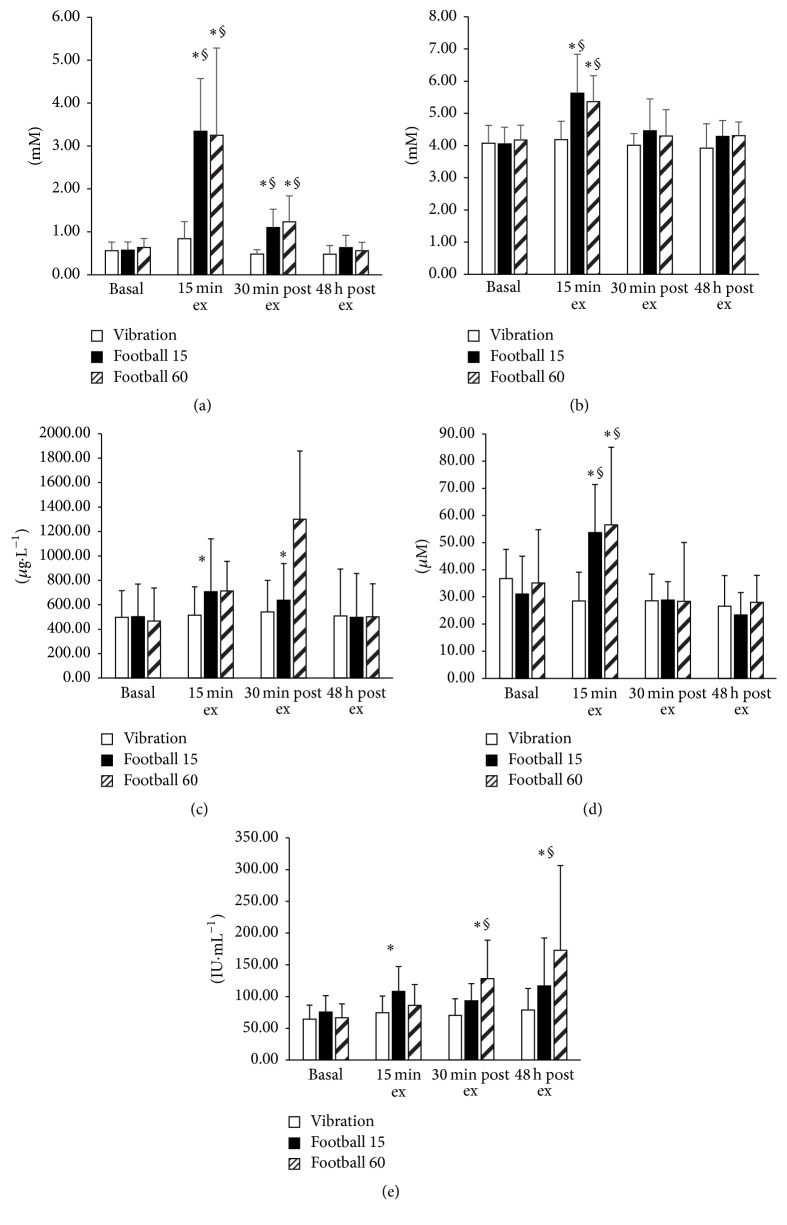
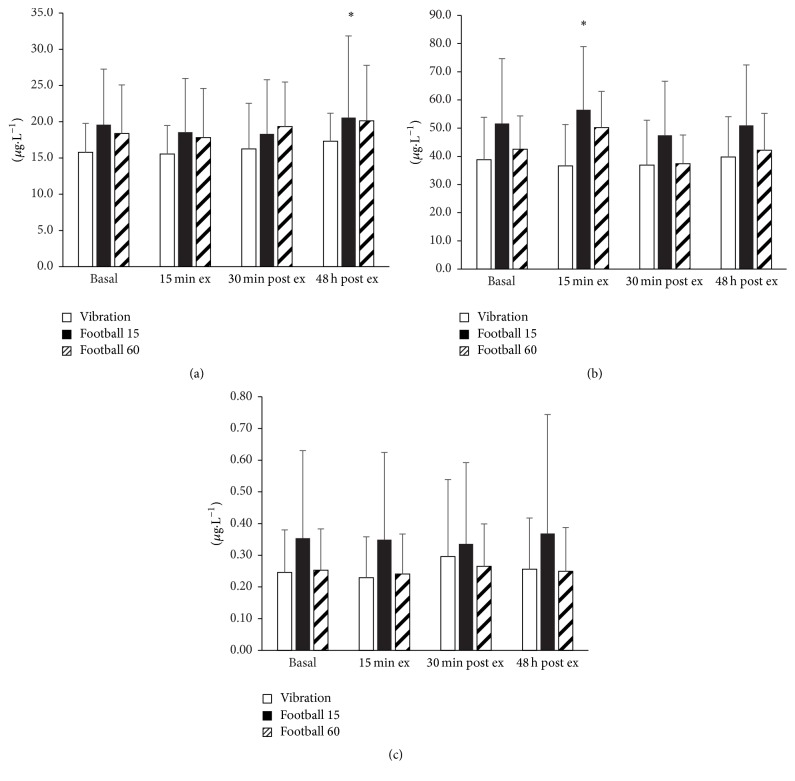
We aimed to study whether short-duration vibration exercise or football sessions of two different durations acutely changed plasma markers of bone turnover and muscle strain. Inactive premenopausal women ( = 56) were randomized to complete a single bout of short (FG15) or long duration (FG60) small sided football or low magnitude whole body vibration training (VIB). Procollagen type 1 amino-terminal propeptide (P1NP) was increased during exercise for FG15 (51.6 ± 23.0 to 56.5 ± 22.5 g·L, mean ± SD, < 0.05) and FG60 (42.6 ± 11.8 to 50.2 ± 12.8 g·L, < 0.05) but not for VIB (38.8 ± 15.1 to 36.6 ± 14.7 g·L, > 0.05). An increase in osteocalcin was observed 48 h after exercise ( < 0.05), which did not differ between exercise groups. C-terminal telopeptide of type 1 collagen was not affected by exercise. Blood lactate concentration increased during exercise for FG15 (0.6 ± 0.2 to 3.4 ± 1.2 mM) and FG60 (0.6 ± 0.2 to 3.3 ± 2.0 mM), but not for VIB (0.6 ± 0.2 to 0.8 ± 0.4 mM) ( < 0.05). Plasma creatine kinase increased by 55 ± 63% and 137 ± 119% 48 h after FG15 and FG60 ( < 0.05), but not after VIB (26 ± 54%, NS). In contrast to the minor elevation in osteocalcin in response to a single session of vibration exercise, both short and longer durations of small sided football acutely increased plasma P1NP, osteocalcin, and creatine kinase. This may contribute to favorable effects of chronic training on musculoskeletal health.
我们旨在研究短期振动运动或两种不同时长的足球运动是否会急性改变骨转换和肌肉拉伤的血浆标志物。未绝经的非运动女性(n = 56)被随机分组,以完成单次短时长(FG15)或长时长(FG60)的小型足球比赛或低强度全身振动训练(VIB)。FG15运动期间1型前胶原氨基端前肽(P1NP)升高(51.6±23.0至56.5±22.5g·L,均值±标准差,P<0.05),FG60运动期间也升高(42.6±11.8至50.2±12.8g·L,P<0.05),但VIB组未升高(38.8±15.1至36.6±14.7g·L,P>0.05)。运动后48小时观察到骨钙素升高(P<0.05),各运动组之间无差异。1型胶原C端肽不受运动影响。FG15(0.6±0.2至3.4±1.2mM)和FG60运动期间(0.6±0.2至3.3±2.0mM)血乳酸浓度升高,但VIB组未升高(0.6±0.2至0.8±0.4mM)(P<...